本ブログは観光業、企業接待、留学生対応等で英語案内が必要ながら、多忙で準備に時間をかけられない方々の為にすぐに使える情報を分かりやすく解説しています。
今回は加賀百万石の歴史と文化を今に伝える『金沢城公園』をインバウンドに案内する際の英語表現についてご紹介します。本ブログは同じスポットでも多様な視点でカバーしており、全体ボリュームがありますので目次からピンポイントでご選択されることをお勧めします。数は多いですが基本構成は下記の通りです。
- 押えておきたい基本用語
- 金沢城公園全体のご説明
- 説明ポイント
- インバウンドの視点
- 笑いが取れるかも?説明例
- 各スポット毎のご説明
- 同上
👉タイトルの各語は「海鼠壁(なまこ壁)」”sea cucumber wall” 、「鉛瓦(なまりがわら)」”lead roof tile”という言い方が可能です。「腑に落ちる」は『腑に落ち』の英語表現で確認できます。👉特定のお城でなく日本の城に共通した一般的な英語表現は『日本の城』わかりやすく解説 へお立ち寄りください。
👉直接インバウンドに向けてまとめた英語版ご参照の際はこちらからどうぞ!
1.押えておきたい基本用語
最初に押さえておきたい基本用語をご紹介します。他の城案内でも使える共通用語からマニア向け、及び金沢特有表現まで、ニーズに合わせご活用ください。纏めて覚えておきたいものにはサンプル音声を付けました。
1.0 本ブログの用語について
本ブログではインバウンドと歩きながら、極力思考力を相手に求めない短めの簡単な表現を心掛けておりますので、詳細情報や高度な描写をご要望の場合は下記の公式サイトを直接ご参照下さいませ。(HP上部メ言語ニューにてEnglishに設定できます。)
金沢城公園・玉泉院丸庭園|観光・体験|【公式】金沢の観光・旅行情報サイト|金沢旅物語 (kanazawa-kankoukyoukai.or.jp)
1.1 日本の城共通用語(日常会話向け)
👉日本人の日常会話でも使うレベルの用語です。
- Japanese castle(城)/ hill castle(平山城)/ castle town(城下町)
- 👉平山城は金沢城のように高台の上に建てられた城です。
- story(《建物の》階)/a 2-story building(二階建て)/This tower is 5 stories high(この櫓は5階建て)
- castle gate(城門)/ castle wall(城壁)/stone wall(石垣)
- plaster(漆喰、石膏)/ stucco(漆喰)/mortar(モルタル, 漆喰)
- moat(堀)/ inner moat(内堀)/ outer moat(外堀)
- lord(領主、殿様)/fuedal lord(大名)/ vassal(家臣)/ retainer(家臣)
- castle tower(天守閣)/main tower /keep /donjon
1.2 日本の城共通用語(城愛好家向け)
👉日本人でも正確な説明が難しく城愛好家が使うレベルでの用語です。
- turret (櫓:やぐら)/guard tower / watch tower / lookout tower / storage rooms
- 👉「矢倉」とも書き,読んでの通り兵器の倉庫ですが、見張りや装飾などの役目も負っています。
- enclosure(曲輪:くるわ)/main enclosure (本丸)/secondary enclosure(二の丸)/tertiary enclosure(三の丸)
- 👉土塁、石垣、水堀で区切られた区画のことで、本丸、二の丸、三の丸も曲輪の1種です。
- gable / gablet (破風:はふ) /roof over bay window
- 👉日本建築独特の装飾性のある雨除けです。先の2語は建築用語ですので、最後に補足表現を付けました。
1.3 金沢城の説明で使われる関連用語
👉金沢城の説明でのみ使われる関連用語です。
- marsh of gold(金の湿地)/ digging potatoes (芋ほり)
- 👉金沢の名前の由来と言われる「芋掘り藤五郎」伝説の説明用。
- restoration (復元)/ fully restored castle(復元城)
- 👉金沢城は完全復元がウリです。鉄筋コンクリート造りではありません。
- fortress(要塞)/ administration(行政)/ residence(住居)
- 👉金沢城は戦争用でなく行政と住宅用でした。だから金沢文化の司令塔になり得たのです。
- Diamond Turret(菱櫓:ひしやぐら)/diamond-shaped turret(菱形櫓)
- 👉他に例のないダイヤモンド型の櫓(やぐら)
- sea cucumber wall (海鼠壁:なまこ壁)
- 👉金沢城の随所にある壁塗り様式。目地がナマコに似ていることから。
- lead tile(鉛瓦:なまりがわら)
- 👉金沢城の屋根は普通の瓦でなく鉛の板で葺いてあります。
2.金沢城全体
”About Kanazawa Castle Park”
👉本章の英語表現の演習ツールが別ブログ『金沢城』《入城前》英語案内の為の口頭即訳演習ツール💛音声&用語集付!通訳ガイドも活用》に、ありますので、必要時には是非ご利用ください。
2.0 金沢城全体説明のポイント
👉これらを全てを説明する必要もその様なケースもありませんが、念頭にあれば、精神的に楽ですのでご参照下さい。日英と続きますが、英語の音声サンプルは3ファイルに分けて纏めました。
- 金沢城には天守閣がないが、意図的に無理に作らなかった。
- 何故なら内戦の時代が終わったため必須ではなかった。
- また、時の政府への謀反を連想させる天守閣の再建はできなかった。
- 特に藩主は政府に次ぐ財力があったので、いつも監視されていた。
- その為、その財力を文化に投入し、現在の金沢文化を構築した。
- 金沢文化は自然発生的なものでなく城主が意図的に創ったものである。
- 金沢城は金沢文化の発祥の拠点と言える。
- もはや戦争本部でなく行政の府であり文化的な住まいであった。
- 当時資料に基づき完全復元された城である。
- よって、我々は当時の城主が見た風景や雰囲気をそのまま味わうことができる。
- Kanazawa Castle does not have a castle tower, but it was not intentionally built.
- This is because it was not necessary since the era of civil war had ended.
- Furthermore, the reconstruction of a castle tower, which evoked thoughts of rebellion against the government at the time, could not be carried out. 👉1~3音声サンプル
- In particular, they were always under surveillance because of their financial resources second only to the government.
- Therefore, they invested their resources into culture and built the current Kanazawa culture.
- Kanazawa culture did not arise naturally, but was intentionally created by the lords of the castle.
- Kanazawa Castle can be said to be the birthplace of Kanazawa culture. 👉4〜7音声サンプル
- It was no longer a war headquarters, but rather an administrative center and a cultural residence.
- The castle has been completely restored based on historical records from that time.
- Therefore, we can experience the scenery and atmosphere that the lords of the castle saw at that time.👉8〜10音声サンプル
👉音声サンプルは夫々に長いですが、もしお気に入りのセリフあれば、それだけ覚えてしまいましょう。
2.1 インバウンドの視点
👉多くのインバウンド(特に初訪日レベル)には日本の城は同じに見えるというアンケート情報もあり、(実際に金沢城を目にして)素直に感じるであろうと思われることを並べて見ます。
- 何故ここに城ができたのか?
- 領主はどんな人達だったか?
- 彼らはどんな生活、日常送っていたのか?
- 城内には何人くらいいたのか?
- 日本の他の城と何か違うのか?
- 何故天守閣がないのか?
- 何故こんなに新しいのか?
- 何故兼六園の隣にあるのか?
- 金沢城の地名(かなざわ)には何か意味があるのか?
- Why was the castle built here?
- What kind of people were the lords?
- What was their daily life like?
- How many people lived inside the castle?
- Is there anything different about this castle compared to other castles in Japan?
- Why isn’t there a castle tower ?
- Why does it look so new?
- Why is it located next to Kenroku-en ?
- Does the name Kanazawa Castle have any meaning?
2.2 主な回答例として
上記のインバウンドの様々な疑問に対しては色々答え方ありますが、こちらも一例としてご紹介します。長いと思ったら小間切れで使うのもありでしょう。日英、音声サンプルは上記と同じ構成です。
- 金沢城は防御しやすい高台の端に建てられた。
- 時の政府に次ぐ日本で2番目に裕福な一族だった
- 鑑賞用の庭園や石垣を作って文化的な生活を送っていた。
- 当時の金沢の人口は10万人超え全国有数の大都会だった。
- 戦用の城の名残りはあるが快適な居住を意図されている。
- 天守閣は雷で焼けたが、時の政府の目を恐れて作らなかった。
- 当時の資料が発見され、そのまま復元されたため新しく見える。
- 兼六園はオーナーの土地に私庭として作られた。
- 伝説によるとここには昔、砂金の取れる沼があったそうだ。
- Kanazawa Castle was built at the edge of a highland, making it easy to defend.
- It was the second wealthiest family in Japan after the government at the time.
- They created stone walls and gardens for enjoyment, leading a cultural lifestyle.
- At that time, Kanazawa had a population of over 100,000, making it one of the largest cities in the country.👉1〜4音声サンプル
- Although it retains remnants of a military castle, it was designed for comfortable living.
- The castle tower was struck by lightning and burned down, but it was not rebuilt out of fear of the government at the time.👉5.6音声サンプル
- Thanks to the discovery of historical records from that time, the castle has been restored to its original appearance.
- Kenroku-en was originally created as a private garden on the owner’s land.
- Legend has it that there used to be a swamp of gold dust here.👉7〜9音声サンプル
2.3 笑いが取れるかも?説明例
👉《笑いがとれるかも?》パートについて:実際の案内現場では難しい、脱線気味の長い説明ですが、日常会話でも使える色々な表現を意図的に織り込んでいますので、お相手のその時の状況に応じた柔軟な説明力や雑談力UPに役立ちます。
Q1:なぜ金沢と呼ばれる様になったの?
”What is the reason that Kanazawa came to be called Kanazawa?” / “Why is this city called Kanazawa? “/ “What is the meaning of this city, Kanaawa? “
👉同行中によく聞かれる質問ですので、それなりに備えておきたいですね。これらを全部説明することは現実的ではないので、相手の興味に合わせて使えそうな表現があれば。
- The name Kanazawa means “marsh of gold.”
- 金沢は『金の湿地』の意味です。
- According to legend, there was a marsh of gold located here.
- 伝説によるとここに金の湿地が在ったと言われています。
- This legend originates from a peasant who discovered gold flakes while digging potatoes there.
- ある農民の伝承によると、彼は芋ほり中にそこで金を見つけました。
- Ironically, the peasant had no interest in money or gold.
- 皮肉なことに彼はお金,つまり金に興味がありませんでした。
- It’s interesting to note that the art of gold leaf developed in Kanazawa.
- その金沢で金箔で発展したのは面白いですね。
- Kanazawa holds an almost 100% market share of gold leaf.
- 金沢の金箔シェアはほぼ100パーセントです。
- It is probable that people in Kanazawa had a much stronger interest in gold compared to the peasant.
- きっと金沢人は その農民より遥かに金に興味があったですね。
Q2:この目の前の金沢城って何?
“What is this ground, Kanazawa Castle, in front us?”
👉石川門を抜けて目の前に広がる三の丸広場を見て多くの人が素朴に思う疑問ですが、学術的な説明を避ける例として。
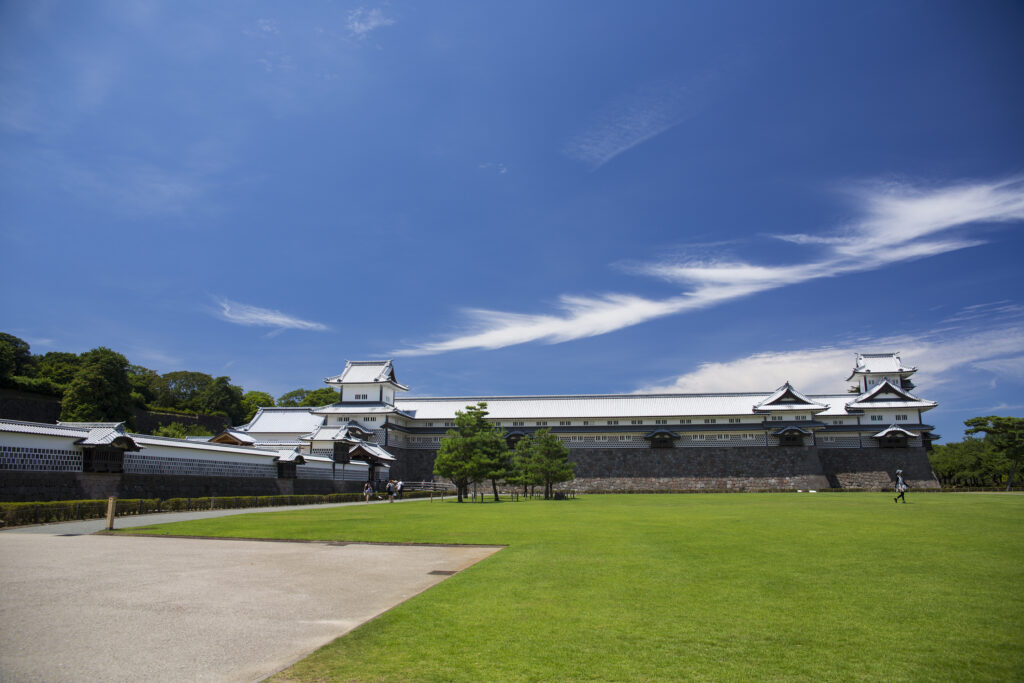
- This is where Kanazawa culture was born.
- ここは金沢文化発祥の地です。
- The lords who lived here brought together different cultural figures and helped shape the culture we have today.
- ここの居住者、領主は色々な文化人を集め、現在の文化を育て上げました。
- They made Kenroku-en as their own private garden.
- 兼六園も彼らの私庭として造ったのです。
- This garden, which used to be a vegetable field, was cultivated into a truly “cultured” garden.
- 昔は野菜畑でしたが、耕して(cultivate)、本当に「文化的」な庭園を作ったのです。
Q3:何故こんなに新しいの?/とても新しく見えるけど…
“Why is it so new?”/”It looks very new, however.”
👉これも目前の城郭群を見て多くの人が素朴に感じる印象への応対例です。
- This castle was originally constructed about 400years ago
- 元々この城は約400年前に作られました。
- 👉敢えて戦国時代も江戸時代も使わない例です。
- Most of the buildings were destroyed by frequent fires, but were restored to their current appearance based on the documents found recently.
- 殆どの建物は度々火災で焼失しましたが、最近発見された書類に基づき現在の姿に改修されました。
- The restoration was done using the same technology, tools, materials and methods of that time.
- 再建は当時の技術、道具、材料及び手法によるものです。
- So we can say that this is a fully restored castle, not a fake.
- なのでフェイクでない完全復刻城と言えます。
- People in Kanazawa prefer real gold over imitation gold.
- 金沢人はイミテーションゴールドでなく本物の金が好きなのです。
Q4:どうして屋根が白く見えるのですか?
“Why do the roofs look white?”
👉音声サンプルは前半(1~6)と後半部(7~13)はトーン、話者とも変わります。かなり長いので、この中の1フレーズでも実際に試せたらよいですね。👉👉本表現の演習ツールはリンクから!
- The roofs of the castle are covered with lead plates instead of ordinary tiles.
- 城の屋根は普通の瓦ではなく、鉛の板で葺いてある為にです。
- When exposed to rainwater for a while, lead reacts and changes color to white, giving the appearance of snow covering it.
- 鉛は暫く雨水にさらされるとそれに反応して白く変色するので、雪が積もった様に見えるのです。
- Not everything is made of lead; the roofs are constructed using wood and then covered with thin lead plates.
- 全てが鉛でなく、木で屋根を作り、その上に、薄い鉛板を張り付けて造ります。
- I’m not sure why lead tiles came to be used, but they were also used in Edo Castle (in Tokyo), not just here.
- なぜ、鉛瓦を使うようになったのかは分りませんが、ここだけでなく江戸城にも使われておりました。
- 江戸城がわからない人の場合は東京で補足を.
- なぜ、鉛瓦を使うようになったのかは分りませんが、ここだけでなく江戸城にも使われておりました。
- One theory suggests that lead tiles were used to make bullets during emergencies, but old documents mention that they were also used to enhance the appearance.
- 非常時に鉄砲の玉に使える様にという説もありますが、姿を美しく見せる為と古文書に記載あるそうです。
- Considering the unstable circumstances at that time, it is likely that there were both purposes.
- 当時の不安定な状況を考えると恐らく両方の目的があったと思われます。
- In the past, lead was used in the cosmetics of white face powder called “oshiroi” for women’s makeup (equivalent to today’s foundation).
- 昔は女性のお化粧のおしろい(今のファウンデーションに相当)にも鉛が使われていました。
- In essence, in order to make them look more beautiful, they would regularly use lead, which is harmful when ingested, on their skin.
- 要は、より美しく見せる為に、飲むと有害な鉛を肌の上に日常的に使うわけですね。
- In addition, women of that time also used decorative hair pins called “kanzashi” to adorn themselves.
- その他にも、当時の女性は着飾るために髪に装飾品のかんざしも指していました。
- Interestingly, kanzashi had a pointed end for piercing into the hair, so they were also used for self-defense when necessary.
- 実はかんざしは髪に刺すために先が尖っているので、いざと言うときの護身用にも使われたそうです。
- In the past, women could kill others with makeup and hairpins, so I think we are fortunate to be born in modern times.
- 昔はおしろいとかんざしで人が殺せるので、我々は現代に生まれて良かったと思います。
- However, when you think about it, this dangerous lead is also used in smartphone batteries, right?
- でも考えてみれば、この危険な鉛はスマホのバッテリーにも使われていますね。
- Modern husbands might want to consider managing the whereabouts of their wives’ smartphones more seriously.
- 現代の御主人たちは奥様方のスマホがどこにあるかもっとまじめに管理したほうがよいかもしれませんね。
Q5:どんな人が住んでたの?
“What kind of people lived there?”
👉ここでも日本の歴史を知らないインバウンドへの対応を想定しました。
- The founder was the second richest lord next to the government of that time.
- 初代は時の政権に次ぐ二番目に裕福な城主でした
- 👉江戸幕府(Edo government)等の表現は避けます。海外旅行先で欧州王室の『何とか朝』と突然言われてもよくわからない人と同じですね。
- The wealthy lords lasting for more than two centuries and their loyal retainers lived here.”
- 2世紀以上続いた裕福な領主と忠実な家臣団が住んでいました。
- 👉前田家(Maeda Famiy/Maeda Clan)を使うかどうかも都度判断で。
- They were filled with money, education and culture not caring about the era of civil war.
- 内戦時代(戦国時代)を気にしない、お金と教養と文化に溢れた人達でした。
- In Japan, there is a proverb, “the rich do not fight.” They embodied it to the fullest.
- 日本語では金持ち喧嘩せずと言う諺がありますが、それを地で行く人達ですね。
Q6:他の城とどこが違うの?
“What makes it different from other castles?”
👉日本人の私達ですら、ちょっと見、日本の城は殆ど同じに見えます。(勿論詳しい人は別にして)
- Most castles were fortresses, but this castle was used for administration and residence.
- 殆どの城は要塞ですが、この城は行政と居住に使われました。
- As a result, you can see various efforts made for a comfortable living.
- なので、快適な生活の為の工夫が見られます。
- They were so wealthy that they enjoyed this castle’s luxurious structures.
- お金持ちだったのでお城の贅沢な造りを楽しんだのです。
- In Japanese, when we are in good spirits, we say ” feeling like a lord”.
- 日本語ではとてもご機嫌が良い時を”殿様気分” と言います。
- We are walking through this castle right now feeling like lords.
- いま我々はまさに殿様気分でこの城を歩いているのです。
Q7:何故天守閣がないの?
“Why is there no castle tower?/Doesn’t this castle have a donjon?”
👉シンボルタワーの天守閣がないので、ここは只の古城公園と思う人もいるでしょうね。
- Without the symbol of the castle, the main keep, you might think it’s a park for old castles, right?
- お城のシンボルの天守閣がないので古城公園と思うかもしれませんね。
- The original main keep was burnt down by lightning, and since then, there have been no more battles, so it couldn’t be rebuilt.
- 最初の天守閣は雷で焼けて、その後はもう戦いがないので建てられませんでした。
- Due to the lack of historical records, the main keep has remained unrestored to this day.
- その時の資料がないので現在も復元されていません。
- However, there are many tourism businesses that hope for the reconstruction of the main keep, so maybe someday it might be viewable in the metaverse.
- でも天守閣再建を願う観光業者が多いので、そのうち、メタバースで見られるかもしれませんが。
- In the end, a digital image of the main keep is just as empty as the Tower of Babel.
- 結局、デジタル画像の天守閣なんかバベルの塔のようにむなしいだけです。
- Furthermore, if there is a metaverse main keep, people in tourism businesses may feel empty because tourists can see it without coming to Kanazawa.
- 更にメタバースの天守閣だと金沢に来なくても見れるかもしれないので、観光御者にとっても空しいかも。
Q8:この城いつまで使われてた?
”How long has this place been a castle?”
ここは昔からこんな広い(なにもない)のか?とたまに質問されますので、それに絡めてみました。👉これで金沢城の明治維新以降の変遷の歴史が身に付くかも?ここの英語音声も前半の真面目パートと後半のおふざけパートは話者とトーンが変わります。👉Q8表現の音声演習ツールはこちら!
《原文:英語》
- It served as a castle until about 150 years ago, marking the end of the Samurai period.
- Subsequently, the new government’s army utilized it as a headquarters and military supply warehouse.
- However, following their defeat in World War II, the army disbanded, and Kanazawa University temporarily occupied the site.
- The castle bears influences from both the era of samurai and military power to the era of scholarly pursuit and education.
- Ultimately, the policy emphasizing military prowess and wisdom didn’t yield the desired outcomes in their respective periods.
- Consequently, efforts have revitalized the castle as a tourist attraction.
- Reportedly, significant investments, totaling billions of yen, were made for its restoration.
- The impact of this investment will become evident over time.
- Should this investment prove ineffective, will this era of economic significance wane?
- Today, we need electricity for everything we do. So, could the age of electricity become the next focal point?
- Fortunately, castles have ample roof space, making it relatively inexpensive to install solar panels.
- Moreover, Kenrokuen Garden’s abundance of pine trees presents an opportunity to utilize pine resin as a substitute for gasoline in vehicles.
- Considering its origins in an era devoid of electricity, why not repurpose the castle as an energy-efficient hotel?
- Furthermore, how about offering a long-term stay service where you can save money by not going out and eating only simple meals day after day?
- Originally designed for long besieged battles, Kanazawa Castle allows guests to stay as long as they like, thrilled with the feeling of being lords on the verge of a castle’s fall!
《原文:日本語》
- 城としてはサムライ時代が終わった150年頃前までです。
- その後は新政府の軍隊が作戦本部や軍需物資の倉庫として使っていました。
- しかし、第2大戦に敗れて、軍隊は解散となり、その後暫く金沢大学が置かれていました。
- サムライや軍の武力の時代から大学教育の智力の時代の影響を受けた訳ですね。
- 結局、どの時代も軍事力や智力重視政策が思ったより成果を上げられませんした。
- その反省から、今は観光資源としてこのように城を再生された訳です。
- ある新聞記事によるとその再生に数十億円も投資したそうで。
- その効果はいずれ明確になるでしょう。
- でも、もし、その投資効果がないとわかったらこの経済重視の時代もおわるのでしょうか?
- そうなると現代はなにをするにも電気が必要なので、次は電力の時代でしょうか?
- 幸い、お城の屋根は沢山あるので、太陽光バネル設置するにはそれ程お金はかからないでしょう。
- 更に兼六園は松が豊富なので、松ヤニで自動車のガソリンの代用ができます。
- 何より、電気のないサムライ時代のお城なので、省エネ型ホテルとして使えませんかね?
- さらに、どこにも出かけず連日質素な食事だけで、お金節約型の長期滞在サービスご提供なんてどうでしょ?
- 元々金沢城は長期籠城戦のために設計されてるので、宿泊客は好きなだけ滞在でき、落城寸前の大名気分でゾクゾクできまっせ!
Q 9:そんなに雷が多いのですか?
’Is there that much lightning?’
👉👉本パートQ9の演習ツール(日英双方向の上級者用)をご用意していますのでご興味に合わせリンクよりお試しください。
多くのインバウンドから(天守閣落雷の火災の説明から)雷についての質問が多いので、省エネつながりで前編Q8の続編的に纏めてみました!👉末尾に英語音声を置きました。雷のような雰囲気の米国女性話者で電力用語もしっかり身に付くかも?
《原文:英語》
- As mentioned earlier, Kanazawa Castle boasts an eco-friendly roofs perfect for solar panels and even a bit of pine resin as an alternative of gasoline.
- Furthermore, Kanazawa Castle has the potential to withstand the upcoming era of intense global competition for power resources.
- This castle has a history marked by several instances of being damaged by lightning strikes.
- Researchers predict a 50% increase in global lightning strikes due to global climateclimate change, which might potentially benefit Kanazawa Castle.
- As the potential for harnessing lightning’s power as an energy source has received little attention, there is a prospect of enhancing Kanazawa Castle’s energy-generating ability if this technology is realized.
- This would make it one of the world’s leading natural energy power plants and could be used to distribute electricity to ordinary homes in Kanazawa City.
- In Japanese, effective communication is likened to the exchange of alternating current (same as that of electricity).
- As what is being distributed is electricity, it guarantees to strengthen the relationship between Kanazawa Castle and its citizens!
《日本語》
- 前述の通り、金沢城はソーラーパネルに最適なエコな屋根とガソリン代わり松脂が自慢です。
- さらに金沢城には、次の世界的な電力資源獲得競争の時代にも耐えうるポテンシャルもあります。
- この城は何度もの落雷被害の歴史があります。
- 研究者の予測によると世界的な気候変動により落雷が50%増加するとのことですが、これは金沢城に恩恵をもたらすかもしれません。
- 雷をエネルギー源にする可能性にはあまり注目されてませんが、もしこの技術が実現すれば金沢城の発電能力が高まる可能性があります。
- そうなると世界有数の自然エネルギー発電所として金沢市内の一般家庭にも配電できるかもしれません。
- 日本語では、効果的なコミュニケーションは交流(電気と同じ)のやりとりに例えられます。
- 配電されるのは電気なので、金沢城と市民との関係は強固になるのは間違いありません!
Q 10: 金沢城公園の中にお城は何処にあるのですか?
“Where is the castle located in Kanazawa Castle Park?”
ご自身は既に金沢城の中に入っているのに、お城は何処にあるのですか?とたまに聞かれますので、それに因んだストーリーです。このパートではガッカリした感情に関する表現を織り込んでみました。英語音声は前半(1~5:米国女性話者)と後半(6~11:米国男性話者)の2話者(2ファイル)に分けました。
《原文:英語》
- You are already in Kanazawa Castle, where many authentic samurai once served!
- Indeed, numerous foreign visitors to Kanazawa Castle Park often inquire, “Where is the castle?”
- For many, a castle implies a castle tower itself, and since Kanazawa Castle lacks one, they might not perceive it as a castle.
- Typically, most foreign visitors to Japan head straight for the castle keep upon arrival at a Japanese castle.
- Presumably, they aspire to ascend the castle tower and relish the sense of accomplishment, akin to scaling a mountain and reveling in the breathtaking view from its summit.
- Truth be told, the founders of this castle were prohibited from erecting a castle tower, symbolizing defiance against the central government of that era.
- Allegedly, the lords of that time shared your frustration, leading them to construct Kenroku-en Garden adjacent to this castle.
- Their aim was to assuage their discontent by luxuriating in the opulent private garden and entertaining esteemed guests.
- We also wish for our international visitors, such as yourself, to relish Kenrokuen Garden and set aside any disappointment about not experiencing the castle keep.
- Nevertheless, as local tour guides, we must confess that we, too, often feel unfulfilled.
- Many foreign visitors are so captivated by Kenroku-en Garden that they not only forget their initial sense of unfulfillment but also lose the existence of Kanazawa Castle Park entirely!
《日本語》
- 貴方はすでに、かつて多くの本物のサムライたちが仕えた金沢城にいるんですよ!
- 実際、金沢城公園を訪れる外国人観光客の多くが、”お城はどこですか?”と尋ねるんです。
- 多くの人にとって城とは天守閣そのものを意味するのですが、金沢城には天守閣がないため、城と感じないのかもしれません。
- 通常、日本を訪れる外国人観光客の多くは、日本の城に到着すると天守閣に直行します。
- おそらく彼らは天守閣に登ることを熱望し、あたかも山に登って頂上から息を呑むような眺めを楽しむような達成感を味わいたいのでしょうね。
- 実のところ、この城を創った人たちは、当時の中央政府への反抗の象徴となる天守閣を建てることは許されませんでした。
- 聞くところによると、当時の領主たちはあなたと同じ不満から、この城の隣に兼六園を造らせたようです。
- 彼らの狙いは豪華なプライベート・ガーデンで贅沢をし、高貴なゲストをもてなすことで不満を解消することでした。
- 私たちも、あなたのような外国人観光客に兼六園を楽しんで頂きたいと願っていますよ。天守閣を体験できなかったことへの失望は脇に置いて頂いて。
- とはいいながら、我々のような地元のツアーガイドも、しばしば満たされない気持ちになることを告白しなければなりません。
- 多くの外国人観光客は兼六園に魅了され、最初の物足りなさを忘れるだけでなく、金沢城公園の存在をすっかり喪失してしまうんです!
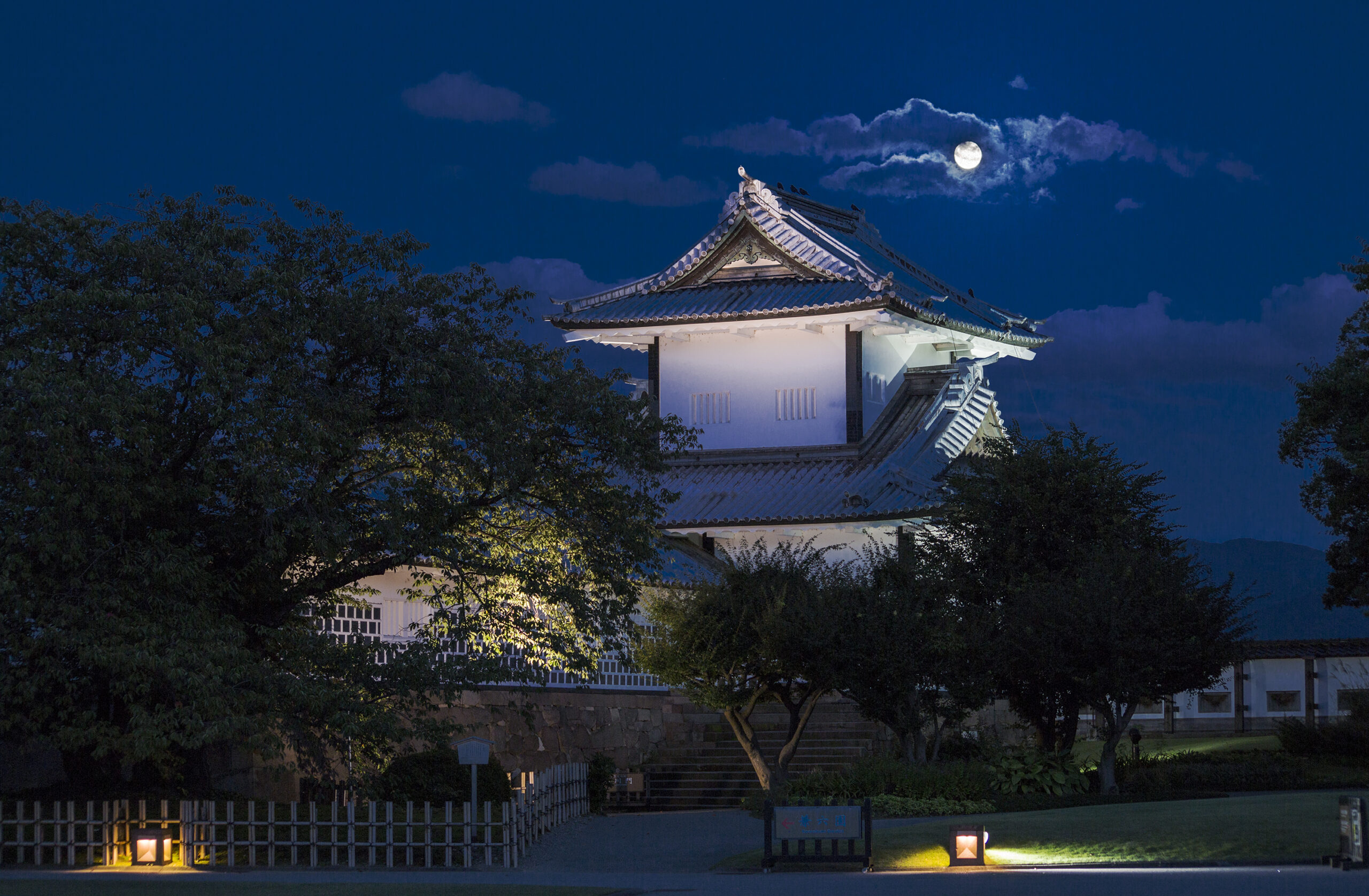
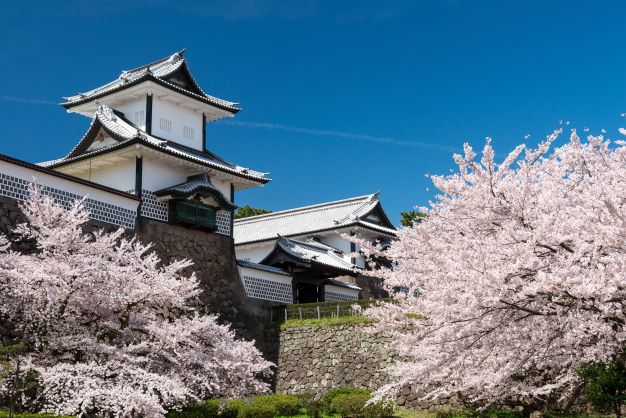
3. 石川門(いしかわもん)
“Ishikswa-mon Gate”
3.0 石川門説明のポイント
ここではご案内の際に押さえておきたいポイントをご紹介しています。説明用の文章ではありませんのでネタとして使えるところあればご活用ください。
👉👉本パートの(基本ポイント)演習ツール(日英双方向の上級者用)をご用意していますのでご興味に合わせリンクよりお試しください。
- 元々は城主の私庭、兼六園に通じる裏門であった。
- しかし、高台続きの兼六園側からの外敵侵入を防ぐ正門である。
- 防御力のある典型的な日本の枡形門であるが日本最古の門の1つである。
- 金沢城でも現存する建造物の1つで、重要文化財にも指定されている。
- 防御力と装飾性を備えた金沢城の顔である。
- 装飾性は2種の石垣と破風で見る事ができる。
- Originally, it was a back gate that led to Kenroku-en, a private garden of the lords.
- However, it was a front gate to prevent enemy invasion from Kenroku-en located on the same hill.
- It is a typical Japanese box-style gate with high defensive capabilities and is one of Japan’s oldest gates.
- It is also one of the existing buildings in Kanazawa Castle and has been designated as an Important National cultural Asset.
- It is the face of Kanazawa Castle, which combines both defensive capabilities and decorative elements.
- The decorative elements can be seen in the two types of stone walls and the gables.
3.1 インバウンドの視点
👉殆どの日本人にとっては金沢の象徴的な建物なので細かい説明は不要ですが、多くのインバウンドにとっては只の入口(通過点)ですよね。しかも日本の典型的な枡形門なので、特にインバウンドには違いがよくわからないでしょう。
3.2 笑いが取れるかも?説明例
👉《笑いがとれるかも?》パートについて:実際の現場では難しい脱線の多い長い説明ですが、色々な日常会話表現も織り込むことで多様な説明力UPを意図しています。
Q1:この門の何が見処なの?
“What is interesting about this gate?”
👉今回は主に兼六園との関連付けで置いてみました。前半(No1~4)と後半部(No5~8)はトーンと話者が違いますのでご注意ください。
👉👉本パートQ1の演習ツール(日英双方向の上級者用)をご用意していますのでご興味に合わせリンクよりお試しください。
- As a common gate for Kenroku-en and the castle, it has a decorative appearance.
- 兼六園とお城の通用門なので、装飾性があります。
- It is characterized by two types of diverse stone walls and a decorative gabled roof.
- 多様な2種の石垣と破風の装飾屋根が特徴です。
- It is one of the few surviving buildings.
- また、数少ないオリジナルの建物の一つなのです。
- The gate is constructed in a box shape style, a typical traditional Japanese gate.
- この門は典型的な和式門の枡形で作られています。
- This type of gate can trap and eliminate enemies within the box-shaped structure.
- この枡形門は桝の中に敵を閉じ込めてせん滅することができます。
- If you enter inside admiring the beauty of this gate, it could be a disaster.
- 門の美しさに見とれながら中に入ると、とんでもないことになるかも。
- As with anything, there are two sides, a front and a back.
- 何事にも表と裏の両面があります。
- Don’t be fooled by its appearance, especially when you get married.
- 見た目の美しさに騙されてはいけません。特に結婚の際は。
Q2:この門の特徴は?
“What are the features of this castle gate?”
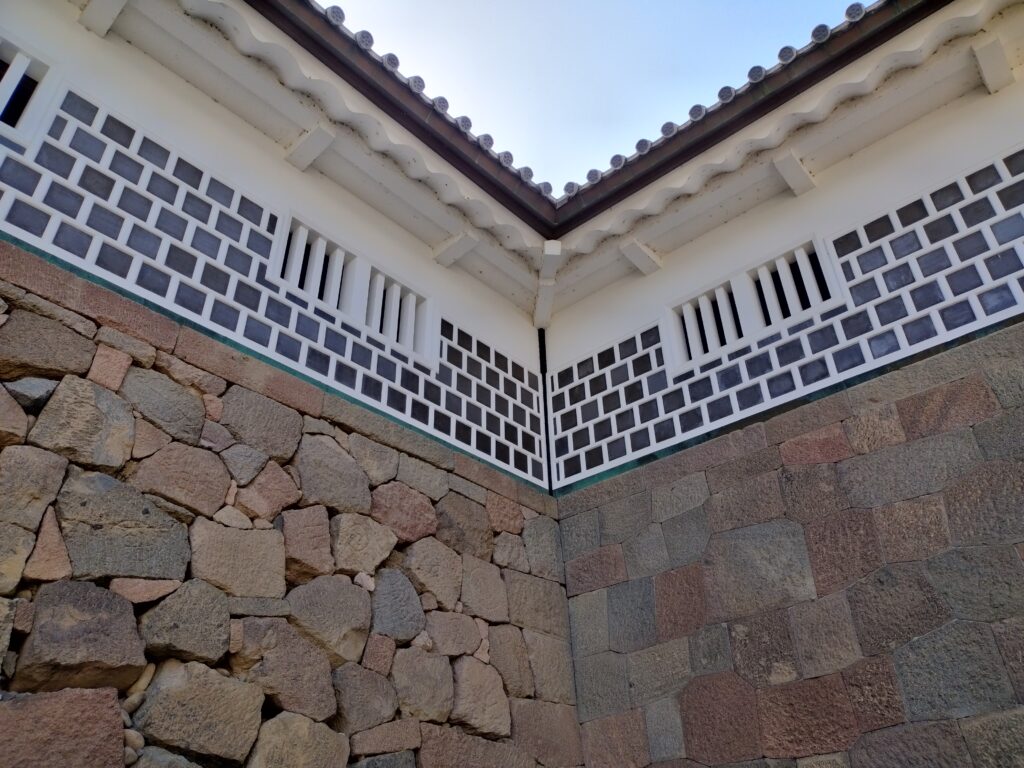
👉お相手と一緒に見ながら、敵の進入時の状況含め説明してみます。ここも長いので音声ファイルは二つに分けました。
👉👉本パートQ2の演習ツール(日英双方向の上級者用)をご用意していますのでご興味に合わせリンクよりお試しください。
- The gate has a strong defense as most enemies would attack through Kenroku-en.
- 殆どの敵は高台続きの兼六園側から侵入するので、防御力があります。
- The castle and the park are located on the same hill, and the road under the bridge in front of the gate used to be a moat for defense.
- 城と公園は同じ高台にあり門の前の橋の下の道路はかつては防御用のお濠でした。
- This structure, a box style gate, improves its defense by surrounding the enemies in this box.
- この枡形門は枡の中に敵を取り囲むことで防御力を高めています。
- The enemy who entered through the first gate had to change direction and stop their momentum.
- 最初の門に入った敵は方向を変えなければならず勢いを止められます。
- Surrounding the enemy within the first and second gates increased the defensive power.
- 第一と第二の門で取り囲むことで防衛力を高めたのです。
- You can see this structure in other castles, but this gate is one of the oldest.
- この様式は他の城でもありますが、この門は最古のものの一つです。
- After World War II, Kanazawa University was located here for a while.
- 第二次大戦後しばらく、ここには金沢大学が置かれていました。
- As a national university, it was very difficult to pass the entrance examination meaning passing through this gate.
- 国立大学だったので、合格してこの門に入る事はとても難しかったのです。
- At all times, passing through this gate has always been very challenging, due to its high defensive power.
- 今も昔も、防御力の高さから、この石川門を通過することは大変だったのですね。
Q3:この出窓(破風)は何ですか(何のために)?
“What is this roof over bay window (for)? ”
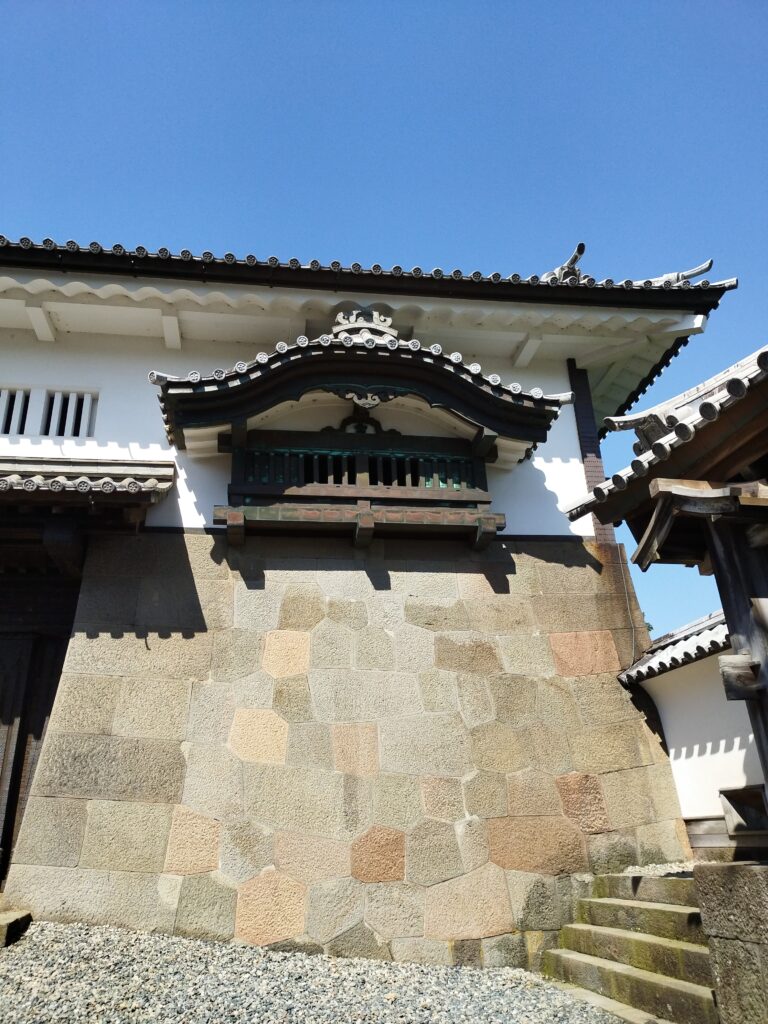
👉城内に沢山ありますが、最初に見る破風なので、質問された場合の例として。
👉👉再確認!《破風》(hafu):gable / gablet (🔶いずれも建築用語なので ここでは《出窓の屋根》ロroof over bay windowも使います)
- The basic role is to protect the castle from rain and wind.
- 基本的な役割はお城を雨風から守るためです。
- This roof over bay window (gablet) is a typical traditional Japanese architectural style having decorative elements.
- この出窓は装飾性ある日本の伝統建築様式です。
- This style (known as “Karahafu,”) is characterized by a curved, asymmetrical roof that is favored by the Japanese.
- この様式(唐破風)は日本人好みの曲線的で非対称な屋根が特徴です。
- There is a theory that since Kanazawa Castle does not have a keep, they invested money in detailed decorations like this.
- 金沢城には天守閣がないので、この様な細かい装飾にお金をかけたとの説があります。
- Come to think of it, real wealthy people often spend more money on accessories than clothing.
- そう言えば人間も本当のお金持ちは服装よりも小物にお金をかけますものね。
Q4【 追加:Q3 パート2】:この出窓(破風)は何ですか(何のために)?
前項(Q3)の終わり方が今ひとつ、とのご意見を頂きましたので、【パート2】として4連ギャグ(⁇)追加致しました。個人的には、No2辺りで終わるのが、余韻的にも一番良い様に思いますが、ユーモアのセンスは多種多様ですので、お好みと状況に合わせて、いずれかお試しください。👉音声は豪華な車に乗って、いかにもこう語りそうな米国女性。
👉👉本パート(Q2+Q3)の演習ツール(日英双方向の上級者用)をご用意していますのでご興味に合わせリンクよりお試しください。
- Speaking of which, many young Japanese who drive luxurious foreign cars are said to struggle with maintaining their stylish appearance.
- ちなみに、豪華な外車を乗り回している若者の多くは、その派手さを維持するために汲々としていると言われます。
- Could that be why? Somehow, I don’t see as many luxury cars in Kanazawa City as I do in other areas.
- そのせいでしょうかね?なんとなく金沢市で、他の地域ほど豪奢な車を多く見ないのは。
- True rich people don’t drive luxurious cars that might antagonize people, but use gold leaf lavishly for car accessories without being noticed, and enjoy their golden lifestyle.
- 真のお金持ちは反感を買いかねない豪華な車には乗らず、人知れず車のアクセサリーに金箔を豪勢に使って、黄金の日々を楽しむのでしょね。
- And those who are not truly rich have no choice but to taste their golden days with gold leaf ice cream while suppressing their antipathy toward such true riches.
- そして真の金持ちでない人は、そんな真の金持ちへの反感を押えながら金箔ソフトで直ぐに溶けてなくなる黄金の日々を味わうしかないのです。
Q5:以前ここには大学があったってホント??
”Is it true that there used to be a university here?”
👉👉本パートQ5の演習ツール(日英双方向の上級者用)をご用意していますのでご興味に合わせリンクよりお試しください。
「かつてここに金沢大学があった」系のトークは多くのインバウンドに好評なので、Q2に続きここでも「金沢大学」ネタ追加してみました。👉本項よりスタイルを改めました。まずは英語話者でお試しできます。その後に原文置いますが、これまでは一文単位で英語+日本語のセットでしたが、英語(全文)>日本語(全文)の順で置いています。英語話者はこのトークにピッタリのLGBTQ風男性話者が半ばやけ気味に語ります!
《英語》
- For some time after the war, Kanazawa University, a national institution, was situated here.
- Being the sole university in Japan housed within a castle, it garnered significant popularity.
- Being a national university and highly selective, its popularity intensified the competition for admissions.
- Consequently, gaining acceptance to Kanazawa University, marked by passing through the Ishikawa Gate, was a source of immense pride not just for students but also their families.
- However, as often happens, a single event altered everything.
- After the completion of the Kahoku Gate, which served as the formal front entrance, it was revealed that the Ishikawa Gate had originally been considered a back entrance.
- Having proudly entered the university through the main gate, can you believe that it might have been seen as a backdoor admission?
《日本語》
- 戦後暫くここには国立大学の金沢大学がありました。
- お城の中にある大学は日本にここだけだったので、人気がありました。
- 国立大学で難関だったのに、その人気で更に競争率があがったのです。
- だから、金沢大学に合格してこの石川門を通れたことは本人ばかりでなく家族も鼻高々でした。
- でも、どこの世界にもよくあることですが、ある出来事で全てが変わったのです。
- 正門の河北門が完成したあの日、石川門は裏口だったことが白日の元にさらされたのです。
- 堂々と正門から入学したと思っていたら、実は裏口入学だった?なーんちゃってさ!
4. 河北門(かほくもん)
“Kahoku-mon gate”
👉本章の英語表現の演習ツールが別ブログ『金沢城』《河北門/三の丸》英語案内向け《口頭即訳演習ツール(音声&用語集付き)》に、ありますので、必要時には是非ご利用ください。
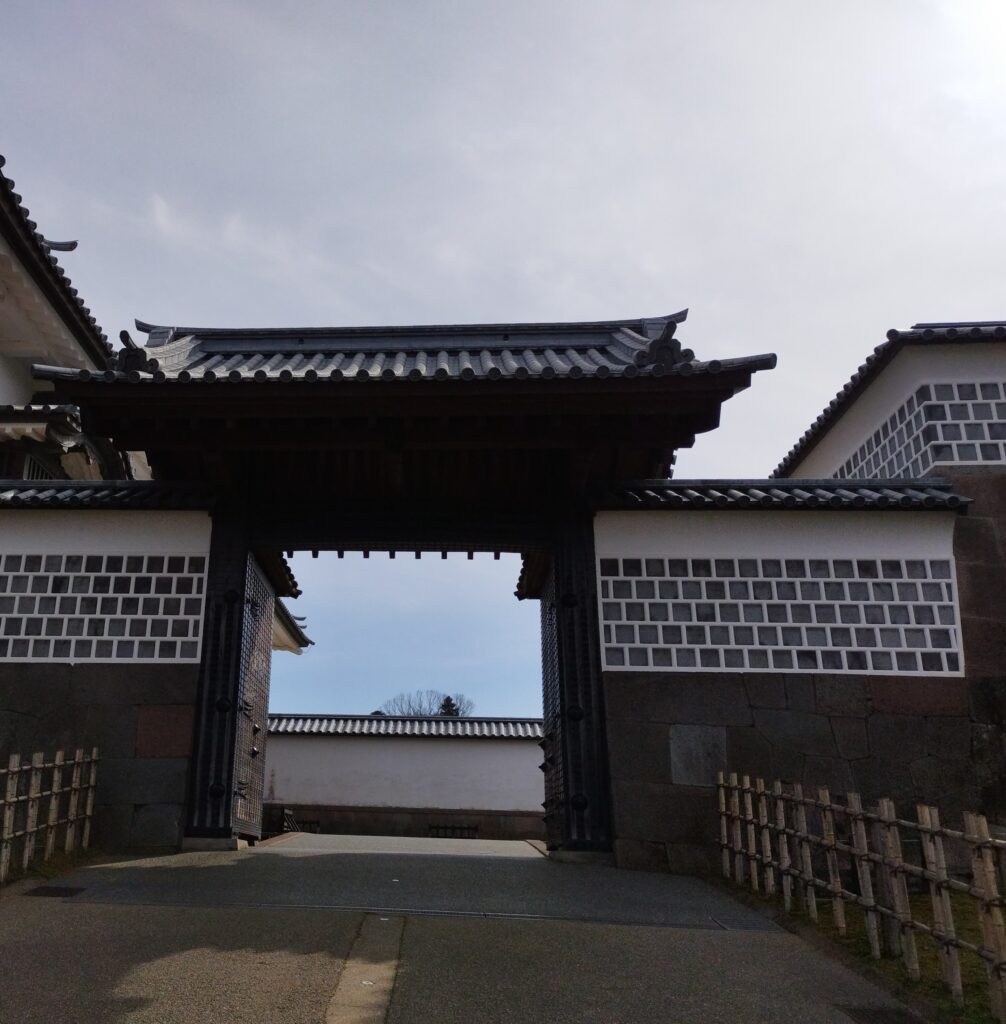
4.0 河北門説明の主ポイント
- 元々は城主たちが入城する際の正門であった。
- 発見された最近の資料に基づき復元されたばかり。
- 門上部の無料展示室で復元展示(材料、手法)が見られる。
- 現在は兼六園の入口、石川門に主役の座を奪われている。
- Originally, it was the main gate for castle lords to enter.
- It has just been restored based on the latest materials discovered.
- You can see the restoration exhibition (materials, techniques) in the free exhibition room on the top of the gate.
- Currently, it has lost its leading role to Ishikawa Gate, an only gateway to Kenrokuen Garden.
4.1 インバウンドの視点
👉すぐ目に入る大きな門なので、説明するのが望ましいですが、どの門も同じに見えるでしょうから元来は大手門から入る正門で重要な門であった事は伝えたいですね。
4.2 笑いが取れるかも?説明例
👉《笑いがとれるかも?》パートについて:実際の案内現場ではあり得ない、脱線の多い長い説明パートですが、日常会話でも使える色々な表現を意図的に織り込んで構成されています。それによりインバウンドのその時の状況に合わせて柔軟な説明ができることを目指しています。
a) この門は先の門(石川門)と何が違うの?
“What is the difference between this gate and the previous gate (Ishikawamon)?”
- Originally, it was the main gate where the lords entered the castle.
- 元々は殿様が入城する正門でした。
- It was a very important gate, but now it has been overshadowed by the Ishikawa Gate of the entrance of Kenrokuen Garden.
- とても重要な門でしたが、現在は兼六園の入口の石川門に主役の座を奪われています。
- If you stand outside this gate, you may be able to experience the feeling of the lords entering the castle.
- この門の外に立つと入城した殿様の気分が味わえるかもしれませんね。
- However, the current “lord”, the general public is a big fan of the Ishikawa Gate..
- でも現在の殿様である一般国民は石川門が大好きなのです。
- In fact, the common people are even more capricious than feudal lords. Who can see when one door shuts, another opens?
- もっとも、一般国民は殿様以上に気まぐれです。先のことはわかりません。
b) この階段は何ですか?/ どこに行けるんですか?
“What is this staircase?” / “Where does it lead to?”

- If you climb these stairs, you can enter the upper level of this gate.
- この階段を上れば、この門の上層階の中に入れます。
- You can see how to restore this gate through the videos, panels or actual materials.
- この門が再生されるまでの方法が動画、パネル、実物でご覧いただけます。
- It’s free, so please give it a try, if you have time.
- 無償ですので、もしお時間があればお試しください。
- By attracting a large audience, it might be able to regain the position of the protagonist someday.
- 多くの人に見に来てもらえれば、かっての主役の座を取り戻せるかもしれません。
- But reclaiming that glory is a narrow gate. It’s too narrow for many to pass through as it is. What should we do, then?
- でも、その栄光を取り戻すことは狭き門です。狭いままでは多くの人が通れません。一体どうすれば?
5. 三の丸広場(さんのまるひろば)
👉本章の英語表現の演習ツールが別ブログ『金沢城』《河北門/三の丸》英語案内向け《口頭即訳演習ツール(音声&用語集付き)》に、ありますので、必要時には是非ご利用ください。

5.0 三の丸説明の主ポイント
- かつては家臣の住居と番所があった。
- 現在はイベント会場でお祭りや屋外能に使われている。
5.1 インバウンドの視点
👉只の広場にしか見えないので、かつては、重臣の居邸や番所があったことは伝えたいですね。勿論、城址公園にはよくある跡地なので、地元の人ですら知らない人が多いのです。
5.2 笑いが取れるかも?説明例
a) ここも昔のままですか?
“Is this place still the same as it was in the past?”
- There is nothing now, but there used to be buildings for vassals and guards.
- 今は何も無いですが、かつては重臣宅や番所がありました。
- Currently, it is used for various events such as outdoor Noh performances.
- 現在は野外能等の色んなイベントに使われます。
- Of course, there was originally no “Noh” stage here.
- 勿論、本来ここに”能”舞台は” 無し”でした。
- Of course, outdoor Noh performances are full of performance, not ‘No performances’.
- 勿論、屋外の能はパフォーマンス一杯で、ノーパフォーマンスとは真逆です。
6.菱櫓(ひしやぐら)
“Hishi Yagura/ Diamond shaped tower “
👉本章の英語表現の演習ツールが別ブログ『金沢城』《菱櫓》英語案内向け《口頭即訳演習ツール(音声&用語集付き)》に、ありますので、必要時には是非ご利用ください。
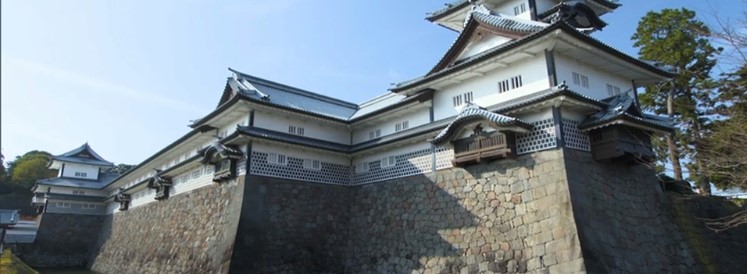
6.0 菱櫓説明の主ポイント
- 菱形になっているが外見からはわからない。
- 金沢城で最も高い櫓で天守閣の位置づけ
- でも取り立てて高くないので印象が薄い。
- 北東に向いて鬼門除けの構造になっている。
- 中に入ると菱形構造がわかる。
- It is shaped like a diamond, not a square, but you can’t tell from the outside.
- It is the highest turret in the castle and serves as the main keep.
- However, it is not particularly tall, and not so impressive.
- It faces northeast and is designed to ward off evil spirits.
- Once inside, you can see the diamond-shaped structure.
6.1 インバウンドの視点
👉初めて見る人は菱櫓より続櫓の長さに注意が向くでしょうから、五十間長屋とセットで説明したいですね。残念ながら、見た目、菱櫓は菱形で有ることがわかりませんし、天守閣の高さもないので印象が薄いのです。
👉👉再確認!《櫓》(yagura):guard tower / watch tower / lookout tower / storage rooms / turret(🔶天守閣も櫓の一種と言えますので”tower”は共通単語です。大きな違いは天守閣が見張りと権威誇示の為、櫓は倉庫を兼ねた実用性。なので “storage room”も場合によっては使います。)
6.2 笑いが取れるかも?説明例
👉《笑いがとれるかも?》パートについて:実際の案内現場ではあり得ない、脱線の多い長い説明パートですが、日常会話でも使える色々な表現を意図的に織り込んで構成されています。それによりインバウンドのその時の状況に合わせて柔軟な説明ができることを目指しています。
Q1 この塔(櫓)は何?
“What is this tower(turret), Hishi Yagura?”
- This tower called Hishi Yagura, meaning a diamond- shaped turret, is the highest tower here.
- 菱櫓は金沢城で最も高い櫓です
- This tower is playing the role of donjon, as this castle doesn’t have it.
- 天守閣がない金沢城でその役割を果たしています。
- According to some experts, the purpose of Diamond shape is to improve its monitoring capacity.
- 専門家によると菱形は監視力を高めるためと言われています。
- Both sides of the obtuse angles(wider angles) have a wide field of view.
- 鈍角(広い角度)を挟む両面は広い視野を確保できます。
- 👉面倒な説明ですが、外人はWhy?発想なので、聞かれた場合の例です。「鈍角」は発音も難しく、うまく聞こえない可能性もあるので、”wider angle(広い角度の方)”や”not acute angle(鋭角でない方)”で手で角度を作って補足してください。
- This turret faces northeast, the direction of bad luck in Japan, intending to protect the castle from evil spirits.
- この櫓は鬼門の北東方向を向いて凶運から城を守ろうとしています。
- 👉NHKの城番組でも紹介されましたね。
- The tower, as its name Diamond suggests, is not only hard but also solid for defense.
- ダイヤモンドの名の通り、硬いだけでなく守りも固いのです。
Q2 中はどうなっているのですか?
“What can we see in this tower?” / “What is the layout of this building?” / What kind of structure is it?”
- It is a three-story building, and would be equivalent to a seven-story apartment building in height.
- これは3階建てで、マンション七階位の高さです。
- The first and second floors were used as a storage area for weapons and other supplies, while the third floor served as a lookout tower.
- 1,2階は武器備品倉庫として、3階は見張り台として使われました。
- The turret walls are thick and contain loopholes for archers to defend the castle.
- 防御の為、壁は厚く、矢の穴もあります。
- Visitors can climb the tower to enjoy panoramic views of the castle grounds and the city of Kanazawa.
- 櫓に上り、城郭や金沢市内の眺望が楽しめます。
- If you have time, you can enter from the back and potentially experience the sensation of being surrounded by diamonds.
- もし、お時間があれば、この裏から、はいれますが、中で、ダイヤモンドに囲まれた感覚を、経験できるかもしれませんね。
- During crowded times, the concentration of carbon dioxide inside the building increases, although not enough to create real daimonds.
- 中が混んでいるときは、二酸化炭素濃度が高いので。ダイヤモンドができる程ではありませんけど。
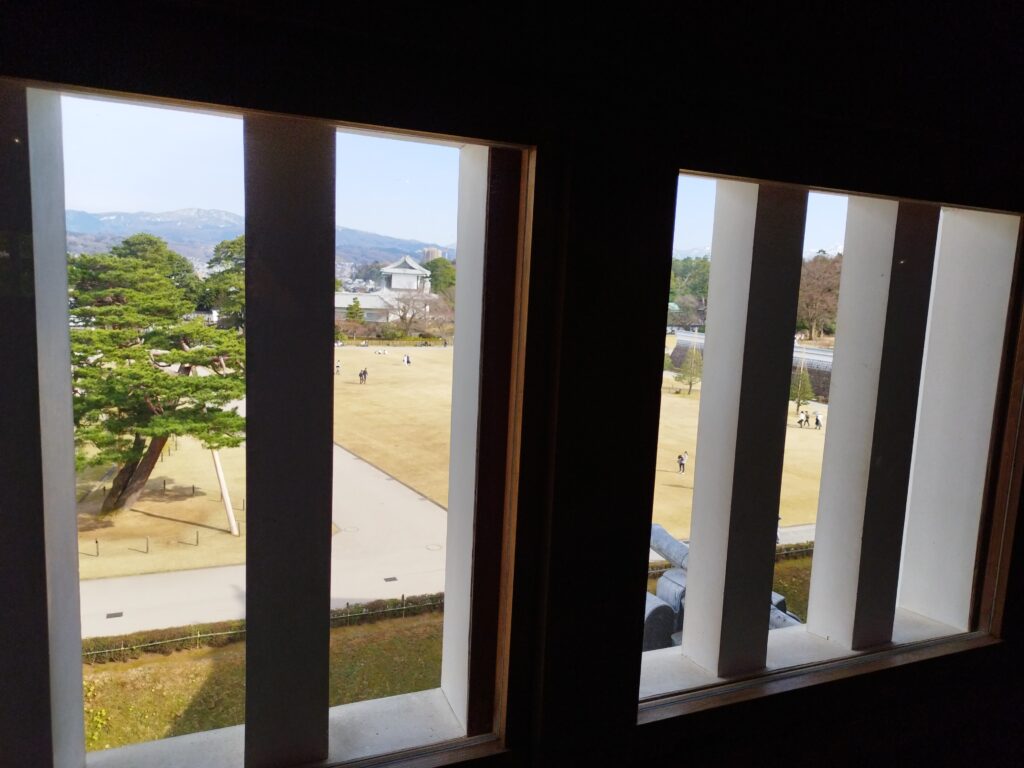
Q3 建物の鬼門はどう対処するのですか?
”How do people deal with the unlucky direction in a building?”
ここでは北東向きであることをネタに、不吉な鬼門、邪気払う非対称の櫓等の英語表現をご紹介しています。英語音声は前半真面目パート(1-5)と後半おふざけパート(6-10)の2ファイルです。👉Q3表現の習得用の音声ツールはこちらへ!
- In Japan, the northeast direction is called “Kimon”, and this diamond-shaped turret was built to face that direction.
- 日本では北東方向を鬼門と呼び、この菱型櫓はその方向を向いて建てられています。
- It is also known as the “demon’s gate” and is considered an unlucky direction in Japanese culture.
- それは鬼の門としても知られ、日本文化では不吉な方角と考えられています。
- Japanese buildings sometimes have L-shaped indentations at the northeast to ward off evil spirits.
- 日本建築では時々、北東の場所にL型の凹みを設けて邪気を払おうとしました。
- In Japan, there has been a tendency to dislike complete symmetry, as it is believed to invite evil spirits since ancient times.
- 日本では、完全な対称性を嫌う傾向がありますが、それは古来より、邪気を招くと信じられた為です。
- Therefore, for example, shrines and temples were often intentionally designed to be asymmetrical, avoiding perfect left-right symmetry.
- なので、例えば神社やお寺では、しばしば意図的に非対称で作られ、完全な左右対称性を避けました。
- If you think about it, humans too can invite a lot of unhappiness when they fall into perfectionism.
- 考えてみれば、人間も 多くの不幸を招くことがあるのは完全主義に陥るときです。
- That’s why Kanazawa Castle had a L-shaped indentation near the diamond-shaped turret.
- それで 金沢城 では ひし形 櫓のところに L 型の凹みを設けました 。
- Thanks to that, Kanazawa didn’t experience air raids during World War II.
- そのおかげか、金沢には 第二次世界大戦中、空襲がありませんでした。
- However, recently, I have a slight concern after Kanazawa Castle was completely restored.
- でも最近、金沢城が完全に復元されてから少し心配な事があります。
- The concern is that this indentation area too has been restored so perfectly and beautifully that it might invite evil spirits.
- それはですね、この凹みの部分もあまりに完全で美しく復元されたので邪気を呼び込むのではないかと。
7.五十間長屋(ごじゅっけん ながや)
“Gojukken Nagaya”
👉本章の英語表現の演習ツールが別ブログ『金沢城』《五十間長屋》英語案内向け《口頭即訳演習ツール(音声&用語集付き)》に、ありますので、必要時には是非ご利用ください。
7.0 五十間長屋説明のポイント
- 二つの櫓をつないで裏にある二の丸(領主の)御殿を囲って守る長い壁型倉庫。
- 石落しの出窓や鉄砲狭間の格子窓で防御力強化。
- 海鼠壁で防火構造になっている。
- 名前の由来は五十間(100m)の長さから。
これまで通り、単に情報として持っていると便利。因みに1間=約1.81m。
- A long wall-like store house that connects two turrets and surrounds and protects the Ninomaru(lords’) Palace behind it.
- It is reinforced with bay windows for dropping stones and lattice windows for firing guns.
- This building is covered with seacucumber wall for fire protection.
- The name of this building comes from its length of 50 ken (about 100 meters) .
7.1 インバウンドの視点
初めて見る人はこの建物の目的、役割がわからないので、裏の二ノ丸御殿を守る本来目的とその為の工夫は説明したいと思います。でないと、只の横長の建物で終わってしまいます。
7.2 笑いが取れるかも?説明例
👉《笑いがとれるかも?》パートについて:実際の案内現場ではあり得ない、脱線の多い長い説明パートですが、日常会話でも使える色々な表現を意図的に織り込んで構成されています。それによりインバウンドのその時の状況に合わせて柔軟な説明ができることを目指しています。
a) この横長の建物は何ですか?
“What is this horizontally long building?”
👉長いことは見ればわかるので、これは五十間長屋です、と言っても仕方がないので、その役割をWhy?に答える形で並べてみました。

- At Kanazawa Castle, this kind of a long wall-like building is called “Nagaya” serving both as a warehouse and a defensive structure.
- 金沢城では倉庫と防御を兼ねた横長の建物を「長屋」と呼んでいます。
- This “Nagaya” connects two turrets and surrounds the lord’s mansion for defense.
- この長屋は2つの櫓を繋いで領主の邸宅を囲んで防御しています。
- This long warehouse is a common feature seen in Japanese castles.
- このような長い倉庫は日本の城でよく見られる特徴です。
- The lord’s residence is located beyond this warehouse.
- 領主の邸宅はこの長屋の向こうにあります。
- For this type of building, plaster walls are used for fire protection, but Kanazawa Castle uses special walls called “namako” meaning a sea cucumber.
- この種の建物には防火の為に漆喰壁が使われますが、金沢城では海鼠壁という特殊な壁が使われてます。
- These walls are made of numerous roof tiles by connecting them with thick plaster, and the connecting parts resemble sea cucumbers, so they were given this name.
- 沢山の屋根瓦を厚めの漆喰で繋いで壁を作っていますが、その繋ぎ部分が海鼠に見えるのでこのような名前が付けられました。
- However, they could have been named “cucumber wall” from their appearence, as “namako”, sea cucumbers in Japanese are referred to as “sea cucumbers” in English. Why named seacucumers?
- でも、英語で海鼠は海の胡瓜と言うように、胡瓜壁と言っても良かったのに、なぜ海鼠になったのでしょうか?
- This is because sea cucumbers, which live in water, have no association with fire. Additionally, they could be as cool as a cucumber even if they faced fires!
- 水中に棲むなまこは火に縁がないからです。そして、火事になっても、とても落ち着いているので。
b) 海鼠壁は何が特殊なのですか?
“What’s so special about the sea cucumber wall?’
英語の音声サンプルは前半(真面目)と後半(微真面目)の2ファイルです。
- This sea cucumber wall is a construction method unique to Japan, and Kanazawa Castle is famous as a representative example.
- この海鼠壁は日本独自の工法ですが、金沢城はその代表格として有名です。
- Does it look like a sea cucumber? It sounds good because a sea cucumber is a luxury food here.
- 海鼠のように見えますか?ここでは海鼠は高級食なので響きが良いのです。
- To withstand Kanazawa’s humid climate, the roof tiles are lined up and covered with thick plaster.
- 湿気の多い金沢の気候に耐えられように屋根瓦を並べ厚い漆喰で覆っています。
- Of course, even though these walls look like being made of sea cucumbers, they are not edible.
- 勿論、海鼠のように見える壁といってもこれは食べられません。
- An actual sea cucmber is so grotesque in appearance that the first humans to eat it must have been very hungry.
- 実際の海鼠は見た目がとてもグロテスクで、人類で最初に食べた人はよっぽど空腹だったのでしょう。
- However, they are unexpectedly tasty, and their crunchy texture is addictive to those who like it.
- でも外見の印象からは考えられないほど美味で、コリコリして好きな人は癖になります。
- So the actual sea cucmbers are weakly defended because everyone knows that they can’t move, they are not poisonous, and they are delicious.
- なので、実際の海鼠は動けないし毒もないし美味なのは皆知っているので防御が弱いのです。
- On the other hand, the sea cucmber wall looks delicious like a cake roll, so some people may not be able to bear the hunger and put it in their mouths.
- 片や、この海鼠壁は、見た目、ロールケーキの様に美味しそうなので空腹に耐えられず口に入れる人もいるかもしれません。
- But this one, if raw, will upset your stomach, and it can’t be cooked over a fire. It may be the strongest wall that really defends itself and keeps out intruders.
- でも、これは、生だとお腹を壊すし、火でも煮えない。侵入者も寄せ付けず本当に防御力がある最強の壁と言えるかも。
8. 橋爪門
“Hashizume-mon”
👉本章の英語表現の演習ツールが別ブログ『金沢城』《橋爪門》英語案内向け《口頭即訳演習ツール(音声&用語集付き)》に、ありますので、必要時には是非ご利用ください。
8.0 橋爪門説明のポイント
- 二の丸(領主)御殿の直前の門なので防御力が高く格式がある。
- 二の門の床には御殿と同じ戸室石(高級な石)が同じ工法で敷かれている。
- 門の脇に24時間詰めの番所があった。
- なまこ壁の裏に狭間が隠されている。
- 平時はただの壁に偽装されているが、有事にはその壁から狭間が現れる。
- Since it is just before the Ninomaru(lords’)Palace, it has a high defensive power and is prestigious.
- The floor of the second gate is paved with the same high-quality stone as the palace using the same construction method.
- There was a 24-hour guardhouse next to the gate.
- The gaps of this gate are hidden behind the namako(sea cucumber) wall.
- It is disguised as a normal wall during peacetime, but gaps appear from that wall in times of emergency.
8.1 インバウンドの視点
石川門から入ると三つ目の門だけれど、殆どの訪日外国人にはどの門も同じに見えるでしょう。どうしても門の先に何があるか見たくて、さっと通り過ぎてしまう、そんな難しい門、難問ですね。
- 👉単語の再確認!《狭間》(sama):crenel (建築用語)/ interstitial space / split / gap / in-between space
- 👉他国の城でも見られますが、日本の城のものには(姫路城のように)意匠性もありますね。また建築用語は相手次第なので、補足説明が望ましいですね。
8.2 笑いが取れるかも?説明例
👉《笑いがとれるかも?》パートについて:実際の案内現場ではあり得ない、脱線の多い長い説明パートですが、日常会話でも使える色々な表現を意図的に織り込んで構成されています。それによりインバウンドのその時の状況に合わせて柔軟な説明ができることを目指しています。
a) この門はこれまでの門と何がちがうのですか?
“What is the difference between this gate and the previous two gates?”
👉石川門以上に防御力と格式が意識されていますので、その辺りはしっかり伝えたいですね。音声ファイルは長いですが1本です。
- This was the entrance to the lord’s residence, so defense was strengthened.
- 領主の邸宅の入口なので、防御が強化されていました。
- There were many barriers(or gaps) installed.
- 狭間(さま)が沢山設置されています。
- There was a guardhouse keeping an all-night watch/ around-the-clock vigil.
- 24時間監視の番所がありました。
- This gate is of high formality and the floor is paved with the same luxury stones and in the same technique as the palace.
- また、この門は格式も高く、足元は御殿と同じ高級石が同じ工法でしかれています。
- The lords might have considered this gate as a part of the palace.
- この門は御殿の一部と考えられて作られたのですね。
- In Japan, a luxurious house is often described as “having a high threshold”, making it difficult to visit.
- 日本では高級な家はしばしば近寄り難いので、『敷居が高い』という表現を使います。
- Perhaps this gate might have been also designed to make it difficult for intruders to approach by raising the threshold with luxury stones.
- この門も高級石で敷居を高くして、侵入者に近寄り難くしようとしたのかもしれません。
b) この穴/狭間(さま)は何ですか?(何のために?)
“What are these holes /sama (for)?
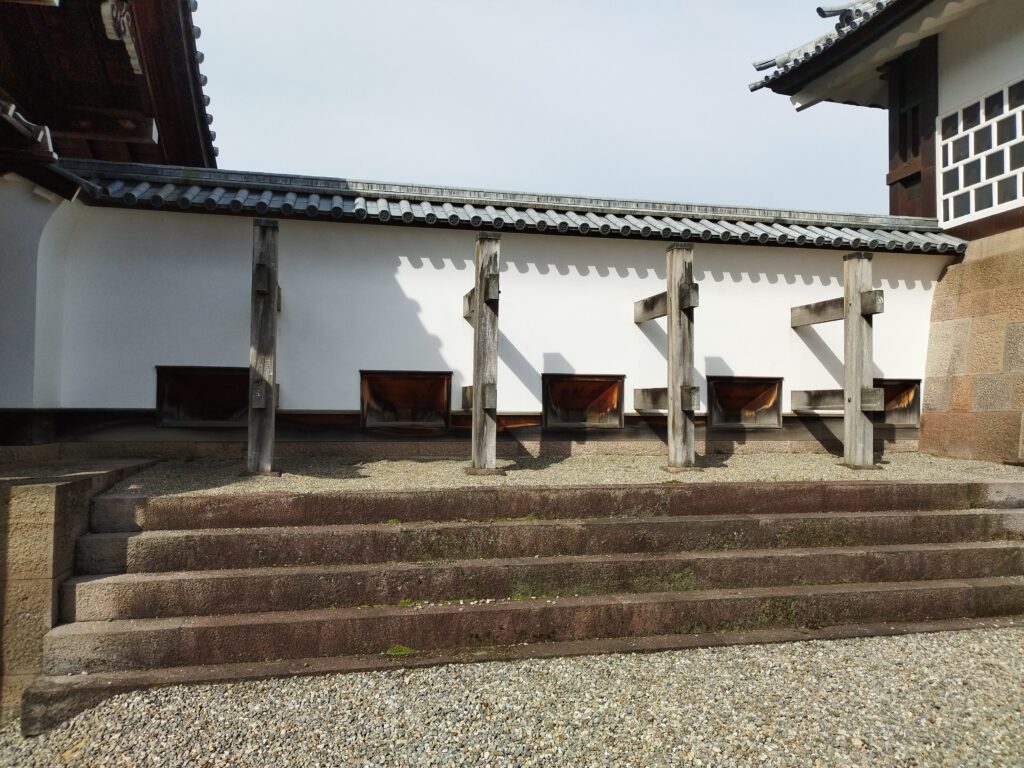
- They are for shooting guns or arrows.
- 鉄砲や矢を放つためです。
- The inside is narrow making it difficult to aim from the outside.
- 敵から狙いにくいよう、内側は狭くなっています。
- You can see theses narrow spaces or gaps between walls, floors, or pillars in a Japanese castle.
- 日本の城で見られる壁、床、柱の間にみられる狭い隙間です。
- It can provide a place for defenders to hide or attack from, but also having a decorative element in architectural design.
- 隠れながら攻撃できるスペースになりますが、建築的な装飾性も見られます。
- A gap is just a hole, dull and uninteresting, so it is often shaped in various ways to fill the gap.
- 狭間(”ギャップ”)はただの穴で単調で面白くないので、そのギャップを埋めるために色々な形状にするのです。
c) この狭間(さま)は何故ふさがっているのですか?(何のために?)
“Why is this space closed?”
👉よく見ると狭間はふさがってますね。何故でしょうか?反対側の海鼠壁とセットの説明が必要です。石川門にもありますが、橋爪門より目立たないのと人通りが多いので、ここでの説明がお勧めです。
👉音声サンプルは前半(1~5)と後半部(6~9)はトーンも話者も変わります。現実的にこんな長い会話はないですが、使えそうなパートがあればGive it try!

- These gaps are not used during normal times and are covered.
- この狭間は平時は使われず蓋がされています。
- However, in case of emergency, the covers are removed and the gaps are used for defense.
- しかし有事の際は取り払われ防御に使われます。
- Nobody can see that there are the gaps behind the wall from the opposite side.
- 反対側の壁からは背後に狭間があることはわかりません。
- They are camouflaged by this decorative wall.
- この装飾的な壁にカモフラージュされているのです。
- We should be careful, okey? As the proverb goes, even beautiful roses have thorns.
- 気をつけましょうね。諺にもあるように、きれいなバラにはとげがある。
- But most men can tolerate being deceived by beautiful roses, but they don’t want to be fooled by sea cucumbers, I suppose.
- でも、殆どの男性は美しいバラにだまされるのはまだ許せますが、なまこに騙されたくはないでしようね。
- However, despite their grotesque appearance, sea cucumbers are crunchy and delicious when eaten.
- でも、なまこは見かけはグロテスクですが、食べるとコリコリして、美味しいですよ。
- It might be a nice surprise to find the unexpected pleasant texture, which you wouldn’t imagine from their slimy appearance.
- この外見のヌルヌルのイメージから想像もつかない歯ざわりの良さは嬉しい誤算かもです。
- Believe it or not, why not give it a try? Eating roses will only upset your stomach.
- ぜひ、騙されたと思って試して見ませんか?バラは食べてもお腹をこわすだけですよ。
9. 二ノ丸御殿
“Ninomaru Goten/Ninomaru Mansion”
9.0 二の丸御殿説明のポイント
ここは説明用でなく、背景知識として押えておきたいポイントをご紹介しています。👉説明用に修正した英語表現を習得する為の音声ツールはこちらから!
《日本語》
- 領主の拠点(行政、住まい)であった。
- 約60室の大邸宅であった。
- 邸宅の中には二つの能舞台があった。
- 理由は諸説あるが本番用と練習用の可能性あり。
- 側室のエリアもあり、本妻は江戸住まいであった。
- 当時資料に基づき復元の可能性について調査中。
- 基礎部分の掘削調査状況から新たな新発見も期待できる。
《英語》
- It was the lord’s residence, administrative and living quarters.
- It was a large mansion with approximately 60 rooms.
- There were two Noh stages inside the mansion.
- The reason for two stages is uncertain, but they may have been used for performances and practice.
- There was also an area for the lord’s concubines, while his main wife lived in Edo, Tokyo.
- Research is currently being conducted on the possibility of restoration based on historical records.
- New discoveries can also be expected from the excavation survey of the foundation.
9.1 ネイティブの視点
残念ながら、当座の期間は復元の為の発掘調査中で、本来であればお城の花形的な存在なのに、視覚的に訴えるものが何もありませんのでインバウンド向けに補足説明が必須です。今は何が見えるのか?、何が楽しめるのか?の視点にどう応えるべきか?のホスト側の観点で一通り(日英の順で)置いてみましたので、お好みあれば現地でもお試しください。👉本パート表現の習得用演習ツールはこちらへ
《日本語》
- この御殿はサムライ時代が終わった後は、近代政府の軍隊が利用しました。
- しかしながら、約百年前に火災で焼失してしまい、現在は何も残っていません。
- 現在は跡地の掘削調査や建物の設計検討作業が進められていて、最新の発見資料に基づき御殿を完全復元する為です。
- この御殿の紹介映像がここの案内所の中で観られますが、近い将来、完全に復元されたオリジナルの威容が楽しめるかもしれません。
- この展示板の御殿の見取り図で当時の領主一族の生活のイメージを掴むことができます。
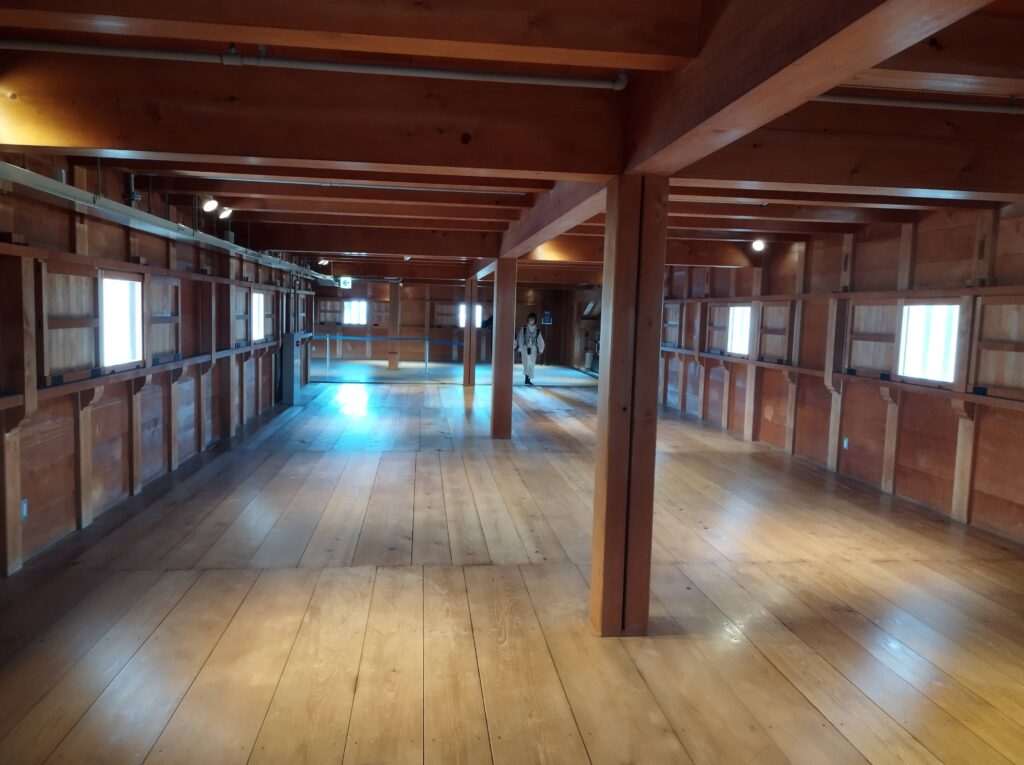
- 目の前の長い建物(五十間長屋)の中では当時の城の中の構造を見れますので、有料ですが、もしお時間とご興味あれば、と思います。
- 見学者はこの長屋の実際の長さを歩いて体感でき、菱櫓の中に入れば、そのユニークな形状が確認できます。
- 格子のある窓からは城全体の眺めや、金沢市内の遠景を楽しむことができます。
- お時間がなければ、入口だけ入って、中の構造を垣間見ることが、費用なしで出来ます。
- わかりますのが、一般住宅より多くの木材が使用されていて、柱の間隔が狭く、床板が厚めであることです。
- 構造は通常家屋では見られない密度の高さで、防御の為に城の強度を高める狙いです。
- 材料は強度だけでなく見た目の美しさも必要の為、城の殆どは柱は桧で、角梁はヒバで、小屋梁には松丸太で出来ています。
- 日本の湿気の高さを考慮し、錆びやすい釘の様な金属的なパーツは殆ど使われませんでした。
- その代わり、木材の端の凹凸を利用することで、木材同士を連結させました。
《英語》
- This palace was used by the military forces of the modern government after the Samurai period ended.
- But it was destroyed by fire about a hundred years ago, and nothing remains today.
- Currently, an excavation survey of the site and a design study of the building are underway in order to fully restore the palace based on the latest findings.
- You can watch an introductory video of the palace in the information center here, and in the near future, you may be able to enjoy the majesty of the fully restored original.
- The floor map of the palace on this exhibit board will give you an idea of the life of the lord’s family at that time.
- Inside the long building in front of you (50-ken Nagaya), you can see the structure of the castle’s interior from that period, for a fee, if you have time and interest.
- Visitors can walk around and experience the actual length of this building, and once inside the diamond turret, they can see its unique shape.
- The lattice windows provide a view of the entire castle or a distant view of Kanazawa city.
- If you do not have time, you can enter only the entrance to get a glimpse of the structure inside at no charge.
- You can see that more wood is used than in an ordinary house, with narrower spacing between columns and thicker planks on the floor.
- The structure is of a high density not usually seen in ordinary houses, designed to increase the strength of the castle for defense.
- Because materials must not only be strong but also beautiful, most of the castle is made of cypress for the pillars, hiba cypress for the angle beams, and pine logs for the tie beams.
- Considering the high humidity in Japan, metallic parts such as nails, which easily rust, were rarely used.
- Instead, the woods were interconnected by making use of the uneven edges of the wood parts.
9 2 笑いが取れるかも?説明例
👉《笑いがとれるかも?》パートについて:実際の案内現場ではあり得ない、脱線の多い長い説明パートですが、日常会話でも使える色々な表現を意図的に織り込んで構成されています。それによりインバウンドのその時の状況に合わせて柔軟な説明ができることを目指しています。
Q1 二ノ丸御殿ってなんですか?(何のためのもの?)
“What is Ninomaru Goten (for)?/ the lord’s palace for?
英語音声は前半(No1-4)と後半(No5-7)の2ファイルです。
- It served as the residence of the feudal lords and the administrative center of the Kanazawa domain.
- 領主の住居で金沢行政の中枢でした。
- The complex consists of about 60 rooms and two Noh stages for the traditional Japanese performances.
- 約60部屋があり能舞台も2つありました。
- It was decorated luxuriously and had areas for political affairs, living quarters, and even for concubines.
- 豪華な装飾が施され、政務、居住エリアの他に側室のエリアもありました。
- As a government rule at the time, the legal wife lived in Edo as a hostage.
- 当時の政府の決まり事として、正妻は人質として江戸に住んでいました。
- We envy the lords that they had two stages of Noh as well as two types of women.
- 能舞台だけでなく、女性達も2つ持つなんて、本当に羨ましい限りです。
- But perhaps it was the women who were truly envious. If the lord was on one side, he was absent from the other.
- でも、本当に羨ましいのは女性達だったかも。殿様が一方にいれば他方は留守。
- Some say that a wife’s greatest happiness is to have a husband who is always healthy and spends time away from home.
- 亭主元気で留守が良い、というのが妻の最高の幸せだという説もありますので。
Q2 何故能舞台が2つもあったのですか?
“Why were there two Noh stages in this building?”
長いので英語音声は前半(No1-6)と後半(No7-12)の2ファイルです。
- The reason for having two Noh stages in the complex is not entirely clear.
- その理由は完全に明らかになってはいません。
- It is said that one was for performances for visitors and the other was for practice.
- 一つは客先用、一つは練習用といわれています。
- Another theory is that it may have been to accommodate different types of performances or to provide a backup in case one stage was unavailable.
- 他説では異なる種の公演の為とか、一方が使えない時の予備の為とか言われてます。
- The lords had a strong passion for Noh theater and established Kanazawa own unique style called “Kaga Hosho.”
- 領主は能芸にも情熱が高く、加賀宝生という独自のスタイルを確立しました。
- You can enjoy monthly performances at the Noh theater in the city.
- 市内の能楽堂では毎月定例公演が鑑賞できます。
- The unique business started by the feudal lord is still thriving today.
- 領主が始めた独自の能ビジネスは現在もこのように盛況です。
- In Japan, businesses started by noble people are called “daimyo businesses,” but in English, they are referred to as “amateur businesses.”
- 日本では偉い人が始めるビジネスを殿様商売と言いますが、英語では素人ビジネスというのですね。
- In other words, noble people usually don’t understand the feelings of ordinary people, or consumers, so their businesses don’t typically prosper.
- つまり、偉い人は下々の人、つまり消費者の気持ちがわからないので普通は商売繁盛しないです。
- The lords in Kanazawa probably had good business sense, establishing the current Kanazawa culture as entrepreneurs.
- 金沢の殿様は恐らくビジネスセンスがあったのですね。現在の金沢文化を起業したのてすから。
- Since masks are an integral part of Noh, it is significant that the lords “saved their faces.”
- 能にお面はつきものなので、殿様の面目が保てて良かったですね。
- However, we cannot tell from the Noh masks what kind of expressions they had behind them.
- でも、能面からは、その面の裏でどんな表情をしていたかわかりませんね。
- Highly educated people like the feudal lords may have had high self-esteem and been complex, having “two faces.”
- 殿様のように教養がある人たちは、その分、気位も高く複雑な性格で、表裏或る性格だったかもしれませんよ。
- This duality might explain why we don’t know the exact purpose of the two Noh stages.
- この二面性で2つの能舞台の目的が不明の理由がわかるかもしれません。
- The lords might not have wanted people to know which was the backstage, revealing their real faces!
- 領主たちは本当の顔が見えてしまう裏舞台がどちらなのか知られたくなかったのかもしれません!
10. 玉泉院丸庭園
10.0 庭園のポイント
ここではインバウンド説明の為の基本情報(背景知識)をご紹介していますが、今回はこのまま、眼の前の庭園を一緒に観ながらの説明にも使えるように、インバウンドの関心の高い「アート」「日本人」を主体に纏めてみました。いつも通り、関心の薄い固有名詞や年代は避けた日本語、英語順の構成です。
《日本語例文》
- 金沢城の領主はこの高台にこの庭園と兼六園のふたつの庭園をつくりました。
- この庭園は小さいですが兼六園より約五十年も前に領主一族の観賞用に作られました。
- 池を中心に置いてその周りを散策する伝統的な回遊式庭園ですが、目新しい仕掛けが見られます。
- 例えば、この庭園の石垣は純粋に観賞用に作られたもので美術作品の様に美的に積み上げられています。
- 更に、狭い敷地を最大限活用するために池底から石垣の最上部まで約20mの高低差のある立体的な庭園としました。
- この庭園での仕掛けや工夫がこの後の兼六園の創出のアイデアに影響与えたとも言われています。
- この庭園は近年復元された為、新しく見えますが約4百年の歴史があります。でもモダンで古さを感じさせません。
- この庭園にはサムライ時代には珍しく女性の名前がつけられています。
- この庭園が造られる前はここに二代目領主の正妻の住む屋敷が建っていました。
- その正妻の死後、屋敷は壊されましたが、正妻の子供ではない3代領主が彼女の為にこの庭園を造ったとの説があります。
- 正妻の子供でないのに3代目領主に推薦してくれた感謝の気持ちからだったようです。
- サムライ時代は忠義が特に重視されたのですがもしかして名前を残したかった位の綺麗な女性だったのかもしれませんね。
《英訳例》
- The lords of Kanazawa Castle created two gardens on this hill: this garden and Kenrokuen Garden.
- This smaller garden was created for the lord’s family to enjoy about 50 years before Kenrokuen.
- It is a traditional circular garden with a pond at its center around which visitors stroll, but it also has some novel features.
- For example, the stone walls of the garden are purely ornamental, and are aesthetically pleasing, piled up like a work of art.
- Furthermore, in order to make the best use of the narrow site, the garden was designed as a three-dimensional garden with a height difference of approximately 20 meters from the bottom of the pond to the top of the stone wall.
- It is said that the devices and innovations in this garden influenced the ideas for the later creation of Kenrokuen Garden.
- This garden was recently restored, so it looks new, but it has a history of about 400 years.But it is modern and does not look old.
- The garden is named after a woman, which was unusual in the Samurai period.
- Before this garden was built, there stood a mansion where the wife of the second lord lived.
- After the death of the wife, the house was destroyed, and it is said that the third lord, who was not the wife’s child, built this garden for her.
- It seems that it was out of gratitude for her recommendation for him to become the third lord, even though he was not the child of her, a legal wife.
- Loyalty was especially important during the samurai period, but maybe she was just a beautiful woman whom the lord wanted to keep her name for.
《補足》多くのインバウンドは見るだけで良いので、上記では石垣の形式は省きましたが、中には興味を示す外国人もいるので用語だけ付記します。
- 鑑賞目的だけの為の切石積石垣(色紙短冊み)に代表される趣向をこらした庭園。
- This garden employs various decorative features such as the stone walls with the technique of cut stone stacking (colored strip of paper) purely for viewing purposes。
10.1 インバウンドの視点
ここではいつも通り、実際にこの庭園を目の前にした多くのインバウンドが素直に感じるであろう彼らの想定視点をQAでご紹介します。実際のところ、本庭園は伝統的な回遊式庭園のイメージと違うので、戸惑うインバウンドも多いように思います。復元されたばかりの事もあり、高低差を活かしたコンパクトな設計はゴルフのショートコースも彷彿させ、モダンで古さを余り感じさせない要素がありますので、その辺り日英の順で置いてみました。
10.1.1:疑問例
《日本語例文》
- この庭園はいつごろ誰に作られたのてすか?
- 昔からずっとこのままだったのてすか?
- この庭園は何の目的で作られたのですか?
- 何故ここに作られたのですか?
- どうしてこんなに綺麗なんですか?
- 当時はどの様に使っていたのですか?
- 持ち主はどんな人達だったのですか?
- この庭園の見所、魅力はなんなんですか?
- この石垣の石はどこから運んできたものなのですか?
- 他の庭園となにが違うのですか?
《英訳例》
- When was this garden created and by whom?
- Has it always been this way?
- What was the purpose of this garden?
- Why was it built here?
- Why is it so beautiful?
- How was it used in thoseWhat were the owners like?
- What is the attraction of this garden?
- Where did the stones for this stone wall come from?
- What makes it different from other gardens?
10.1.2:回答例
《日本語例文》
- 約四世紀前に現代の金沢文化の基礎を造ったと言われる3代目領主によって作られたました。
- サムライ時代から近代政府に変わった約百五十年前に一旦埋められ近年復元されました。
- 主に領主一族の慰霊と文化観賞目的でつくられました。
- 元は二代目領主の正妻の邸宅がありましたが、彼女の死後、暫く更地でままで、庭に再活用されました。
- 近年の観光政策で発掘資料を元に復元され、小まめにメンテされている為です。
- 現代人が美術館を絵を観賞する様に、庭園内を散策しながら色々な角度から違った風景を楽しんでいました。
- お茶や能楽等の文化を堪能した裕福で優雅な人達でした。
- 本来は防衛の為の石垣をお城の中の屋外美術館と言えるほど美的に置き換えた点です。
- 金沢城の近辺の山からで、そこでしか取れない青と赤の種類の高級石です。
- 石垣上部の石樋からの人工滝の様に伝統的な日本庭園と人工物の合体と調和です。
《英訳例》
- It was built about four centuries ago by the third generation of lords who are said to have laid the foundation of modern Kanazawa culture.
- It was buried about 150 years ago when the Samurai period gave way to the modern government, and has recently been restored.
- It was built mainly for the purpose of memorializing the family members of the lords and for cultural appreciation.
- Originally the residence of the wife of the second lord, it remained vacant for a while after her death, and was then reused as a garden.
- The reason for this is that it has been restored based on excavated data in accordance with the recent tourism policy, and has been maintained carefully.
- Visitors strolled through the garden as if they were looking at a painting in an art museum, enjoying the different views from various angles.
- They were wealthy and elegant people who enjoyed the culture of tea ceremony and Noh drama.
- This is the point where the stone wall, originally intended for defense, was replaced so aesthetically that it could be called an outdoor museum inside the castle.
- They were brought in from nearby mountains in the vicinity of Kanazawa castle, and they consist of the blue and red types of high-grade stone, which can only be found there.
- The stone wall is a combination and harmony of traditional Japanese garden and artificial objects like the artificial waterfall from the stone gutter at the top of the stone wall.
10.2 笑いが取れるかも?説明例
👉《笑いがとれるかも?》パートについて:実際の案内現場ではあり得ない、脱線の多い長い説明パートですが、日常会話でも使える色々な表現を意図的に織り込んで構成されています。それによりインバウンドのその時の状況に合わせて柔軟な説明ができることを目指しています。
a.)この庭はいつ頃作られたのてすか?
“When was this garden made?”
👉古さを感じさせないので、新しく創ったのでは?と思われた外国人を想定しました。
- This looks new because it faithfully restored the garden of that time based on the latest excavation materials.
- 新しく見えるのは最新の発掘資料により、当時の庭園を忠実に再現したためです。
- The original was created over 300 years ago.
- オリジナルは300年以上前に作られました。
- The garden was named after the wife of the second lord.
- この庭園は二代目領主の妻の名前からそのまま命名されました。
- Unfortunately, there are few records of her.
- 残念ながらその妻の記録は殆ど残っていません。
- However, giving a woman’s name to a garden in a male-dominated samurai society is unusual.
- でも男性優位の武家社会で庭園に女性の名前が付けられることは珍しいのです。
- This is evidence that the lords valued women highly as the source of life wishing for the prosperity of their descendants.
- 領主が子孫繁栄を願い、命の源泉として女性を大切にした証ですね。
- It’s fortunate that this place didn’t become a dry landscape garden.
- ここが枯山水庭園にならなくてよかったですね。
- That is because the lady who was named after this garden wouldn’t have wanted to wither away even after her passing.
- 命名された夫人も死後まで枯れたくなかったでしょうから。
b)この庭園の見どころは何ですか?
“What are the highlights of this garden?”
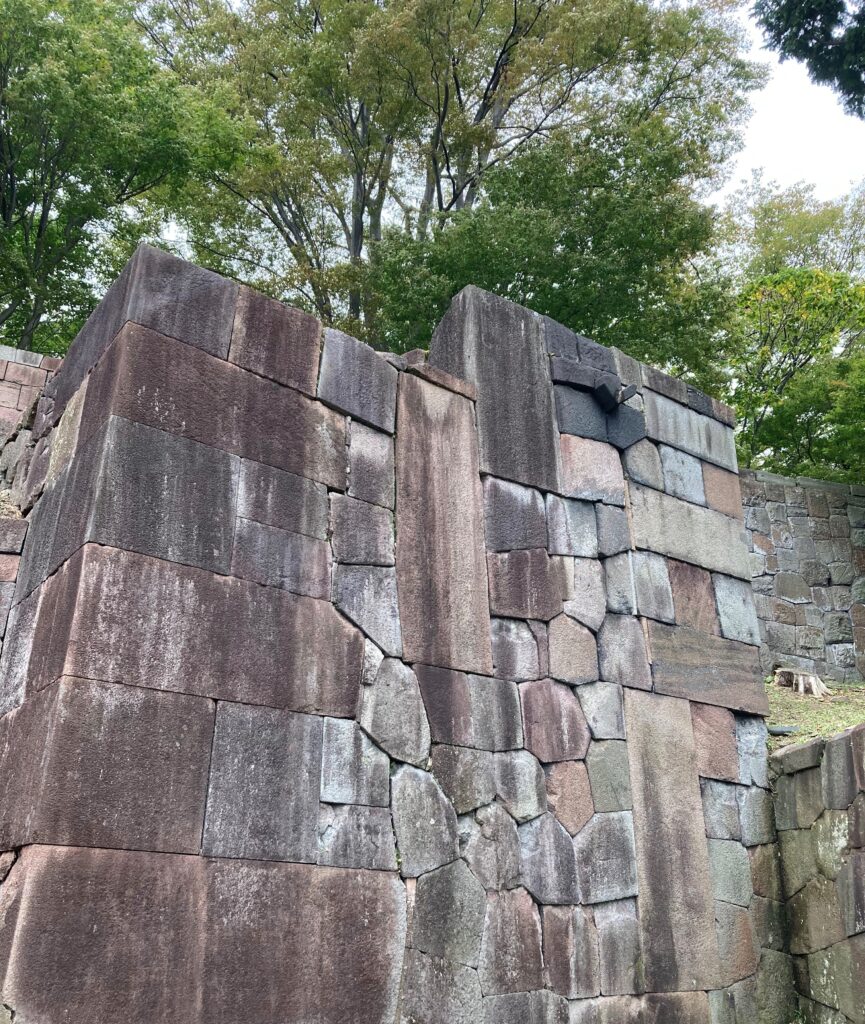
- Unlike the Kenrokune garden for entertaining, we can see the lords’ idea of enjoying it themselves as an inner courtyard.
- 接待用の兼六園と違ってここは内庭ですので自ら楽しむ発想が見られます。
- One of them is the piled stone walls with the unique technology resembling colored strip of paper.
- ひとつには、色紙短冊に似せた石垣積です。
- The stone walls, a symbol of battle, are made just for viewing here.
- 戦いの象徴である石垣がここでは観賞用に作られています。
- It is unusual to stack the stone walls vertically like a strip of paper because it is unstable.
- 短冊のように石垣を縦に置くのは不安定なので普通はあり得ません。
- Originally in Japan, a strip of paper has been used for writing various wishes on it.
- もともと日本では短冊に願い事を書く習わしがありました。
- However, the lords did not think to write their wishes, the prosperity of their family on the stone strip of wall.
- でも領主はその石垣の短冊に文章を書こうとはしませんでした。
- They might not have wanted it to be mistaken for a tombstone, you know.
- 墓石と間違えられたくなかったからかもしれませんね。
11.三十間長屋
11.0 三十間長屋の説明ポイント
- 石川門と同じ石垣、鉛瓦、海鼠壁、唐破風の構成の重要文化財。
- それぞれの壁面が異なった構成になっている。
- もとは武器倉庫の頑丈な造りで、保存食も貯えられていた。
- このような城と同じ造りの倉庫が全部で10以上あったと言われている。
- 領主の裕福ぶりが伺える貴重な現存建造物。
- An important cultural asset composed of the same stone walls, lead tiles, namako walls, and karahafu as Ishikawa Gate.
- Each side of the walls is constructed differently.
- Originally built as a sturdy arsenal, it also stored preserved food.
- It is said that there were more than ten warehouses built in the same style as this castle.
- A valuable existing structure that gives insight into the wealth of the lord.
11.1 インバウンドの視点
城内の建物(櫓、門、五十間長屋)と同じ造りで似た名前の建物がただ続くだけなので、何も説明がないと素通りで終わってしまう、それはできれば避けたいですね。石川門から入ってここまで歩いてくると、疲れも感じたり、同じような雰囲気が続いて、飽きて集中力もない、そんな状態かもしれません。
11.2 笑いが取れるかも?説明例
👉《笑いがとれるかも?》パートについて:実際の案内現場ではあり得ない、脱線の多い長い説明パートですが、日常会話でも使える色々な表現を意図的に織り込んで構成されています。それによりインバウンドのその時の状況に合わせて柔軟な説明ができることを目指しています。
a) この長屋は先の長屋(五十間長屋)と何が違うのですか?
“What is the difference between this house and the previous long house?”
- This is a warehouse for storage purposes only, and one of the few remaining original (, surviving) buildings, not restored one.
- これは保管目的だけの倉庫ですが、再建物でなく、数少ないオリジナルの1つです。
- Despite being a warehouse, it has the same level of design just like the main castle and its each side of the walls is constructed differently.
- ただの倉庫なのに、お城本体と同じく意匠性が高く、壁面が異なる作りになっています。
- Originally, it was built for weapons and later on, preserved foods such as dried seafood were also stored.
- 元は兵器倉庫でしたが、後には干し魚等の保存食も保存されました。
- It’s hard to believe that there were more than ten such luxurious storehouses back then.
- 当時はこのような豪華な倉庫が10以上もあったなんて信じられません。
- In Japan, when we have our own home, we often say that I finally became the lord of my own castle.
- 日本ではマイホームを持つと、俺もようやく一国一城の主になったと言います。
- Although using the word “castle”, our house is far more like a warehouse than these storehouses of Kanazawa Castle. It’s significantly more shabby.
- 城と言っても我々の家は金沢城の倉庫よりもはるかに倉庫らしいです。はるかにショぼいです。
- Dose that mean that we are less valuable than preserved food?
- 我々は保存食より価値が低いってこと?
- That would be disrespectful to preserved food.
- それは保存食に失礼でしょう。
12. 鶴丸倉庫
12.0 鶴丸倉庫の説明ポイント
- 石川門、三十間長屋と同様、現存する重要文化財。
- 城本体より新しい時代のもので、装飾面で若干異なっている。
- もとは武器倉庫の頑丈な造りで、戦前は暫く陸軍も使用していた。
- 城内の土蔵としては、日本最大級の大きさのもの。
- 長い間、いつ建築されたか正確に把握できず、その価値がわからなかった。
- An important cultural property like the Ishikawa Gate and the Sanjukken Nagaya, surving buildings.
- Built in a newer era than the main castle and has some differences in its decorative features.
- Originally a sturdy armory, it was used by the army for a while before the modern wars .
- As a storehouse within the castle, it is one of the largest in Japan.
- For a long time, it was not known exactly when it was built, and its value was not understood.
👉再確認!主単語《土蔵》(dozo):storehouse / warehouse/ storehouse with thick mortar walls(🔶天守閣や櫓の”tower”と同じように”storehouse / warehouse”では正確な意味が伝わらないですが、一緒に見ているものの補足説明なので、結局は機能的な説明が必要となりますね。)
12.1 インバウンドの視点
城内でも地味な存在なので、哀しいかな、城内の(雰囲気をこわさない造りの)休憩所のような建造物の印象もあり、素通りされるケースも多いので説明の際には工夫が必要です。でも、元々倉庫は人に見せる為のものではないので、実力通りの存在感、と言ってしまえばその通りですね。そうは言っても意匠性があるのは加賀のお殿様の面目躍如でしょうか。
11.2 笑いが取れるかも?説明例
👉《笑いがとれるかも?》パートについて:実際の案内現場ではあり得ない、脱線の多い長い説明パートですが、日常会話でも使える色々な表現を意図的に織り込んで構成されています。それによりインバウンドのその時の状況に合わせて柔軟な説明ができることを目指しています。
a) 何が特徴なのですか?/他の建物と何が違うのですか?
“What are the features of this house?”/ “How is this different from the other buildings?”
- This warehouse with thick mortar walls is one of the largest of its kind in castles of the country.
- これは日本の城の中の土蔵としては最大級のものです。
- Furthermore, despite being a storehouse, it has decorative features on the walls, which reveals the lord’s attention to detail.
- しかも、土蔵にかかわらず、壁にも意匠性が見られるので、領主のこだわりを感じます。
- In fact, until recently, it was unclear when it was built.
- 実は、最近までいつ建てられたかわかりませんでした。
- It was ignored for a while, like a person whose age is unknown and value is uncertain.
- 年齢不詳でどう評価してよいかわからない人間のように、暫く軽視されていました。
- Through recent research, it was determined to be an old structure, and its value was recognized, leading to its designation as an important cultural property.
- 最近の調査で古いものと分かり、その価値が判明したので重要文化財に指定されました、
- But buildings are fortunate; when it is known to be old, its value increases.
- でも、建物は羨ましい。古いとわかると価値があがるんだから。
- Just like with an elderly person, when their real age is known, they may be judged worthless and forced to go to a warehoue (,left unused.)
- 高齢の人間だと、実年齢がわかると、無価値と判断され、そのままお蔵入りです。
13.丑寅櫓跡(うしとらやぐらあと)

👉ここからは眺望の良い3つの櫓跡が續きますので、比較説明に使えるので方角の説明も入れてますが、これら3櫓は見ていただいただけで満足されるので、細かい悦明の手間が省けるお勧めスポットです。
13.0 櫓跡の説明ポイント
- 元々は兼六園の物見や本丸の防御の為に作られた櫓の跡。
- なので、視界が良く、兼六園や後方の山々が眺望できる展望台となっている。
- ここを含む3つの櫓跡は本丸からの方角の名前がつけられている。
- ここは本丸から北東(丑寅)の方角にあることから、丑寅櫓の名前がついている。
- 日本では昔から方角と時刻は十二支で表されている。
- 丑寅櫓の石垣は金沢城内、最古の自然石積み石垣である。
- 👉残念ながら櫓からは足元で見えないので説明の際は登る前か降りた際に。
- この下を走っている道路はかってはお堀で今の金沢城公園を囲んでいた。
👉これまで通り、外国人向けに説明するレベル、表現ではありませんが、頭の片隅に置いておくと安心なので英語でも置いておきます。
- This is the remains of a tower that was originally built for surveillance for Kenrokuen Garden and defense of the Honmaru (inner citadel) .
- Therefore, it has become an observation deck with a good view of Kenrokuen Garden and the mountains in the background.
- The three tower remains in this area are named after the directions they face from the Honmaru.
- In Japan, directions and time have traditionally been expressed using the twelve zodiac animals.
- This tower is located in the northeast direction (called Ushitora meaning “cow and tiger” in Japanese), so it is called the Ushitora Tower.
- This tower is on the oldest stone walls here consisting of fieldstones, not processed ones.
- The road running below used to be a moat that surrounded the current Kanazawa Castle Park.

13.1 インバウンドの視点
👉外国人から見たら、単に見晴らしの良い展望台なので(日本人同士であれば。あれが何、これが何と、会話が弾むところですが、当然ほとんどのインバウンドは何がなんだかわかりませんので)(天候にもよりますが)兼六園側を見下ろして、見てすぐわかる地形的ところ(ブラタモリ的に)補足すればとよろしいと思います。
14.辰巳櫓跡

14.0 櫓跡の説明ポイント
- 金沢城の一番の弱点の兼六園方向の監視を補強する為に作られた。
- 他の櫓跡と同じく本丸から南東(辰巳)の方角にあることから巽櫓と名付けられた。
- 南側を向いている為、金沢市内と二十一世紀美術館が見える。
- この櫓を囲うように走っている下の道路はかつてお濠であった。
- Built to reinforce the surveillance of the Kanazawa Castle’s weakest point towards the Kenrokuen Garden.
- Named “Tatsumi Yagura” because it is located in the southeast direction (called Tasu-mi meaning dragon-snake) from the central enclosre like other turret ruins.
- As it faces south, you can see the city of Kanazawa and the 21st Century Museum of Contemporary Art.
- The road below that runs around this turret used to be a moat.
14.1 インバウンドの視点
👉インバウンド的には丑寅櫓より眺望が広く分かり易いので、学生のようにきれいですねェ、(インバウンドに有名な)二十一世紀美術館が見えますよ、なんて言っていればよいと思います。同じく百閒堀についても説明して良いでしょう。
15.戊亥櫓跡

15.0 櫓跡の説明ポイント
- 他の櫓と違い、金沢城内の全域、特に二ノ丸の防衛、監視の為に作られた。
- 他と同様、本丸から西北(戌亥)の方角にあることから戌亥櫓と名付けられた。
- 現在は同じく城内が眺望できる展望台。
- Unlike other turrets, this one was built to defend and monitor the entire area of Kanazawa Castle, especially the Nino Maru of the lords’ mansion.
- As with the others, it was named Inui-yagura because of its location to the northwest (called Inu-i meaning dog-wild boar) of the Hon-maru (center of the castle).
- Today, it serves as an observation deck where visitors can enjoy views of the castle grounds.
15.1 インバウンドの視点
👉高さにはイマイチ欠けますが、城内を先に歩いて来た来訪者は、振り返ってホっとして、一望できる最良のポイントですので、ここも細かい説明は不要です。あれが今歩いてきた橋爪門です、二の丸御殿ですとか、言っていれば大体の方にはご満足いただけると思います。
ご参考🔶『腑に落ちる』の英語表現例
- It finally makes sense!/I see the point now!
- I understand now! / I am convinced now!
- I am satisfied! /I feel content now!
- I am impressed! /I am amazed!
- It hit me!/ It dawned on me!
御礼🔶後書き

🔶今回も最後まで読んで頂き大変ありがとうございます。Gold🔶v5b.5a.3a/S1