Welcome! I’m Mine, your local Japanese garden insider in Kanazawa. Are you planning a trip to Japan or looking for unique spots in Kanazawa?

Forget dry history lessons and official guidebooks! Here, I’m sharing hilarious garden backstories, hidden secrets, and local humor that you won’t find on standard travel sites or AI tours.
✨ Jump Straight to Kenrokuen’s Hidden Secrets & Mysteries!
If these stories make you smile or spark your curiosity, be sure to drop by Kenrokuen Garden during your Kanazawa journey. We’re excited to welcome you—see you in Kanazawa!
📍 Table of Contents (Click to Jump)
1. Overview of Kenrokuen Garden
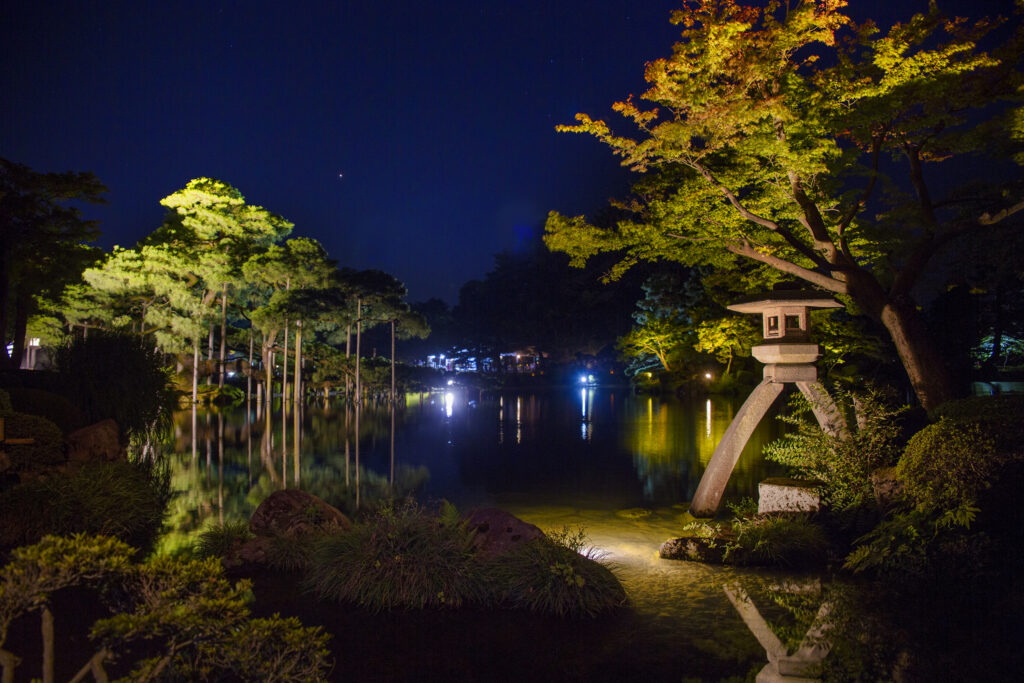
Kenrokuen Garden Illuminated on a Summer Evening
1.1 Essential History & Key Facts
- It Began as a Small Villa Garden
Kenroku-en began as a private villa for the feudal lord, surrounded by a small garden. Traces of this original garden can still be seen around present-day Hisago-ike Pond. - Gradual Expansion Over Several Centuries
The garden was not completed overnight. Successive feudal lords expanded the grounds bit by bit over centuries, adding ponds, streams, and artificial hills to develop its current form. - Fire and Reconstruction
Although parts of the garden were destroyed in a major fire during the Edo period, key features such as the pond, waterfall, and tea houses were later restored, allowing the garden to regain its beauty. - A Name Embodying the “Six Beauties”
The name “Kenroku-en” derives from six traditional attributes used to evaluate a garden’s perfection. Its true charm lies in combining qualities that are usually hard to reconcile—such as vastness and seclusion, or artifice and natural beauty. - Named by Renowned Scholars
The garden was named by the renowned scholar(Matsudaira Sadanobu) at the request of the feudal lord. Drawing on a classic Chinese text on garden design, he chose a name reflecting the garden’s ability to combine all six seemingly incompatible landscape qualities. - Located Adjacent to Kanazawa Castle
Kenroku-en is situated on a hill right next to Kanazawa Castle, connected by structures like the Ishikawa Bridge. The castle and garden are closely intertwined, offering insight into the lord’s lifestyle and castle town culture. - The Tatsumi Canal: Bringing Water from Afar
The ponds and streams are fed by the Tatsumi Canal, which draws water from the upper reaches of the Sai River. Built using advanced engineering techniques, including tunnels through the hills, this nearly 400-year-old waterway still supplies water to the garden and parts of the historic city. - Designed to Be Enjoyed While Strolling
Rather than being viewed from a fixed spot, Kenroku-en was designed as a strolling garden. As you walk among the ponds, bridges, hills, and tea houses, the changing perspectives continually reveal new facets of its beauty. - Dual Purpose: Water as Castle Defense
It is said that the ponds were designed with a mechanism to discharge water outward during emergencies, raising the water level in Kanazawa Castle’s moat. The idea that this serene water feature was also integral to castle defense adds a fascinating dimension to its story. - From Private Sanctuary to World-Famous Garden
Once an exclusive sanctuary reserved for feudal lords and distinguished guests, the garden was opened to the public in the Meiji era. Today, it is designated as a National Special Place of Scenic Beauty, welcoming visitors from all over the world.
1.2 Fun Backstories & Mysteries
Q1: What Is This Garden, Kenroku-en, in Front of Us?
- This is Kenroku-en, a garden created by the lords of Kanazawa Castle for their enjoyment and to entertain their guests.
- But it was more than just a beautiful garden.
- Some of its features are said to reflect the lords’ wishes for prosperity and long life.
- You can discover these wishes by looking closely at the garden’s individual features.
- For example, even the stone lanterns, stone bridges, and simple rocks and pine trees—which are common features in other Japanese gardens—hold an incredible number of mysteries.
- Of course, simply looking at them won’t reveal their hidden meanings.
- The clues are right in front of you, but you need someone to explain them.
- That’s exactly why we guides are here—to help you crack the code.
- It’s a bit like The Da Vinci Code, isn’t it?
- But don’t worry, unlike the Da Vinci Code, no one has died, and there is no danger to you.
Q2: What Are the Three Great Gardens of Japan?
- They refer to what are widely regarded as three of Japan’s most celebrated gardens.
- Of course, Japan is home to countless beautiful gardens, but these three hold a special place in the nation’s gardening tradition.
- In Japan, the label “Three Great” is used in many fields, not just gardens.
- For example, we have the Three Great Scenic Spots, the Three Great Hot Springs, and the Three Great Festivals, to name a few.
- There are no official government criteria for selecting Japan’s Three Great Gardens, and the exact origins of the title remain unclear.
- What’s fascinating is how such labels, despite the lack of clear selection criteria, gradually gained nationwide recognition.
- Today, “Japan’s Three Great Gardens” is so well established that it even appears in official tourism databases.
- But if you think about it, it’s a bit cheeky, isn’t it? After all, there are magnificent gardens all across the country.
- That’s why, as a tour guide, the only time I can drop the phrase “Three Great Gardens” with total confidence is when I’m talking to international visitors.
- After all, they have absolutely no competitive or financial interests in which gardens make the list.
Q3: Why is this garden called Kenrokuen?
- The name Kenrokuen means “an ideal garden that possesses six beauties.”
- In ancient China, six essential features were required for a perfect garden.
- Each condition contradicts the others, making it extremely difficult to satisfy them all.
- It was actually almost impossible, but the castle lords tried to create a perfect garden.
- And a renowned scholar, asked by the lord, named the garden, drawing on an old Chinese text about garden design.
- On the official website, these six conditions are described with difficult terms: “spaciousness,” “seclusion,” “artifice,” “antiquity,” “water-courses,” and “panoramas.”
- These are not words people in Japan use in daily life, so it’s hard to understand them just by hearing them.
- So, as a guide, I try to give explanations that people can understand just by listening.
- For example, I sometimes explain it by focusing on the contradictions—“big and small,” “natural and man-made,” and “far and near.”
- And if such an over‑simplified explanation helps foreign visitors understand, does that mean I’ve achieved the difficult seventh criterion and become a truly great guide?
Q4: What makes Kenrokuen Garden different from other Japanese gardens?
- Kenrokuen Garden is one of the “Three Great Gardens in Japan.”
- Many people consider this garden to be highly perfected as a Japanese garden.
- Here, “perfection” refers to scenery that looks like a carefully crafted painting.
- The garden designers tried to create many beautiful scenes based on the lords’ intentions.
- Here, you can see various garden techniques that were used to create that beauty.
- Other gardens are equally beautiful, but there is one big difference.
- Other gardens often have names that sound pleasant and are easy to use.
- So those names are often used for baseball fields, Chinese restaurants, yakiniku restaurants, ramen shops, and so on.
- However, the name “Kenrokuen” is rarely used.
- Probably, no one feels confident enough to offer entertainment or cuisine that satisfies all six criteria.
Q5: How Were the Three Great Gardens of Japan Chosen?
- There was no official committee that selected Japan’s Three Great Gardens.
- The three gardens are Kenrokuen in Kanazawa, Kairakuen in Mito, and Korakuen in Okayama.
- All three were created by feudal lords during the Edo period.
- After the Meiji Restoration, the feudal system disappeared, and these gardens gradually became public parks and popular attractions.
- By the Meiji era, they were already being referred to as Japan’s Three Great Parks, although no one knows exactly who first grouped them together or why.
- Over time, they came to be widely recognized as Japan’s Three Great Gardens.
- But there was no official committee or clear selection criteria, unlike UNESCO’s World Heritage system.
- Well, that sounds like a very traditional Japanese way of doing things. Throughout Japanese history, there have been many important decisions whose details remain unclear.
- Why not nominate the name “Japan’s Three Great Gardens” for UNESCO World Heritage status?
- “Japan’s Three Great Gardens: A Thousand-Year Tradition of Decisions Behind Closed Doors!” How about that? (Laughs.)
Official Links & Resources
Thank You & Message from Mine

👆 Thank you for reading to the end! If you have any questions, customized itinerary inquiries, or travel planning feedback, please feel free to reach out anytime.
🛡️ Travel Safety Notice: Enjoying Historical Paths with Peace of Mind
Kenrokuen and other historical Japanese landscapes feature ancient stone steps, stepping stones, and natural gravel paths. While breathtaking, unexpected trips or stumbles can occur. For international visitors exploring Kanazawa and Japan’s heritage sites, securing real-time travel health insurance is strongly recommended for seamless medical support during your trip.
⚔️ SafetyWing – Real-Time Travel Insurance for Global Travelers (Check Details)