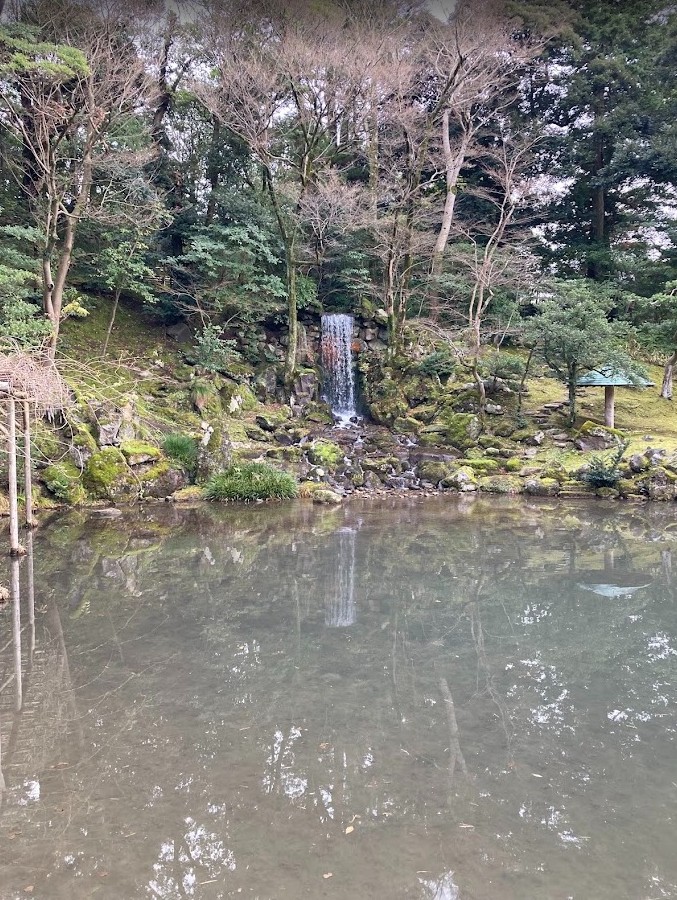
Welcome! I’m Mine, your local Japanese garden insider in Kanazawa. Welcome to the official feature page for Midori-taki Waterfall (Green Waterfall)—the largest artificial waterfall in Kenrokuen Garden, masterfully engineered during the Edo period to serve as an acoustic background music (BGM) system for tea ceremonies at the neighboring Yugao-tei teahouse!

Connecting Kasumiga-ike Pond down to Hisago-ike Pond, this multisensory spot showcases sophisticated acoustic stone arrangement techniques—along with local legends of a samurai lord demanding his gardeners replicate the exact sound of Japan’s famous Nachi Falls!
✨ Jump Straight to the Secrets & Mysteries of Midori-taki Waterfall!
📍 Quick Navigation: Jump to Other Highlights
8. Midori-taki Waterfall (Midori-taki)
8.1 Essential History & Key Facts
- Artificial Waterfall Utilizing Natural Terrain
Sui‑taki is an artificial waterfall built by taking advantage of the natural slope between the upper and lower areas of Kenrokuen. The design blends human craftsmanship with the existing terrain. - Water System Design Connecting Ponds
The waterfall forms part of a planned water system, carrying water from Kasumiga Pond down to Hyōtan Pond. This controlled flow helps maintain circulation within the garden. - Stones for Acoustic Control
The basin is constructed with carefully layered stones. Their placement controls turbulence, water speed, and resonance, functioning as an early form of acoustic engineering. - Seasonal Flow and Water Control
The waterfall’s appearance changes with seasonal water levels, rainfall, and upstream inflow. These variations were intentionally considered in its design. - A Sound Device for Yugao-tei Teahouse
The waterfall was created specifically for Yugao‑tei, the nearby teahouse. Its sound served as an auditory backdrop for tea gatherings, enhancing the sense of tranquility. - Aesthetics of Sound in Tea Culture
In tea culture, sound is part of the aesthetic experience. Waterfalls were often used to create subtle auditory cues that complemented the season and the host’s intention. - Inspired by the Sound of Nachi Falls
A long‑standing theory suggests that the designers attempted to imitate the sound of Nachi Falls, one of Japan’s most iconic waterfalls, reflecting the era’s refined aesthetic ideals. - Advanced Edo-Period Garden Engineering
The waterfall demonstrates advanced Edo‑period garden engineering, including water control, stone arrangement, and sensory design—techniques rarely combined at this scale. - Multisensory Garden Design
Unlike many garden features focused solely on visual beauty, Sui‑taki integrates sound as a deliberate design element, making it a multisensory attraction. - Scenic Connector Between Ponds
Placed between two major ponds, the waterfall acts as a scenic connector, guiding visitors’ movement and framing views toward Yugao‑tei.
8.2 Fun Backstories & Mysteries
Q1: What Is the Meaning of This Waterfall?
- This waterfall is called Midori‑taki, literally “Green Waterfall,” a name so ordinary that you could find it almost anywhere in Japan.
- But despite such a simple and familiar name, this waterfall hides a story far more unexpected than its calm, green appearance suggests.
- It is common to create a waterfall in a Japanese garden, but this artificial waterfall is the largest of its kind.
- Many Japanese people find solace in listening to the sound of waterfalls.
- Some theory says that it was created to enjoy the sound in this tea room.
- It seems that they tried to recreate the sound of the most famous waterfall with the largest drop in Japan.
- The gardener at the time reportedly received multiple rejections from the lord who ordered it.
- But back then, without digital equipment, how could they prove that it was the exact same sound as the waterfall?
- Achieving a goal without objective and accurate data would have been difficult even for the gardener at the time.
- This small waterfall may have had a much greater drop than the tallest waterfall in Japan for the gardener.
Official Links & Resources
Thank You & Message from Mine

👆 Did you enjoy listening to the acoustic secrets of Midori-taki Waterfall? To explore other iconic highlights like the Yamato Takeru Statue, use the navigation buttons above!
🛡️ Travel Safety Notice: Enjoying Historical Paths with Peace of Mind
Kenrokuen and other historical Japanese landscapes feature ancient stone steps, stepping stones, and natural gravel paths. While breathtaking, unexpected trips or stumbles can occur. For international visitors exploring Kanazawa and Japan’s heritage sites, securing real-time travel health insurance is strongly recommended for seamless medical support during your trip.
⚔️ SafetyWing – Real-Time Travel Insurance for Global Travelers (Check Details)