Welcome! I’m Mine, your local Japanese garden insider in Kanazawa. Welcome to the official feature page for Kasumiga-ike Pond—the grand, expansive centerpiece that acts as the very heart and soul of Kenrokuen Garden!

From its “reduced landscape” (shukkei) design modeled after Lake Biwa and the turtle-shaped Horai Island symbolizing eternal youth, to its hidden role as an emergency water defense system for Kanazawa Castle, Kasumiga-ike holds the deepest stories in the garden.
✨ Jump Straight to the Secrets & Mysteries of Kasumiga-ike Pond!
📍 Quick Navigation: Jump to Other Highlights
4. Kasumiga-ike Pond
4.1 Essential History & Key Facts
- Central Pond
In many Japanese gardens, a large pond is positioned near the center of the garden, and in Kenroku-en, Kasumigaike lies almost at the center, functioning like the heart of the garden. - Strolling Features
Various distinctive garden features and scenic elements are arranged around the pond, allowing visitors to enjoy changing views as they walk. - Reduced Landscape
A traditional gardening technique known as “reduced landscape” is often employed in Japanese gardens, where miniature representations of famous scenic places are incorporated into the design. - Model of Lake Biwa
Kasumigaike is said to have been modeled after Lake Biwa, Japan’s largest lake, reflecting its cultural and historical significance. - Cultural Center
Lake Biwa and nearby Kyoto have long been central to Japan’s politics and culture, and their prestige has inspired admiration since ancient times. - Island of Immortality
The small island in the pond represents an islet in Lake Biwa associated with a legend of immortality. - Turtle Symbolism
The shape of the islet resembles a turtle shell—an auspicious symbol of longevity—with a stone placed at the edge suggesting the turtle’s head. - Meaning of the Name
The name Kasumigaike, literally meaning “Hazy Pond,” expresses the idea of vastness, evoking an image of a distant shore softened by haze and disappearing from sight. - Emergency Water System
It is said that the pond was designed not only for its scenic beauty but also with an emergency mechanism that allowed water to drain from the bottom and raise the water level of the castle moat. - Water Source and Circulation
Kasumigaike, which is supplied by water drawn from the Tatsumi Waterway constructed about four centuries ago, feeds other ponds and waterfalls throughout the garden, forming the central hub of Kenroku-en’s water circulation system.
4.2 Fun Backstories & Mysteries
Q1: How Big Is the Pond in Kenroku-en?
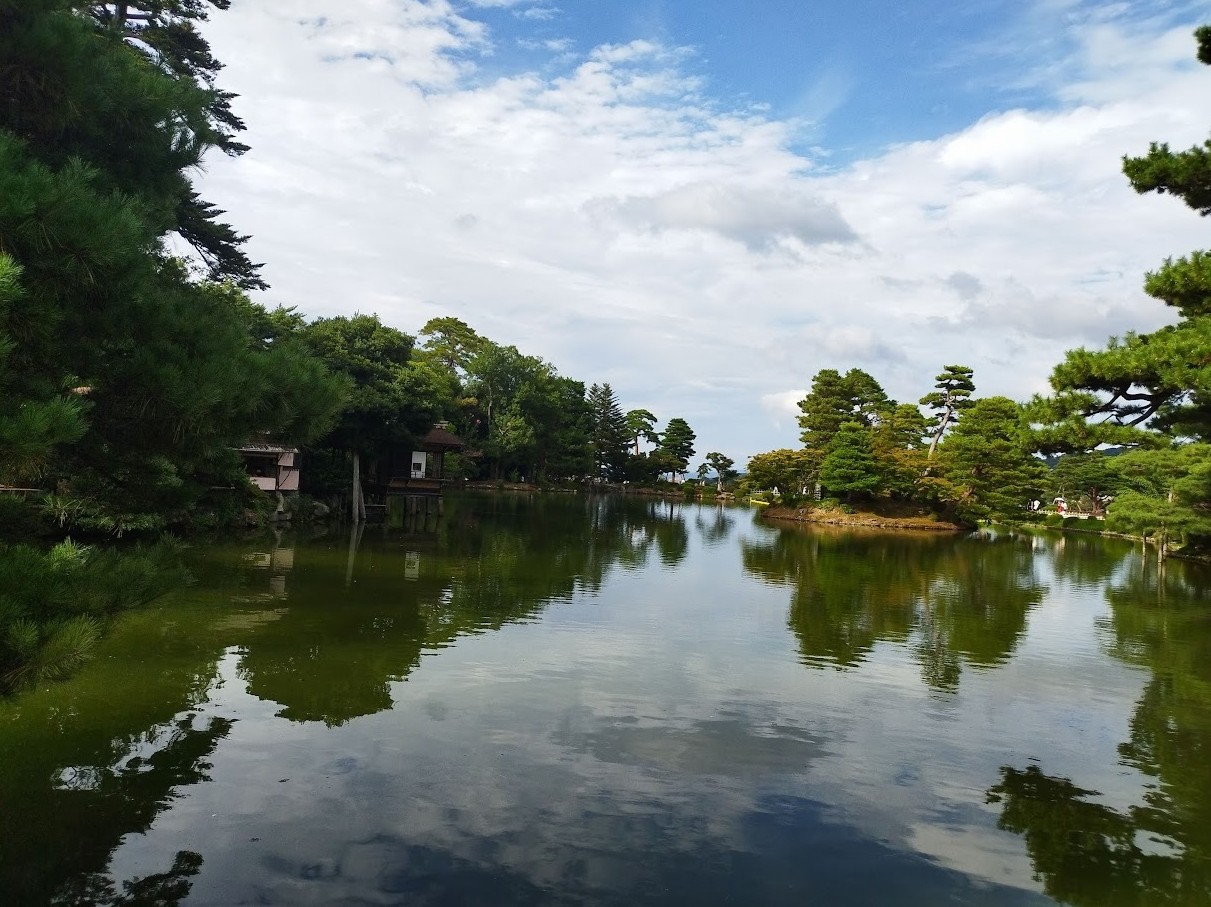
- Although you can’t see its full shape from here, the pond stretches all the way to the tea house in the distance.
- Its actual size is only slightly smaller than a soccer field, so it’s not extraordinarily large.
- Even so, a pond of this scale is quite rare in Japanese gardens.
- Many traditional gardens feature a central pond, and this is likely one of the largest examples of that style.
- The pond is named Kasumiga-ike, which literally translates to “Hazy Pond.”
- The idea is to evoke a serene scene where the opposite shore fades softly into the haze.
- But personally, I suspect the real intention was to make the pond feel so vast that the far shore seems to disappear.
- After all, it was modeled after Japan’s largest lake, Lake Biwa.
- If so, calling it “slightly smaller than a soccer field” sounds a bit less grand, doesn’t it?
- But if a guest comes from a country whose national team struggles in the World Cup, they might just nod and say, “Oh yeah, the opponent’s goal always feels miles away—this place is massive!” (laughs)
Q2: What Are the Main Must-See Features Around the Pond?
- There are many highlights, but first and foremost, this pond is a prime example of shukkei, or a “reduced landscape.”
- Shukkei is a traditional Japanese gardening technique that recreates famous scenic places on a smaller scale.
- Without an explanation, it might look like just an ordinary pond, but it actually depicts Lake Biwa—Japan’s largest lake.
- Lake Biwa lies right next to Kyoto, the ancient capital, and has long symbolized history, culture, and prosperity for the Japanese people.
- It might be similar to what the Mediterranean Sea meant to the people of ancient Europe.
- The small island in the center represents an island in Lake Biwa associated with the legendary realm of eternal youth and immortality.
- In this way, many features around the pond were designed with wishes for long-lasting prosperity and longevity.
- Furthermore, the island is shaped to resemble a turtle—a creature believed in Japan to live for ten thousand years.
- The island itself represents the turtle’s shell, and the rock at the edge represents its head. Does it look like a turtle to you? Does it look happy, too?
- I couldn’t possibly endure staying still like that for 10,000 years! (laughs)
Q3: What Makes This Pond Interesting? / What Makes It Special?
- People appreciate Japanese gardens in various ways, but here at Kasumiga-ike, the main highlight is its stunning water scenery.
- Water is drawn from the upper reaches of the Sai River through the historic Tatsumi Waterway, filling this pond to the brim.
- From here, the water flows to other ponds and waterfalls throughout the garden, making this spot the heart of Kenroku-en’s water circulation system.
- However, some guests aren’t quite satisfied with just a standard explanation, so depending on the audience, I sometimes share a few behind-the-scenes stories.
- As I mentioned earlier, this pond—the largest in the garden and holding a massive volume of water—is actually quite deep.
- One reason is that it needed to store a large amount of water for defensive purposes.
- It is said that there was a secret mechanism to drain water from the bottom during emergencies, quickly raising the water level of the castle moat.
- Kenroku-en was designed not only for scenic beauty but also to bolster the defenses of Kanazawa Castle, so many hidden mechanisms were built throughout the garden.
- Actually, I do know all the confidential details, but given the current geopolitical climate, I’m refraining from revealing all our defensive strategies.
- After all, you never know when a guest’s home country might become an adversary and attack Japan. Your country isn’t planning anything like that, right? (laughs)
Official Links & Resources
Thank You & Message from Mine

👆 Did you enjoy exploring the heart of Kenrokuen at Kasumiga-ike Pond? To discover other iconic spots like Karasaki Pine or Neagari Pine, use the navigation buttons above!
🛡️ Travel Safety Notice: Enjoying Historical Paths with Peace of Mind
Kenrokuen and other historical Japanese landscapes feature ancient stone steps, stepping stones, and natural gravel paths. While breathtaking, unexpected trips or stumbles can occur. For international visitors exploring Kanazawa and Japan’s heritage sites, securing real-time travel health insurance is strongly recommended for seamless medical support during your trip.
⚔️ SafetyWing – Real-Time Travel Insurance for Global Travelers (Check Details)