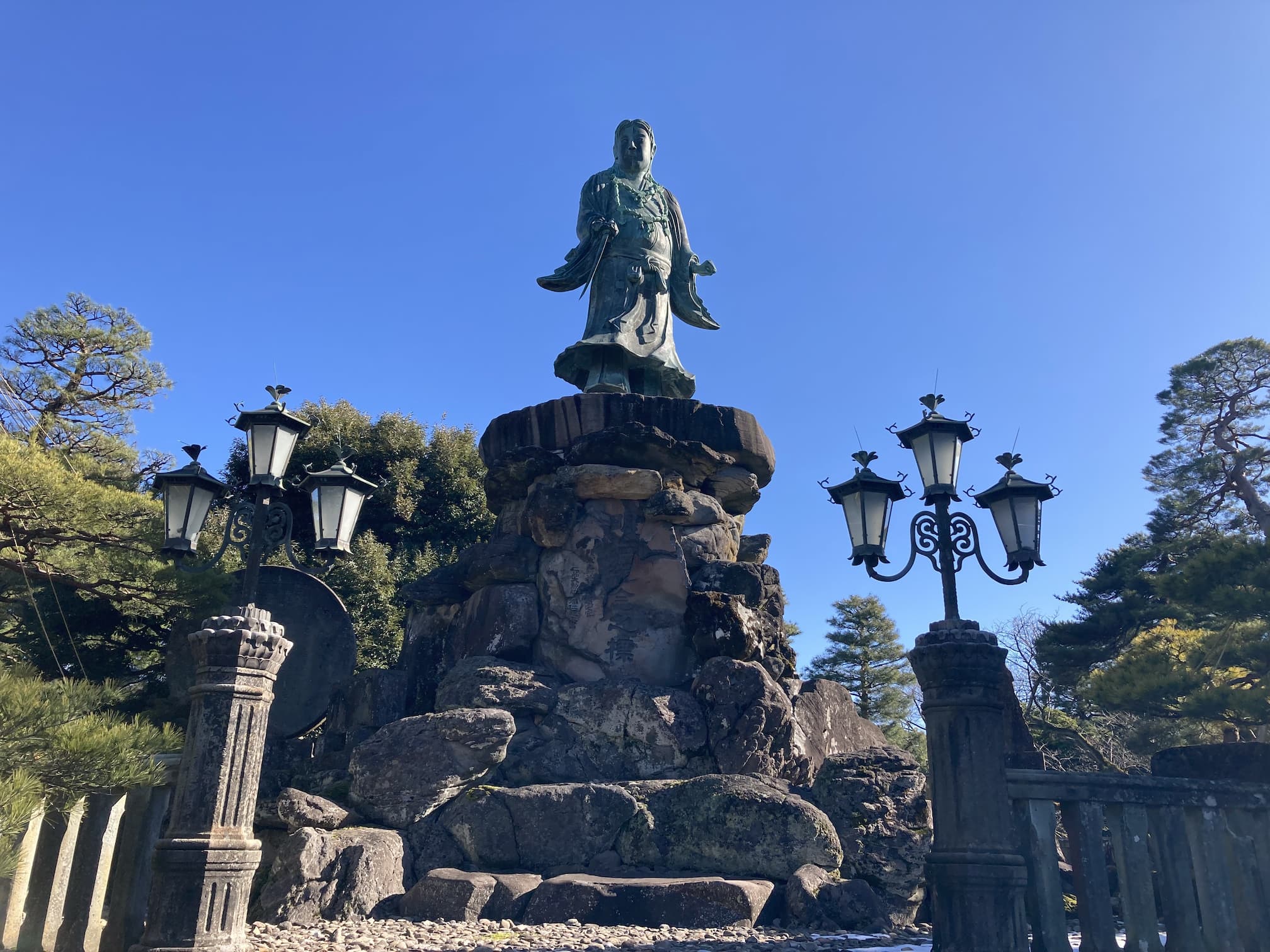
Welcome! I’m Mine, your local Japanese garden insider in Kanazawa. Welcome to the official feature page for the Statue of Yamato Takeru (Yamato Takeru-no-mikoto-zo)—Japan’s oldest surviving outdoor bronze statue, erected in Kenrokuen Garden to honor local soldiers who died during the Satsuma Rebellion!

Depicting a legendary prince from ancient Japanese mythology, this monument holds fascinating secrets—from its Ig Nobel Prize-winning “arsenic bronze” that prevents birds from landing, to the “three-way standoff” stones in its pedestal and its dramatic survival against post-WWII demolition orders.
✨ Jump Straight to the Secrets & Mysteries of Yamato Takeru Statue!
📍 Quick Navigation: Jump to Other Highlights
9. Statue of Yamato Takeru (Yamato Takeru-no-mikoto-zo)
9.1 Essential History & Key Facts
- Historical Purpose
The statue was erected about 150 years ago to honor local soldiers from Ishikawa who died in the Satsuma Rebellion, the largest civil conflict in Japanese history. - Hero Depicted
It portrays Yamato Takeru, a legendary hero from ancient Japanese mythology who symbolizes bravery and national origins. - Stone Base Design
The stone base uses snake-, frog-, and slug‑shaped stones arranged in a “three‑way standoff,” a traditional motif said to keep the structure stable because none can overpower the others. - Arsenic & Ig Nobel Prize
Later research revealed that the bronze contains arsenic, leading to an Ig Nobel Prize for the discovery that “birds won’t land on the statue.” - Postwar Survival
After World War II, the occupying forces ordered its removal as a militaristic symbol, but strong local opposition succeeded in preserving it.
9.2 Visitor Q&A (Popular Traveler Questions)
- Q1: Why is this statue so big?
It was built as a memorial to honor fallen soldiers, so the large size was chosen to give it a strong and dignified presence. - Q2: Who is this person supposed to be?
He is Yamato Takeru, a legendary hero from ancient Japanese mythology. - Q3: Why is this statue placed here?
This spot is the center of Kenrokuen, and it was chosen in the Meiji era as a place to honor the fallen soldiers. - Q4: Is that a sword he’s holding?
Yes, it is a sword. It represents the legendary “Kusanagi Sword,” which Yamato Takeru is said to have used to escape danger. - Q5: Do the stones under the statue mean something?
The stones resemble a snake, a frog, and a slug. According to local legend, they balance each other so none can move, symbolizing stability and good fortune.
9.3 Fun Backstories & Mysteries
Q1: Who Is This Statue?
- This is a legendary hero from mythology who is said to have subdued the whole of Japan about two thousand years ago.
- It’s easier to understand if you think of him as the Japanese equivalent of Hercules, or similar to the heroic figures found in King Arthur legends around the world.
- He appears in Japan’s oldest historical texts and is even sometimes described as an ancestor of the current Emperor.
- His name is Yamato Takeru. It’s a long name, but it is made up of three parts, each with its own meaning.
- “Yamato” refers to ancient Japan, “Takeru” means a brave warrior, and “Mikoto” is an honorific title meaning “one who is revered.”
- This statue was erected to commemorate roughly four hundred local soldiers who lost their lives in a major civil war during the early years of modern Japan.
- Since he himself was a hero who died in battle—one who “gave his life” to “bring peace” in ancient times—he may have been considered the ideal figure to honor their memory.
- But to be honest, I always felt a strange hesitation about explaining this statue, for reasons I couldn’t quite identify.
- When guests asked, “Who is this?”, I only gave the opening explanation. Recently, I finally realized why I had been avoiding the rest.
- It was because I couldn’t use my favorite joke here. Joking about the Emperor’s ancestors? Now that would be brave!
Official Links & Resources
Thank You & Message from Mine

👆 Did you enjoy discovering the secrets of the Statue of Yamato Takeru? To revisit other highlights or return to the main series hub, use the navigation buttons above!
🛡️ Travel Safety Notice: Enjoying Historical Paths with Peace of Mind
Kenrokuen and other historical Japanese landscapes feature ancient stone steps, stepping stones, and natural gravel paths. While breathtaking, unexpected trips or stumbles can occur. For international visitors exploring Kanazawa and Japan’s heritage sites, securing real-time travel health insurance is strongly recommended for seamless medical support during your trip.
⚔️ SafetyWing – Real-Time Travel Insurance for Global Travelers (Check Details)