Japanese History & Samurai Culture Watcher
Welcome! I’m Kotetsu, your local samurai culture insider in Kanazawa. Are you planning a trip to Japan or looking for unique spots in Kanazawa?
Forget dry history lessons and official guidebooks! Here, I’m sharing hilarious samurai backstories, hidden garden secrets, and human drama that you won’t find on standard travel sites or AI tours.
If these stories make you smile or spark your curiosity, be sure to drop by the Nomura Samurai House during your Kanazawa journey. We’re excited to welcome you—see you in Kanazawa!
🧭 Quick Navigation by Spot
- Q1. Background: “Why is there an exhibition room here?”
- Q2. Letter A: “What kind of thank-you letter is this?”
- Q2. Letter B: “What is valuable in this letter of gratitude?”
- Q3. Swords: “Were these swords actually used?”
- Q4. Stirrups (Abumi): “What was this display used for?”
- Q5. Tobacco Tray (Tabako-bon): “Is this some kind of special craft?”
- Q6. Currency Display: “What do the lines connecting these coins represent?”
- Q7. Naginata: “What is this long stick?”
- Q8. Fief Certificate: “What is the purpose of this document?”
- Q9. Ancient Map: “What does this map represent?”
- Q1. Tea Experience: “How do people have tea in this room?”
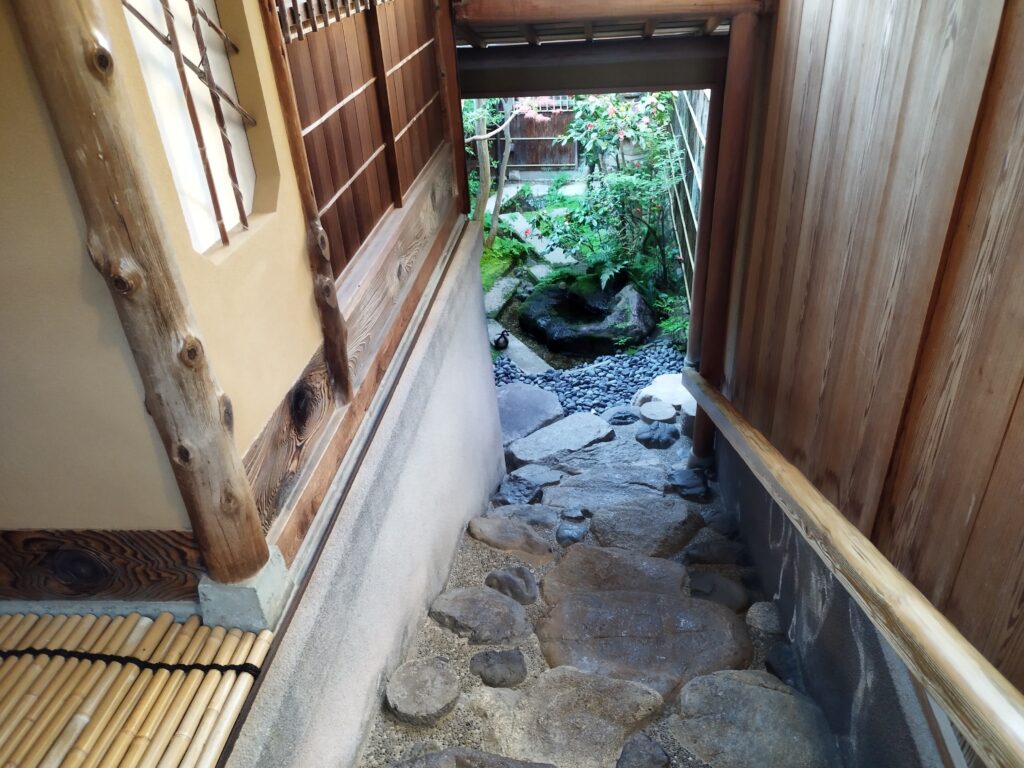
- Q2. Entrance: “Why is the entrance so narrow?”
- Q3. Ceiling: “Isn’t it a very unusual ceiling structure?”
- Q4. Ante-Room Floor: “Does this floorboard have any special meaning or characteristics?”
- Appendix / Recommended Guides & Travel Preparation
- Contact & Inquiries
1. Overall Guide to This Blog 🌲
This blog post is organized into three main steps to help you easily navigate the stories and backstories of Nomura Samurai House:
🧭 【Step 1】 What is Nomura House? “3-Tier” Quick Answers
Concise answer examples for the frequently asked question, “What is this Nomura House?”, structured into three tiers depending on your knowledge level of Japan.
📋 【Step 2】 Essential Basic Information
Key background information summarizing the history, structure, and highlights of the Nomura Residence before entering each spot.
🧭 【Step 3】 Area-by-Area English Explanation
Short commentary stories tailored for each popular attraction (Entrance, Garden, Tea Room, etc.). Based on common questions, each section features a formal explanation part and a lighter, conversational part for engaging dialogue.
2. What is Nomura Samurai House? “3-Tier” Quick Answers
Before stepping inside, here are concise and convincing quick-summaries for the frequently asked question, “What is the Nomura House?”, structured in tiers according to your interest and knowledge level.
👉 Although the Nomura House is well-known among international visitors and many may have seen photos online, they are often overwhelmed by all the information and don’t quite understand it. Presenting a clear summary from a local guide’s perspective ensures a smooth and engaging blog tour.
2.1 In a Nutshell (Standard Overview)
👉 Comparing the Kaga Domain to a modern corporation makes the high status and prestige of the Nomura family instantly understandable for international guests like you.
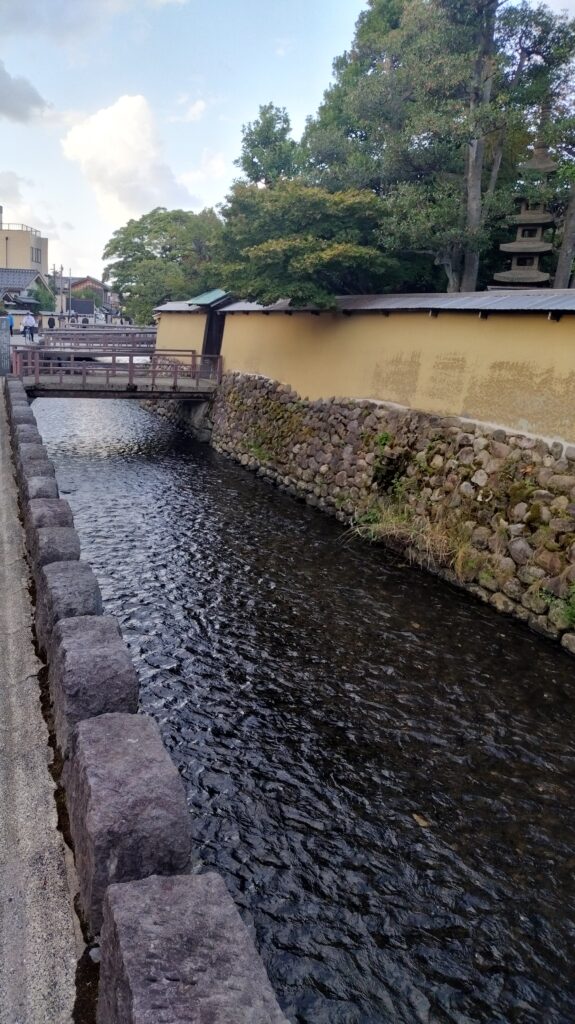
- This site is a reconstructed residence that offers a glimpse into an upper-class samurai home from the Edo period.
- The Nomura family were high-ranking retainers serving the feudal lord for generations—equivalent to senior corporate executives today.
- You can appreciate the lifestyle and aesthetic refined by high-ranking samurai through its garden, tea room, and ancestral artifacts.
- The garden and tea room are especially recommended, as simply sitting there makes you feel like a samurai yourself.
2.2 Simplified Summary (For Non-Native English Speakers)
👉 A concise version for international guests whose native language isn’t English—for those who might not fully understand explanations using complex historical jargon and terms.
- This is a special site—the prominent samurai residence in this district open to the public.
- It was home to high-ranking samurai who held top positions in the domain.
- Inside, the beautiful garden and tea room offer a real glimpse into the daily life of the samurai.
2.3 One-Liner Takeaways (For Busy Visitors / Americans)
👉 A super-simple explanation for an American type who tends to like short sentences, preferring “fall” to “autumn”.
- This place feels as if a samurai were still living here until recently.
- Unlike the meditative Zen gardens of Kyoto, this garden reflects the active, daily life of a samurai.
3. Basic Information
Here, we’ve compiled a list of 10 key points to keep in mind about the Nomura Residence before you visit your intrigued spots and stories in this blog. You can use this list as a basic checklist not only for this blog but also when reading the official website or other sites.

- The Prominent Samurai Residence Open to the Public: Located in the historic Nagamachi district famous for earthen walls and row-house gates, this is the premier residence where visitors can enter authentic historic rooms and view the garden directly from inside.
- High Status of Upper-Class Samurai: The Nomura family were high-ranking retainers with a 1,200-koku stipend who served the Maeda clan for generations, reflecting the prestigious lifestyle of senior samurai.
- Globally Acclaimed Japanese Garden: Highly ranked by international publications, this compact landscape garden features a rich three-dimensional composition of streams, waterfalls, lanterns, and ancient trees.
- Stream Drawn from Kanazawa’s Oldest Canal: The water flowing through the garden is drawn directly from the historic Ono-sho Canal, creating a dynamic auditory and visual ambience unique to samurai estates.
- The Prestigious Jodan-no-ma (Audience Chamber): Built specifically for receiving the feudal lord, this grand chamber demonstrates master craftsmanship with coffered cypress ceilings, rare woods, and paulownia flooring.
- Glass-Paneled Shoji Screens: Installed in the early Meiji period to view the garden from indoors, these sliding screens incorporate antique imported glass, representing a fusion of Japanese and Western design.
- A Rare Second-Floor Tea Room (Fukyuan): Uniquely situated on the upper floor, this tea room allows guests to relax on tatami mats while overlooking the peaceful garden below.
- Historic Artifacts in the Onikawa Library: The exhibition room houses ancestral treasures, including authentic combat armor, fine samurai swords, and official letters from famous historical warlords.
- The Guardian Tree (400-Year-Old Mountain Myrtle): Planted by the first head of the family, this venerable 400-year-old tree survived Kanazawa’s harsh climate and remains a central icon of the garden.
- Preservation and Restored Heritage: Though reduced from its original scale after the samurai era, key structures were relocated here, preserving the authentic ambiance of an upper-class samurai residence.
4. Entrance Area
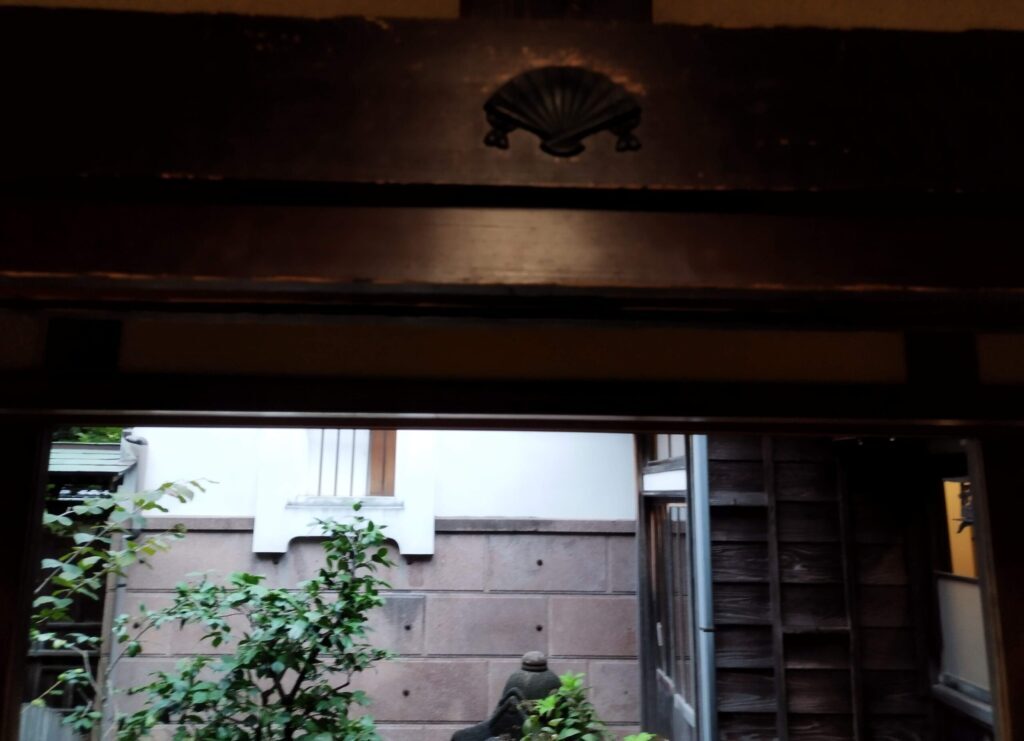
Upon entering the lobby, visitors’ eyes are immediately drawn to the suit of armor actually worn by the first head of the family, Denbei Nomura. Since the entrance is narrow and often crowded, we local guides usually avoid giving lengthy explanations; however, in this blog post, I’ll kick things off with an interesting story that I’d actually like to share but usually hold back on. Since you don’t have to worry about disturbing others, please take your time and enjoy the story.
Q1. Armor: “What is this armor?”
👉 Did you know that the helmet of a samurai’s armor is called a “kabuto,” which is the same term used for the rhinoceros beetle? Also, the stag beetle (kuwagata) actually has a connection to samurai as well. This two-part story features a serious explanatory section in the first half that weaves these facts in, followed by a humorous section in the second half, delivered in a unique style by a local guide.
- This is the actual armor worn by the first head of the Nomura family.
- He earned recognition for his valor in battles while wearing this armor, which led to his promotion as a senior samurai.
- This board provides insights into the details of the battles he participated in.
- The lord of Kanazawa Castle was in a period of significant instability at that time.
- The head of the Nomura family was said to have fought with a spear, his specialty.
- Unlike the ornate armor often displayed in museums, this helmet is both compact and practical.
- In Japan, the helmet part of the armor is called “kabuto”, meaning a beetle, and its frontal ornament is called “kuwagata”, meaning a stag beetle.
- Generally, this ornamentation and size of “kuwagata” indicate the status of the samurai, but unlike stag beetles that usually have a pair of horns, this one is closed at the end.
- As he was a low-ranked samurai at the time, he likely felt he had no other way to survive but to make his way with his spear, equivalent to a beetle’s horn.
- The closed circle of the stag beetle ornament on his helmet might symbolize the dilemma he faced at that time!
Q2. Armor: “Was he really as small as this armor suggests?”
👉 Since I get asked this question quite often by international guests, the first part offers a proper, trivia-style explanation, while the second part is a humorous segment that incorporates a Japanese proverb. The takeaway here is that you’ll learn what tigers mean to Japanese people before you visit Japan. You might even be able to brag about it to your friends.

- Samurai armor comes in two main types, each with a distinct purpose in both appearance and function.
- One is the luxuriously conspicuous armor of a general or a high-ranking commander, intended to boost morale on the battlefield.
- The other is functional armor for front-line soldiers, like infantrymen, which prioritizes agility and ease of movement.
- This armor is made to be lightweight and simple, with minimal decoration.
- According to many studies, the average height of a Japanese man during the samurai period was about 5’1″ to 5’3″ (155 to 160 cm).
- Armor was custom-made to fit the individual’s physique, so it’s natural that the armor on display would seem small to a modern viewer.
- Japanese proverbs say that just as a tiger leaves its skin behind when it dies, a person should leave behind a good name.
- Although this ancestor might have been small in stature and unremarkable in appearance, he not only successfully left behind his name but also his armor, just as a tiger leaves its skin.
- Even today, his spirit seems to reside in his armor, protecting his family.
- As the English saying goes, he is literally in armor—ready to defend his legacy.
Q3. Living Spaces: “Where are the kitchen and bedrooms in this house?”
👉 This is a question often asked at the entrance as guests are leaving this house. The first part explains the historical background of the reduced-size property of the Nomura family, while the second part is a humorous story that incorporates idioms using the Japanese word “shikii” (threshold).
- You might be wondering where the family actually lived, cooked, and slept.
- In fact, what you see today is only a small surviving fraction of the original Nomura residence.
- Originally, this estate spanned a vast area—about 3,000 square meters—including extensive living quarters, kitchens, and servant areas.
- When the samurai era ended, many families faced financial hardship and had to sell off large portions of their land.
- As a result, the magnificent audience chambers and garden were miraculously preserved or restored, while the everyday living quarters were lost over time.
- Presumably, there was no longer enough land, historical documentation, or budget to rebuild those private spaces.
- However, in other regions of Japan, some samurai living quarters still survive, giving us a good idea of their daily life.
- Their kitchens had exposed high ceilings without ceiling boards, creating a surprisingly spacious feel—and the hallways and entrances were likely much larger than what you see here.
- Back then, this main entrance was spacious, but only a privileged few could enter—it had a genuinely “high threshold,” as we say in English and Japanese.
- Today, it’s open to everyone, so it’s a “low threshold”—though since it’s always crowded and hard to get in, maybe we should call it a “narrow threshold”!
5. Onikawa Library Area
👉 This is a valuable exhibition room where visitors can view the Nomura family’s treasured artifacts. However, compared to the eye-catching, lavish interiors and gardens, it can come across as rather additional. Some visitors even feel that having an exhibition room inside a samurai residence is out of place, and others have posted comments saying things like, “That exhibition room wasn’t interesting at all.” Unless its significance is properly explained, its value is hard to convey. In this blog, I’ve included stories I hope will be read by international visitors who left the Nomura residence in a rush amid the crowds, without truly understanding its significance. Since there’s a lot of content, please take your time and enjoy it bit by bit, starting with the titles that catch your interest.
Q1. Background: “Why is there an exhibition room here?”
First, an introductionary story of this exhibition room. The first half explains the historical facts regarding how samurai artifacts have been preserved, serving as background while the second half lightly tell the value of our guiding sutaff this behind this exhibition room.
- In the samurai residence area, high-ranking samurai maintained close ties with lords, aristocrats, and wealthy merchants.
- They amassed impressive collections of rare and valuable items.
- When the samurai era came to an end, many of them faced financial difficulties and were forced to sell their land and family possessions.
- As a result, numerous precious samurai treasures were dispersed.
- The Nomura family, however, managed to preserve ancestral swords and letters.
- Visitors here have a unique opportunity to admire these samurai-era artifacts, typically found only in renowned museums.
- The best part? It’s more affordable than visiting those heavily advertised and staffed museums.
- A descendant of the Nomura family successfully preserved their ancestral home, overcoming various challenges and choosing not to turn it into a large public museum.
- Moreover, as local guides, we can offer captivating and compelling explanations at a fraction of the cost of expensive museums!
- Perhaps this is because we share a similar mindset and position as the lower-class samurais of that time, who had no choice but to serve.
Q2. Letter A: “What kind of thank-you letter is this?”
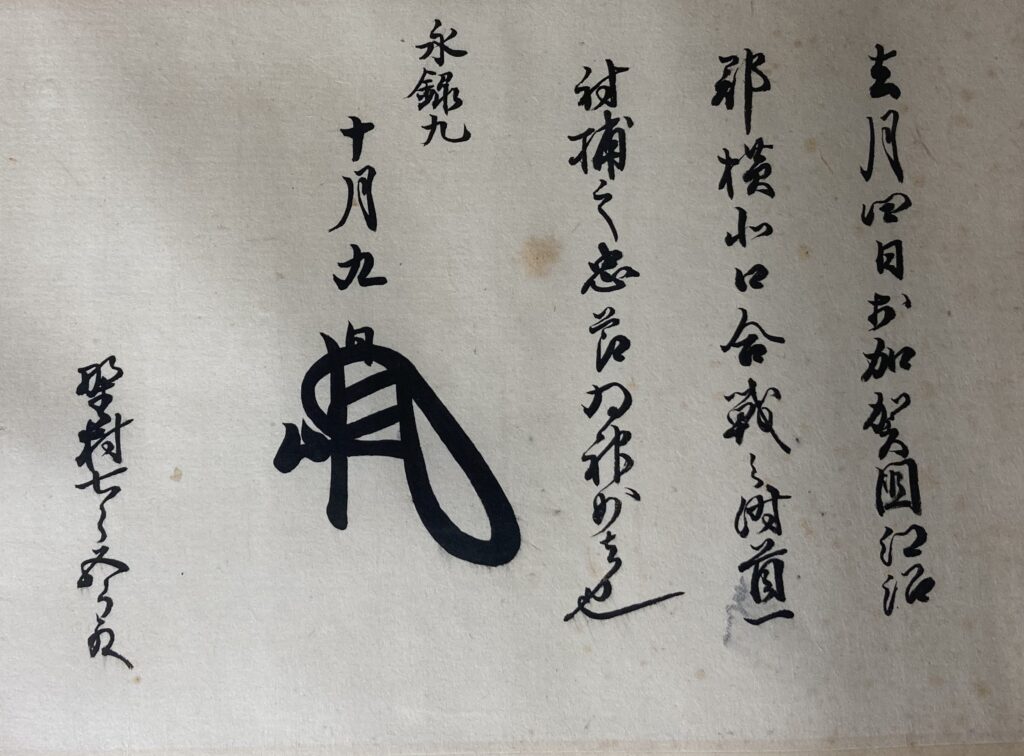
👉 In this section, we’ll take a look at a letter of thanks written by Asakura Yoshikage, one of the prominent daimyo of the Sengoku period. The first half introduces the background of this letter of thanks and explains why it is on display here, while the second half wraps up with a light-hearted joke based on samurai values regarding spoils of war.
- This letter was sent over four hundred years ago by a famous Sengoku‑period daimyo to the first head of the Nomura family. The ancestor of the Nomura household apparently fought in several battles as a subordinate of this warlord.
- In this brief message, the daimyo expresses both astonishment and gratitude for the fact that the Nomura ancestor brought back the head of an enemy commander from a particular battle.
- Remarkably, just a single line in this letter vividly conveys the values and customs of samurai life at the time.
- Overseas visitors, in particular, often react with great interest—or with a wonderfully wry smile—when they read it, so we guides tend to share it often.
- That said, I usually refrain from adding too many extra explanations. After all, topics involving the neck are not always ideal for light sightseeing conversation.
- The neck is, quite literally, a vital part of the human body, directly tied to life itself. Because of that, in both Japanese and English, it often appears as a symbolic expression for “social status,” “death,” or “responsibility.”
- But the real reason I avoid over‑explaining is simple: the Nomura family has preserved this letter with great care for centuries. That alone speaks for itself.
- It is a genuine piece of evidence of their ancestor’s martial skill and samurai spirit.
- A single line on a single sheet of paper is part of what gives this house its unique value. So once again, I would like to express my heartfelt gratitude.
- As the daimyo himself wrote: “We are very happy that you brought us his head.” And even today, well… we guides are still very happy that he brought it too.
Q2. Letter B: “What is valuable in this letter of gratitude?”
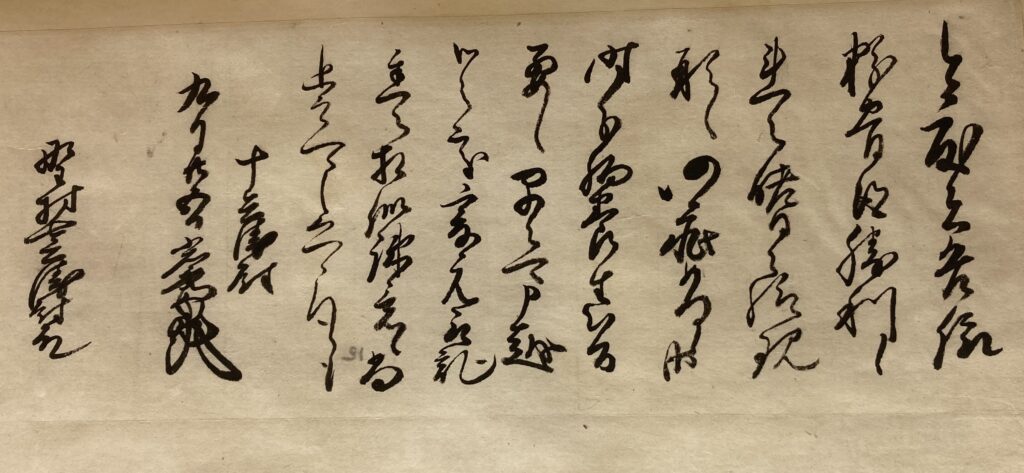
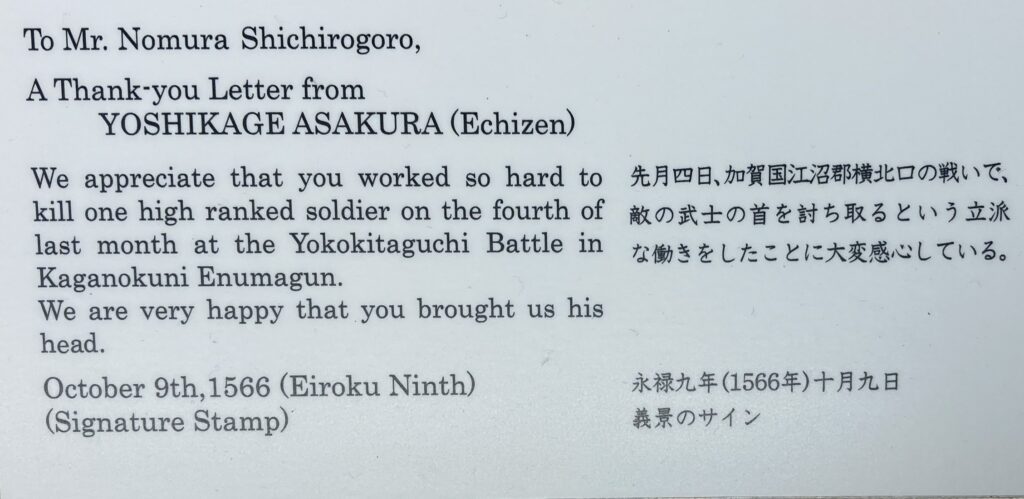
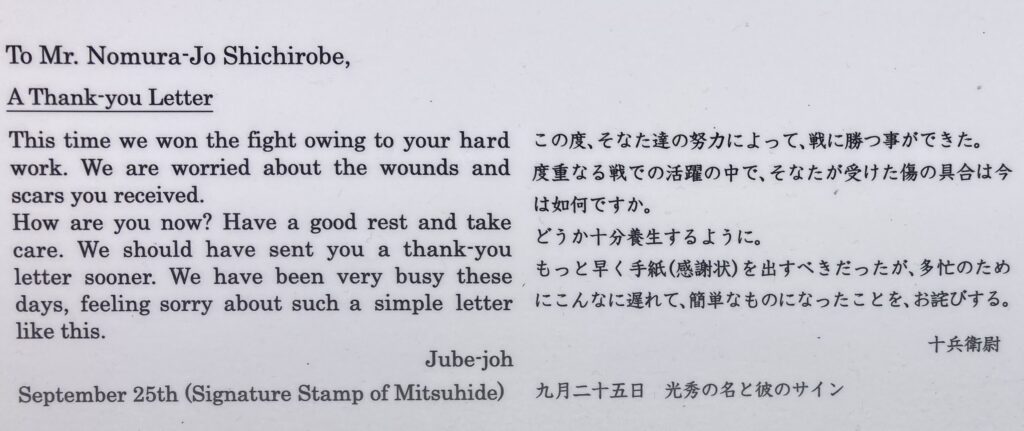
👉 In this article, we’ll take a look at the letter of thanks written by Akechi Mitsuhide, the daimyo who has become synonymous with treason in Japanese history. In the first half, we’ll outline the historical background, and in the second half, we’ll explore—from a guide’s perspective and in the style of a mystery novel—why the nomura family preserve such a dangerous document.
- This is a letter of gratitude from a samurai known for one of the most notable betrayals in Japanese history. Just as “Judas” and “Brutus” are well-known examples in world history, he holds a similar position in Japanese history.
- He sent his own troops to kill his boss, who was then the de facto king of Japan, while the latter was resting. He had been so obedient and loyal to that king up to that point that his betrayal is still considered a mystery.
- At the time of the betrayal, before the lord of Kanazawa Castle assumed his position, he was subordinate to the murdered king and a colleague of the traitor.
- If the king had not met his unfortunate end, there might not have been a Lord of Kanazawa Castle and its retainers, including the Nomura family.
- The king’s tyrannical nature led to the punishment or forced removal of many of his subordinates who failed to meet his expectations, with the most severe consequence being ordered to commit seppuku (ritual suicide).
- Experts suggest that fear, rather than respect or rationality, compelled many of his men to follow him. Both the traitor and the subsequent lord of Kanazawa Castle might have faced their demise sooner or later.
- But why is this letter of gratitude from the traitor addressed to the first head of the Nomura family?
- At the time, he was serving under the traitor. Shortly after the betrayal, however, the traitor himself was killed by another colleague, and the first head of the Nomura family quickly distanced himself from him.
- So why was this letter preserved at all, when keeping proof of a close relationship with such a notorious figure could have been extremely dangerous?
- Perhaps the first head chose to preserve it deliberately—harboring a quiet sense of gratitude toward the traitor, at least in his own mind. Now, try reading this letter again by mentally switching the sender and the receiver.
Q3. Swords: “Were these swords actually used?”

👉 Since there are so many sword enthusiasts visiting from overseas, this story incorporates some wordplay on that theme. The first half explains the functionality and artistic value of Edo-period swords, while the second half uses quotes from the Bible to offer a light, philosophical take on the Japanese cultural concept of the “samurai spirit.”
- The late Samurai period was marked by relative peace, leading to the creation of many ornamental swords.
- It’s astounding that these swords are more than two or three hundred years old because they retain both functionality and beauty.
- It could be considered the last source of pride for the Samurai that they didn’t sell these swords, even amidst the decline of Samurai families.
- “A sword is the soul of a samurai” held great value. So, no matter how dire their circumstances, it might have been unthinkable to “sell their souls”.
- Samurai stood in contrast to merchants who prioritized survival, even if it meant “selling their souls to the devil”.
- It could be said, then, that the contest for leadership between the samurai and the merchants was predictable from the beginning.
- For samurai who had survived by the sword for nearly a thousand years, the weapon became a legacy of pride, even in peaceful times.
- This recalls the famous biblical saying, “Live by the sword, die by the sword.”
- One might argue that the samurai proved this true across time and space—not necessarily in the literal sense.
- They didn’t just die by the sword; they clung to it, refusing to sell, even when it might have been wiser to trade their legacy for survival.
Q4. Stirrups (Abumi): “What was this display used for?”

👉 Here’s the story behind the silver-inlaid stirrups—a topic we’re often asked about. The first half explains their function and the craftsmanship involved, while the second half features some humorous banter tied to Kanazawa’s famous gold leaf tradition.
- This is a decorative footrest that was placed on both sides of the saddle.
- Stirrups were essential for maintaining posture during the violent movements of a horse in battle, allowing the rider to effectively attack opponents.
- But this particular stirrup is decorated with embedded silver wire, not for practical use.
- Similar to the swords mentioned earlier, stirrups also became adorned with decorative features during the peaceful samurai era.
- It was designed and crafted by skilled artisans, a testament to Kanazawa’s long history of producing talented craftsmen.
- While silver is commonly used for rings, it might seem extravagant to use such a valuable metal for stirrups, which are primarily for foot placement.
- However, in Kanazawa, a well-known town famous for its gold leaf craftsmanship dating back to the samurai era, metals other than gold may not have been as highly valued.
- Indeed, people in Kanazawa would never consider embedding gold in stirrups for “foot” placement.
- For the people of Kanazawa, gold holds utmost importance and is reserved for more significant applications.
- This is perhaps why today we see many people delighting their taste buds and eyes alike with gold leaf ice cream!
Q5. Tobacco Tray (Tabako-bon): “Is this some kind of special craft?”

👉 Reactions to this cigarette box fall into two categories: those who recognize what it is at a glance, and those who ask about it and are surprised by the answer. The first half explains the cultural atmosphere of that era, while the second half humorously highlights the contrast with today’s anti-smoking trend in Japan (where smokers are treated almost like criminals). It also reflects my own experience with the difficulty of finding a smoking area for guests.
- This was originally a portable kit designed for enjoying cigarettes anytime, anywhere.
- The kit included all the essentials for smoking – a firebox, ashtray, smoking pipe, and a tobacco container – all neatly packed in a single box.
- In contrast to today’s smoke-restriction era, smoking during the Samurai era was a social activity akin to the tea ceremony.
- These kits were even used during tea ceremonies to entertain guests.
- Much like high-quality incense sticks, the fragrant smoke from these cigarettes was introduced into the tea room, allowing everyone to savor the aroma.
- They were often adorned with maki-e decoration and remain popular as antiques to this day.
- The glory of the samurai of that era has vanished like the dissipating smoke from cigarettes, leaving behind only this tobacco tray.
- Yet, the samurai of that time might have been content not to experience the smoking restrictions of the modern era.
- In modern Japan, smokers are isolated in a limited and confined space, smoking cigarettes shoulder to shoulder with each other.
- Just like the samurais trapped in the smoke of their burning castle.
Q6. Currency Display: “What do the lines connecting these coins represent?”
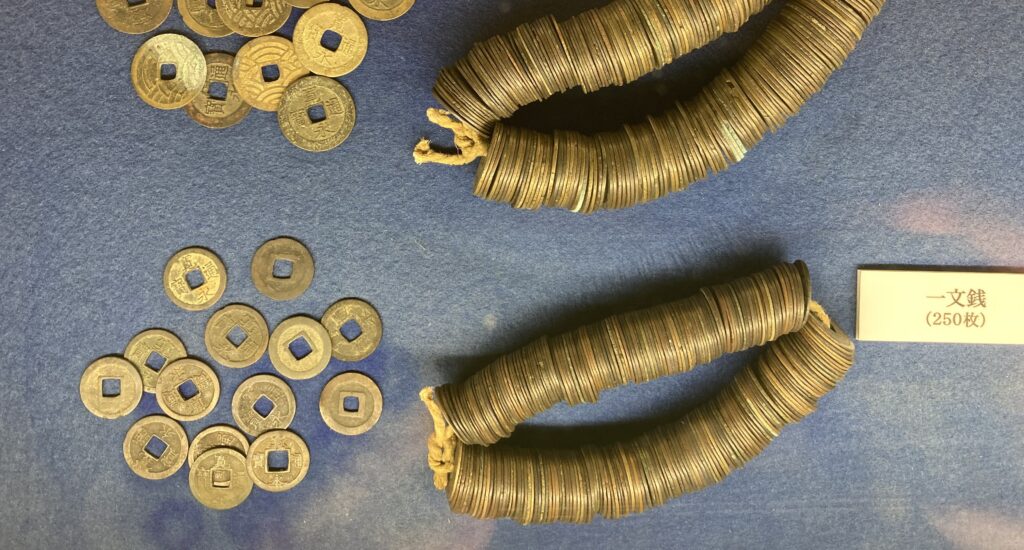
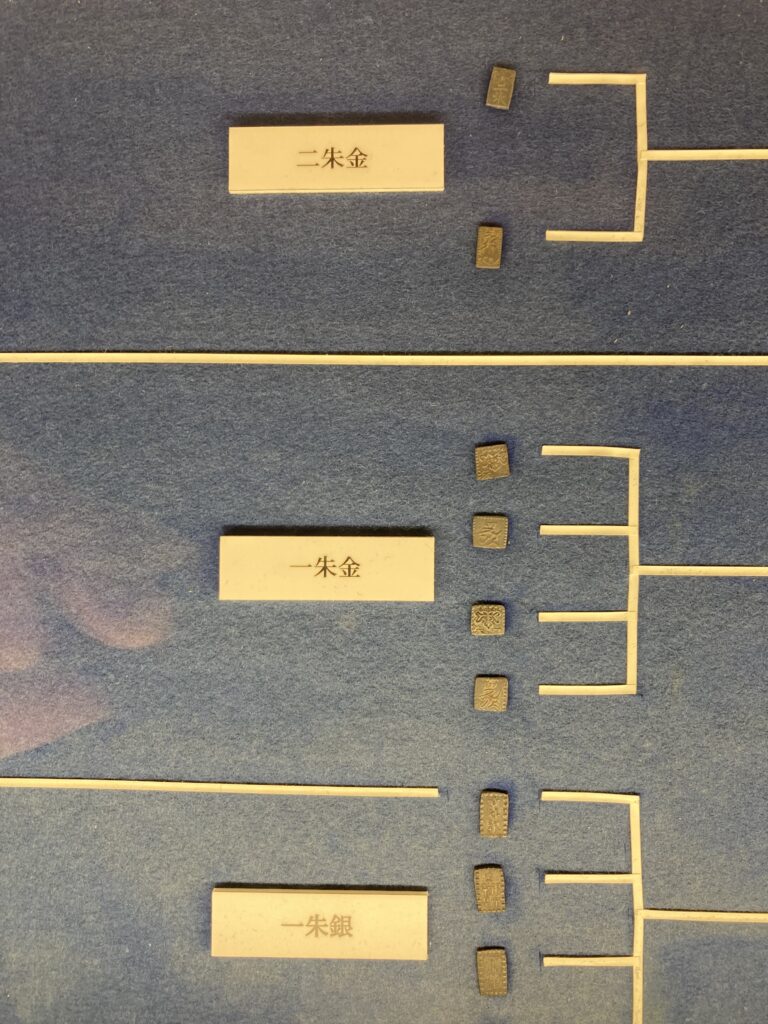
While many guests are satisfied simply with seeing the exhibition of coins from the samurai era, I’ve compiled some even more interesting points for those who want to dig a little deeper. The first half explains Japan’s monetary system during the feudal era and its rice-based economy, while the second half lightly touches on the issues of rice shortages and high prices in modern Japan with a light humor.
- These are Samurai-period coins arranged with the most valuable koban—gold coins—on the far right, and the less valuable ones on the left.
- The yellow lines connecting them indicate that they are of equivalent value.
- Historically in Japan, binary and quaternary systems were used. Coins from that period, for example, often followed a quaternary system rather than the decimal system.
- In practice, it was simpler to count money by halving coins—one half, then another—than by using the decimal system, which made fractional calculations more cumbersome.
- At the time, Japan’s monetary system was still developing, and since trade was often based on the value of rice, there was little need for advanced systems like decimal-based calculations.
- In fact, samurai were paid in rice, and both family status and individual rank were judged by the amount they received. Rice held a stable value, much like gold today.
- But with the end of the samurai feudal era, rice lost its role as currency.
- Even more sadly, since the 1950s, rice consumption has declined further with the growing popularity of bread in Japan.
- In the samurai period, rice was the soul of the Japanese people—its value went beyond money.
- Perhaps because Japan neglected rice for so long, it was punished by the god of rice. What was once priceless has, quite literally, become riceless.
Q7. Naginata: “What is this long stick?”
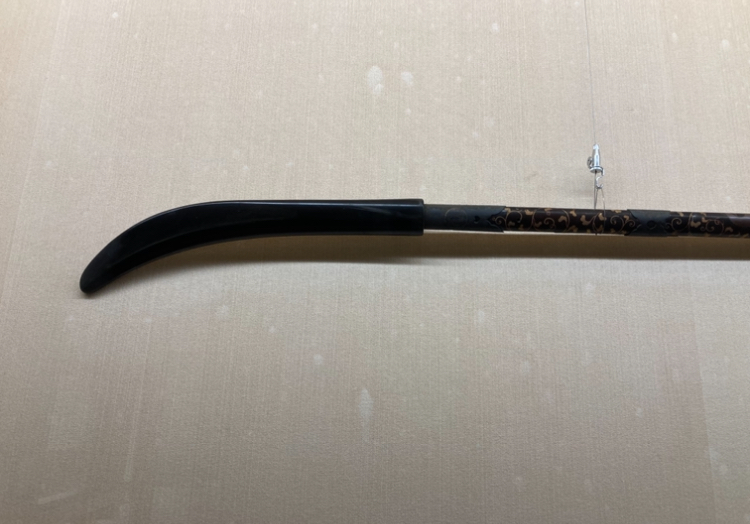
Since women often ask me about this, I put together this story. The first half is an explanatory section based on my actual explanation while the second half is a lighter section that delves a little deeper.
- That’s a naginata, a traditional Japanese weapon with a curved blade on a long handle.
- Its name literally translates to “mowing sword,” and it is often compared to a halberd or glaive in Western weaponry due to its similar form and function.
- The naginata was primarily used by samurai women (the wives and daughters of samurai families) for self-defense and to protect their homes.
- Unlike swords, which are made for close-quarters combat, the naginata’s long handle allowed the user to keep their distance from an opponent.
- As the long handle provided leverage, even a less physically powerful person could use it effectively to fend off an attacker. We find that many of our female guests are very interested in and pleased by this fact.
- Perhaps it’s not just because the weapon was used by women, but also because of its beautiful, graceful, flowing shape—a surprising trait for a weapon.
- Every samurai’s home proudly displayed a naginata, and everyone in samurai society knew it would be used in times of crisis.
- Even if it was never actually used, the naginata was considered an ideal defensive weapon. Its mere presence conveyed formidable protective power—like a guardian deity quietly standing watch.
- Perhaps that’s why our female guests often smile when they grasp the naginata’s true significance.
- They might instinctively feel reassured—after all, this samurai house is clearly well-defended, even today!

Q8. Fief Certificate: “What is the purpose of this document?”
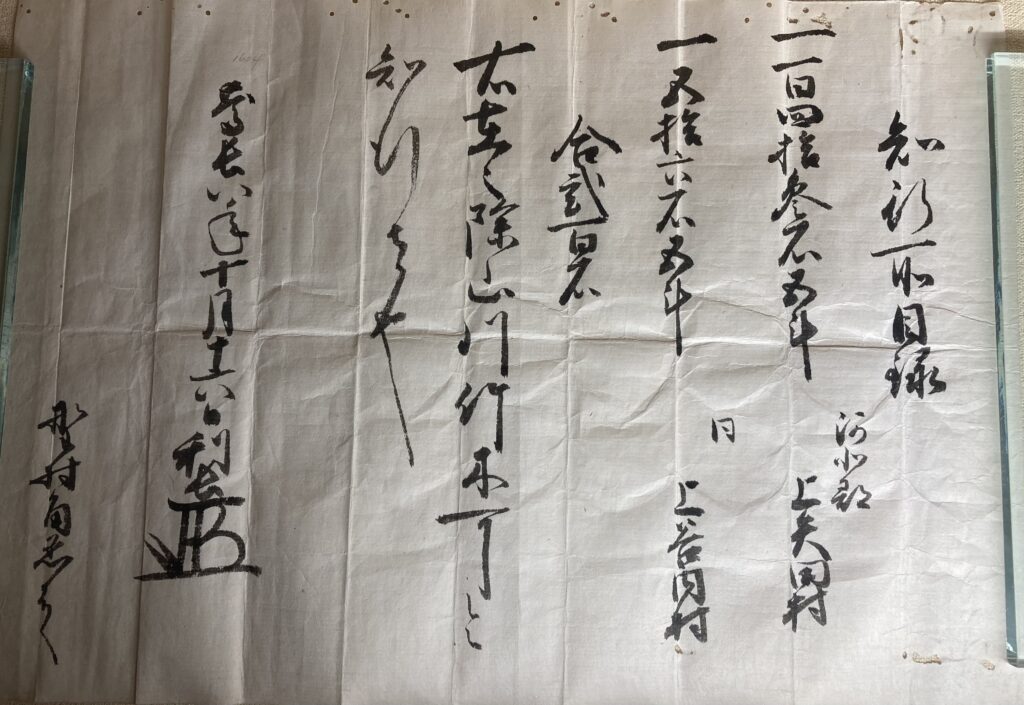
As mentioned in this story, since I only explain this certificate to a select few guests, I compiled it into a narrative so I could share it on this virtual tour. The first half explains the historical significance of the land grant document, while the second half—which I’ve wrapped up with a touch of humor—explains why I don’t talk about it very often, incorporating my genuine feelings as a guide.
- This is an official certificate issued by the lord of Kanazawa Castle about four hundred years ago. It confirms that the Nomura family had the authority to manage a particular domain.
- The land was located on the outskirts of Kanazawa, along the main route to the neighboring province, and it served as an important strategic point in times of emergency.
- Even today, the area is known for rice cultivation and its famous spring water. The “two hundred koku” written here refers to the rice yield of that land.
- One koku is the amount of rice one person consumes in a year—about 150 kilograms—so in theory, it could feed two hundred people.
- The year recorded on this document corresponds to the establishment of the shogunate in Edo, present-day Tokyo.
- At that time, the lord of Kanazawa Castle was suspected of treason by the new regime. This region, ruled by the Kanazawa lord, was known as the “million‑koku domain,” the wealthiest in the entire country.
- Throughout history, supreme rulers have always wanted direct control over prosperous regions, and the shogunate often fabricated accusations of rebellion as a convenient excuse.
- This document is a primary historical source showing the trust the lord placed in the Nomura family. Starting with this grant, they continued to receive land and eventually built this magnificent residence.
- However… many visitors don’t show much interest in this document, and even local guides aren’t always eager to explain it. The worry behind that is quite understandable. After all, how frightening that cold reaction must be.
- No matter how wonderful or historically valuable a document is, in the end, it’s still just words “on paper”, right?
Q9. Ancient Map: “What does this map represent?”
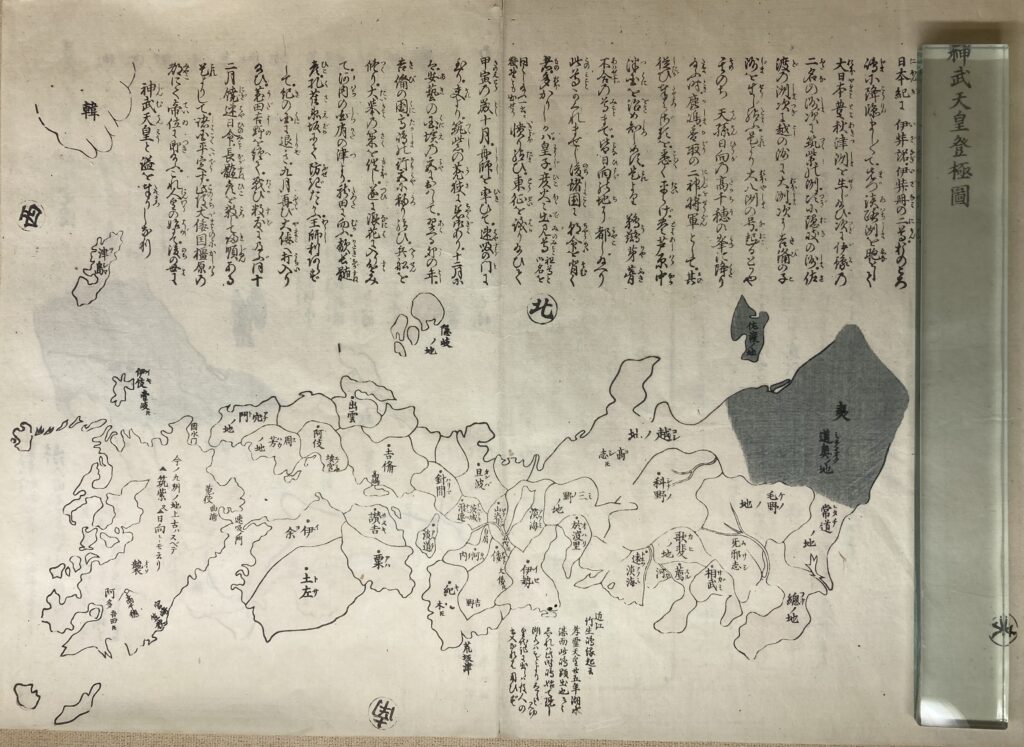
I often explain this map, but I don’t usually go into great detail, considering the crowd in the room. I hope you’ll enjoy this story in this virtual tour. The first half features a commentary on a best-selling map in the Edo period, while the second half uses humor to illustrate that the risks of relying too heavily on maps remain the same even as times change. I’m including this as a reminder to myself not to rely too much on Google Maps!
- This was one of the best‑selling maps of the samurai era.
- It gives a quick, visual summary of Japan’s two thousand years of history and shifting power structures—from the mythical age of the first Emperor (Emperor Jimmu) to the samurai era.
- Its quality was so impressive that it even received an official recommendation from the top authority of the time, which was quite a sensation.
- Because it remained popular for so long, you can still find copies today in used bookstores for tens of thousands of yen.
- It makes perfect sense that the Nomura family, who managed the local domain, owned this map.
- For strategists in military, economic, and administrative fields, it was basically the “Google Maps” of early modern Japan—though, of course, only the ruling class had access to it.
- But while this map offers a broad geopolitical view, it tells us nothing about the future. And then, suddenly, the samurai era ends.
- In that sense, Google Maps might not be so different. It’s become so convenient that people have stopped thinking about directions altogether.
- And when a natural disaster cuts off cloud services, people finally realize it:
- If you rely too much on maps, you lose your sense of direction the moment they disappear—just like the samurai.
6. Japanese Garden Area
Many international travelers arrive at the Nomura House specifically to see this world-renowned landscape garden. Sitting quietly on the veranda with a view of the stream is a serene experience. Here are fascinating stories behind the garden’s lively water, compact 3D spatial design, and 400-year-old surviving tree that you won’t find in standard guidebooks!
Q1. Water Source: “Where does the water in this garden come from?”
Unlike the gentle trickles of aristocratic Zen gardens in Kyoto, this samurai garden features a dynamic, rushing stream. Here is the backstory behind its unique water source and lively sound.
- A large irrigation canal has been maintained in this former samurai residence area for over 400 years.
- Originally, this canal was used to transport heavy timber when samurai residences were first constructed in this district.
- Over time, many samurai families, including the Nomura clan, diverted water from this canal to create private streams in their own gardens.
- The garden stream here is one such example, and the stone water channel flowing in front of the house is a direct remnant of this historical system.
- Before the residence was restored to its current compact footprint, this estate spanned roughly 3,000 square meters.
- Naturally, the original samurai garden would have been much larger and even more expansive than what we see today.
- Although much smaller now, the garden still retains a distinctive, energetic atmosphere unique to high-ranking military commanders.
- The design philosophy originated from a prominent samurai who was also a refined cultural figure, which explains its sophisticated balance.
- Unlike tranquil aristocratic gardens with slow, quiet trickles, this meandering stream creates a lively, refreshing sound fitting for a samurai estate.
- It operated on a purely natural, sustainable water supply long before modern electric pumps existed!
Q2. Open Veranda (Nure-en): “What makes this compact garden so captivating?”
How does a garden covering such a limited space manage to feel like a deep mountain valley? Here is how samurai landscape designers used 3D spatial tricks and natural harmony to create an illusion of boundless space.

- Although the garden footprint is small, the dense, three-dimensional arrangement of each component makes it appear much larger, creating a sense of natural openness.
- The well-balanced composition of ancient trees, stone lanterns, rock formations, and the meandering stream imparts a deep feeling of unity and visual stability.
- Colorful carp glide silently through the clear water, their quiet movements harmonizing with the lively splash of the small waterfall.
- Due to its compact space, it was designed specifically for viewing while seated on the open veranda (nure-en) rather than for strolling.
- The large Mountain Myrtle tree standing before you is over 400 years old.
- The first head of the Nomura family originally attempted to plant species brought from his hometown.
- Kanazawa’s harsh winter climate and unforgiving soil proved extremely challenging, claiming most of those transplanted trees.
- This Mountain Myrtle is one of the few species that survived, standing today like a silent guardian deity of this small garden.
- Much like the first head of the family who endured fierce battles, this modest tree quietly protected the estate through centuries of change.
- If the samurai had planted overly delicate or expensive pine trees, they might have been sold off during hard times, and this garden wouldn’t exist today!
Q3. Mountain Myrtle Berries: “Which one is the 400-year-old tree from the website?”
Known in Japanese as “Yamamomo” (mountain peach), this rare 400-year-old tree produces sweet and tart berries. Here is the funny backstory of why this ancient survivor is still thriving—and why you might want to keep your mouth watering!
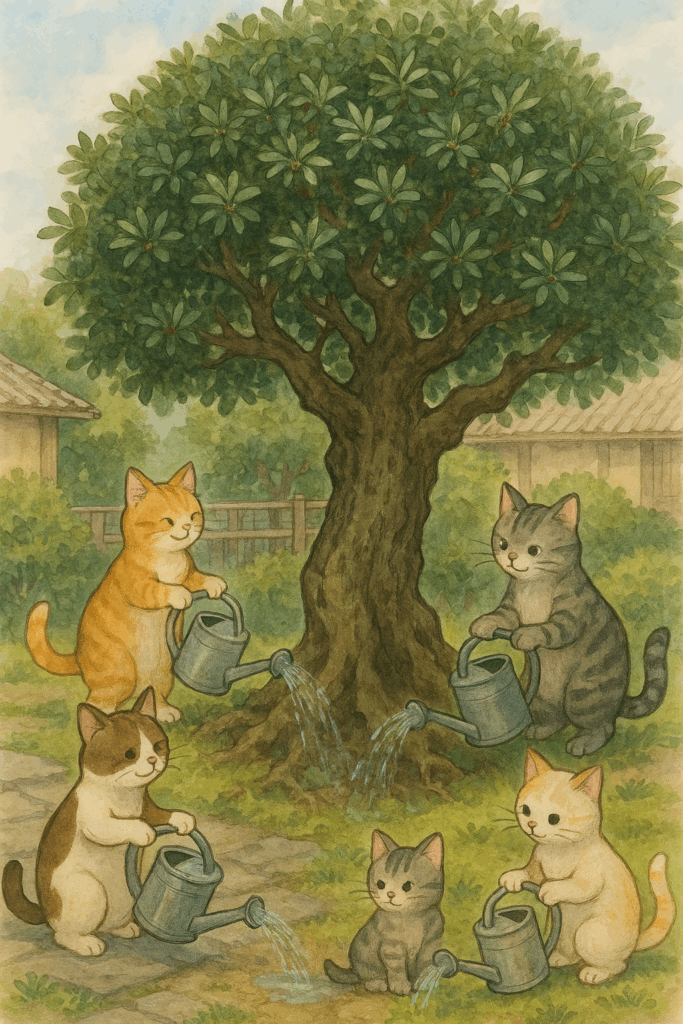
- This is the wax myrtle tree, known in Japanese as Yamamomo, which literally translates to “mountain peach.”
- It is a native Japanese species that grows naturally in coastal and mountain regions, producing vibrant red berries resembling oversized strawberries.
- Botanically, it belongs to the Myrica family (Myrica rubra), commonly known as Chinese bayberry or wax myrtle.
- The fruit is extremely juicy with a pleasantly sharp, tart flavor—traditionally enjoyed fresh, steeped in liquor, or made into sweet jams.
- Typically, these trees live for several decades to about a century, depending on soil conditions and climate care.
- Given Kanazawa’s severe winter snowstorms, it is extraordinarily rare for a single tree to survive and thrive in a garden for four centuries.
- Generations of the Nomura household lovingly protected it, preserving a living legacy brought here long ago from the founder’s hometown.
- I’m not entirely sure if this 400-year-old elder still bears fruit in early summer, but if you happen to spot a ripe red berry, please resist the temptation to pick it!
- If you sneak a taste, you might discover whether it’s sweet or sour—and the samurai spirit in the garden might give you a sharp, sour look in return!
- So enjoy the view with your eyes, and if your mouth starts watering, satisfy your sweet tooth at the local ice cream shop down the street instead!
7. Jodan-no-ma (Audience Chamber) Area
Why is there an elevated audience chamber built specifically for receiving a feudal lord inside a samurai residence? While most visitors simply soak in the impressive atmosphere, here are engaging backstories addressing its historical purpose, architectural craftsmanship, and unique design features.

Q1. Purpose: “What was this room used for?”
- This was a VIP room, known as a Jodan-no-ma, designed for inviting feudal lords. It was built one step higher than the rest of the house to signify its importance.
- The upper-level room is an architectural style that originated about 400 years ago in samurai residences. Originally, lords included such rooms in their own homes to meet with their vassals.
- Therefore, you can find similar rooms not only in the Nomura House but also in the residences of famous daimyo (feudal lords) throughout Japan.
- Historians might wonder why an upper-level room exists in the Nomura House, given that it was not the residence of a lord.
- The answer lies in its history—this room was not part of the original Nomura House but was moved from a related daimyo’s mansion during restoration in the mid-19th century.
- These rooms are boldly and exquisitely crafted using expensive materials, such as ebony and black ebony, and feature elaborate techniques.
- In such audience halls, bamboo blinds were often hung over the room to prevent the nobleman inside from being seen directly.
- Naturally, nobles and lords did not want to be visible to the common people outside.
- In modern Japan, you can find similar screens in many small houses, primarily used to maintain privacy.
- However, the reason for using these screens today is often practical—to hide the inside of small homes and laundry drying indoors from view.
Q2. Coffered Ceiling: “Is there anything special about this ceiling?”

- This ceiling is constructed using a method commonly seen in grand halls, symbolizing high status.
- It features a lattice-like framework made of long, thin wooden pieces, with a backing board attached to it.
- Furthermore, this is a coffered ceiling—the highest class of ceiling—characterized by its concave upper surface rather than a flat one.
- This style is also found in Renaissance architecture in Europe and has the effect of making a room appear larger than it actually is.
- Various decorations and carvings can be added to the open spaces within the ceiling, enhancing the luxurious atmosphere of the room.
- This ceiling is made of hinoki cypress, one of the finest types of wood used in Japan since ancient times.
- Hinoki cypress remains a popular material in high-end construction today due to its beautiful white color, natural luster, and unique fragrance.
- Even now, wealthy individuals install hinoki cypress baths in their homes to enjoy its soothing aroma.
- In fact, the scent of hinoki cypress is said to have a calming effect on the brain, helping to stabilize the autonomic nervous system.
- After all, by installing such fine Hinoki cypress overhead, people in the Samurai era might have hoped it would keep their lords from getting angry enough to order seppuku(ritual suicide)!

Q3. Paulownia Flooring: “Is this tatami mat special as well?”

- Not only is the tatami mat special, but the floorboards beneath it are also uniquely crafted.
- The floorboards are covered with paulownia wood, a material often used in high-end chests.
- Using six-foot-long paulownia boards makes them even harder to source and significantly more expensive.
- Paulownia wood has a component that keeps wood-eating insects at bay, making it an ideal material for chests of drawers.
- So why would such high-quality paulownia wood be used for flooring?
- There are many possible reasons, but one theory suggests that paulownia floorboards are chosen for their ability to retain warmth.
- The interior of paulownia wood contains a lot of air, which doesn’t conduct heat easily, making it resistant to cold, much like a sponge.
- However, its high air content renders it weak, easily scratched, and unsuitable for flooring.
- Thus, paulownia floorboards are best suited for noble individuals who can tread gracefully without harming the surface.
- Sadly, this suggests that paulownia wood can repel not only mold and pests but also commoners like us.
Q4. Glass Shoji Screens: “Is this glass shoji screen also from that time?”

- The glass-filled shoji screens that allow you to see the garden from inside were made in those days.
- The shoji screens, which could be mistaken for modern ones, would have been an object of amazement two hundred years ago.
- In Japan, shoji screens made of washi paper have been used as window coverings since ancient times.
- Shoji screens are highly practical, as they block wind while allowing enough light to illuminate the room.
- However, unlike glass, they do not allow you to see outside while keeping the door closed.
- But why didn’t the wealthy Nomura family opt for adding more expensive yet convenient clear glass?
- Unlike shoji screens, this glass repels rain, keeps out wind, allows all light to pass through, and can be proudly displayed to those around it.
- Since the introduction of glass was a symbol of westernization, its widespread use also signaled the end of the samurai period.
- As if foreseeing this, they decided against turning the place into a glass house after all.
- Instead, this very popular samurai mansion, which has gained worldwide fame, became another glass house open to the eyes of people in the Net world!
8. 1F Rooms & Veranda Area
The first-floor reception rooms and corridors showcase artistic details that reveal both samurai status and surprising human stories. Here are backstories covering the peony fusuma paintings, hand-carved black persimmon wood, the 15th lord’s hanging scroll, and the mysterious warbler box.
Q1. Fusuma Paintings: “What kind of flower is depicted in this fusuma painting?”
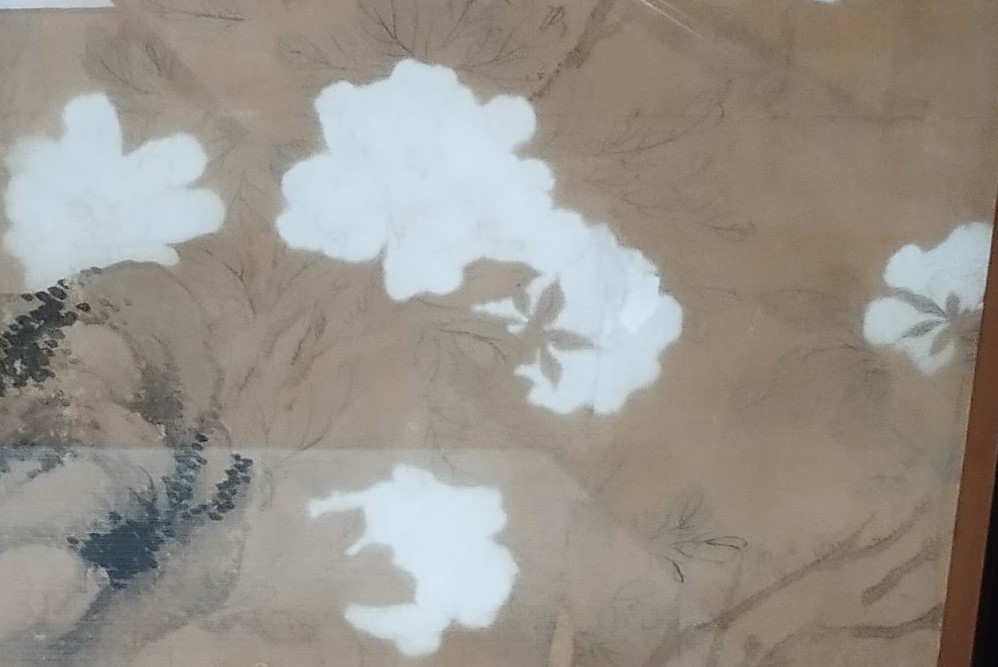
- The fusuma paintings depict traditional monochrome landscapes and white peonies painted by the best painters of the time.
- Since the symbolic meanings of peonies are “elegance” and “wealth,” they are often depicted on fusuma paintings in the residences of lords.
- Interestingly, peonies were considered unlucky flowers among the samurai class. Typically, when most flowers wither, both the flowers and the entire plant gradually decline and die.
- Peonies, however, have such heavy petals that they cannot support their weight, causing the flowers to fall off while the stem remains intact.
- The sudden and simultaneous shedding of petals reminded people of the severed heads of defeated samurai.
- Yet, the sight of the delicate petals falling together conveys both strength and transience, making peonies a popular subject for paintings.
- In China, their country of origin, peonies are called ‘the king of flowers’ or ‘the flower god’ because even a single bloom in a vase can create a luxurious atmosphere.
- Unlike cherry blossoms or plum blossoms, which require many flowers and branches to create a beautiful painting, peonies can create a stunning image with just one flower.
- While painters often needed to depict numerous flowers and branches for cherry or plum blossoms, a single peony was sufficient.
- This seemingly lighter workload might be why the famous painter, tasked with decorating so many fusuma panels in this house, chose peonies!
Q2. Key Covers: “What are these ornaments?”

- These are ornaments used to conceal nail heads.
- In many Japanese houses, they serve as decorative accents, available in various designs.
- Notably, they are made from rare black persimmon wood, not metal.
- Black persimmon refers to the black-patterned part of persimmon trees that appears after more than a hundred years.
- Valued for its durability, unique coloration, and beautiful grain, black persimmon is also used in high-end furniture.
- Ordinary nail head covers are often made from metal, which can be mass-produced using molds at a lower cost.
- However, these wooden ornaments must be individually hand-carved by skilled artisans, enhancing their value.
- In English, the expression “to drive a nail” means to complete a task.
- However, in Japan, driving a nail doesn’t signify the job is complete.
- The task is only finished when the nail is carefully concealed—not simply by driving it in.
Q3. Hanging Scroll: “What’s written on this hanging scroll?”
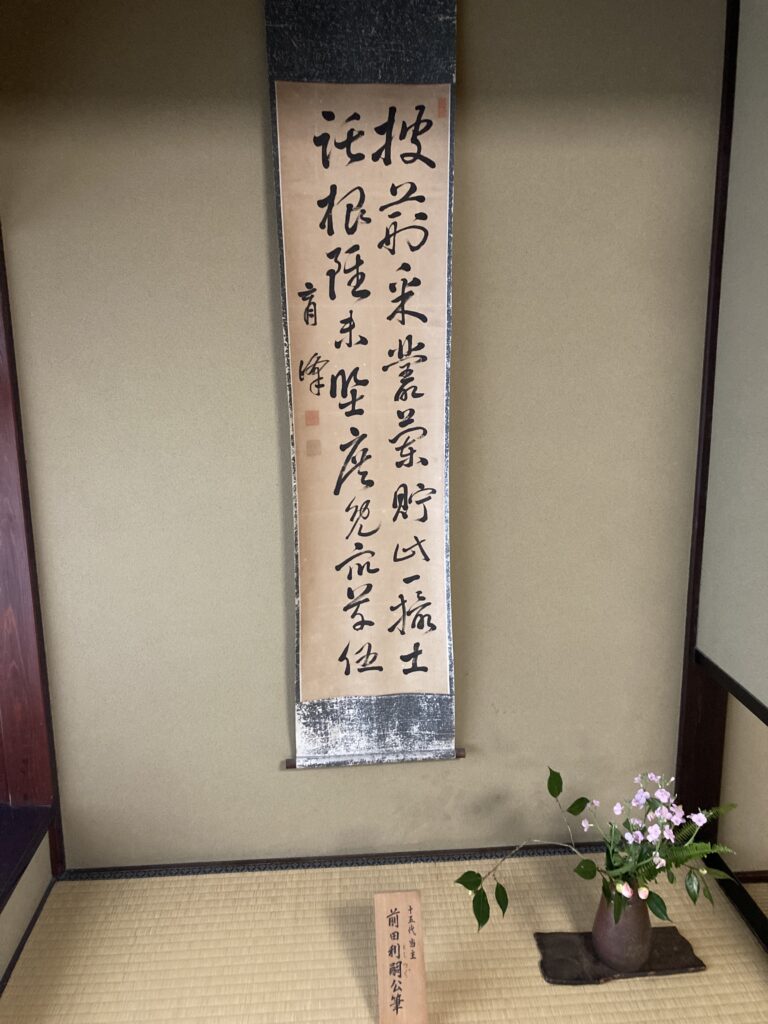
- Well… unless you’re a specialist, it’s almost impossible to read it accurately. But we believe it contains moral teachings for samurai.
- During the samurai era, it was common to write ethical lessons—blending Shinto, Confucian, and Buddhist ideas—in classical Chinese-style poetry.
- It was a way of reminding warriors to balance everyday life with spiritual cultivation.
- This particular scroll was written by the fifteenth lord of the Kanazawa domain. The signature on the left is his pen name, which makes the piece historically valuable.
- Ironically, the samurai era ended when he was only ten, and his family had to leave Kanazawa Castle after the fourteenth generation. Even so, he remained part of the nobility and even studied in England in his early teens.
- Because he was both a nobleman and a cultural figure, someone likely commissioned him to write these “words to live by.”
- He was probably influenced by British ideas of knighthood—everything from the heroic “knight in shining armor” to the “carpet knight,” the sort who talks bravely but never sees a battlefield.
- He must have heard phrases like “chivalry is not dead”… or perhaps “chivalry has gone,” depending on who he met.
- Sadly, many visitors today aren’t very interested in the deep meaning of this scroll. Instead, they’re more fascinated by scrolling their own devices for trivial information.
- If he could see that from the afterlife, he might sigh and say, “The spirit of the scroll has gone!”
Q4. Warbler Box (Kokei): “What is this box for?”
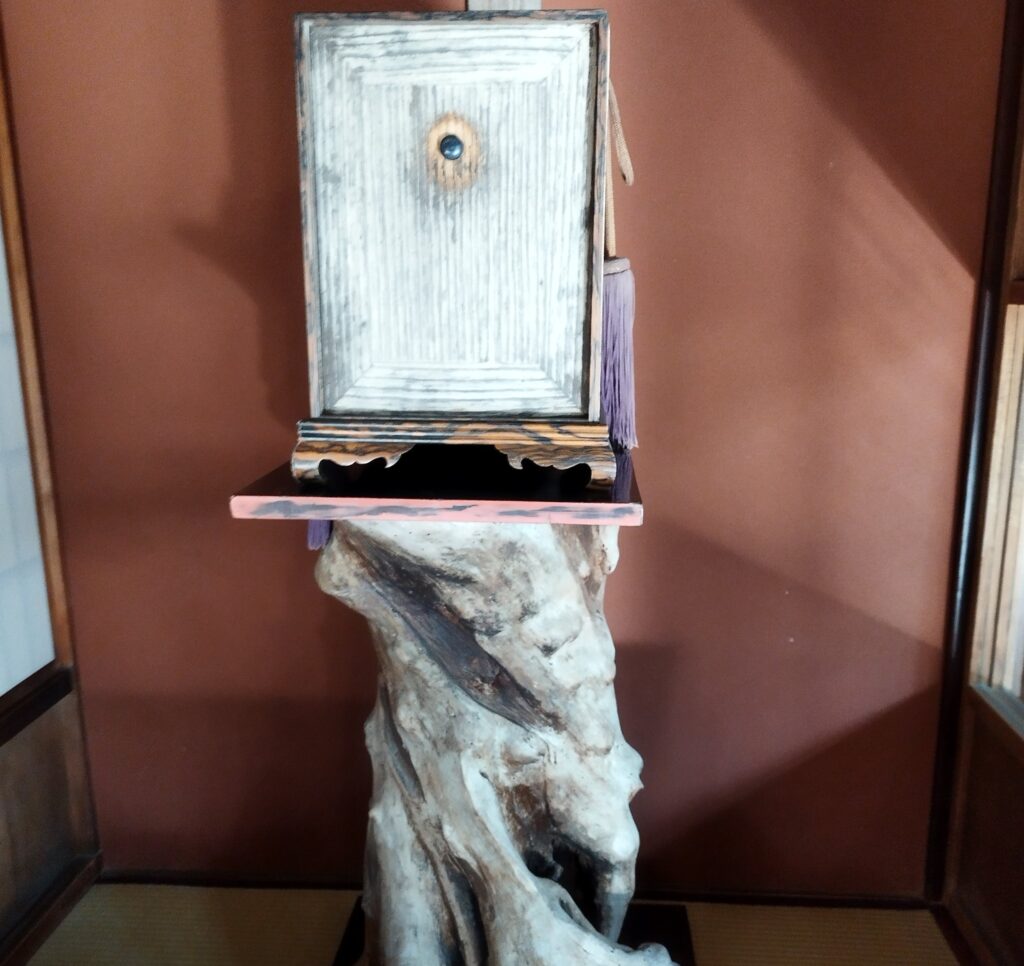
- This is a paulownia wood box designed to hold the birdcages of bush warblers, enhancing the beauty of their songs.
- The Japanese bush warbler has held a special place in the hearts of the Japanese people for centuries, announcing the arrival of spring with its beautiful call.
- Dating back over a thousand years to the aristocratic age, the Japanese practiced “Uguisu-awase,” a competition where they would cage bush warblers in spring and vie for the most beautiful songs.
- Moreover, paulownia has been considered a sacred tree for birds since ancient China, so using such a box also reflected a profound respect and affection for these creatures.
- Of course, in modern Japan, this custom has largely disappeared due to animal welfare concerns.
- Indeed, some visitors who see this paulownia box in person may find the practice of caging bush warblers to be cruel or distressing.
- Historically, caretakers ensured the birds had proper ventilation, but it’s understandable how a seemingly closed box might appear distressing to modern visitors.
- Let’s just say I don’t always volunteer information about this box unless asked.
- Part of it is to avoid any impression of cruelty, but there’s also a somewhat inconvenient truth.
- I’m afraid it might simply highlight an unsolved paradox: that we’re here saying the Japanese weren’t abusing birds, while simultaneously enjoying perfectly grilled and skewered yakitori all across the country.
9. 2F Tea Room Area
Situated on the second floor, the tea room (Fukyuan) offers guests a quiet space to sip matcha while enjoying an elevated view of the garden below. Here are structured Q&A scenarios covering its tea experience, small entrance, natural ceiling design, and rare wood floorboards.

Q1. Tea Experience: “How do people have tea in this room?”
- It was fashionable during the time of the daimyo lords and high-ranking samurai to have tea rooms in their residences.
- They want to showcase not only their martial arts skills but also their refined intellectual tastes.
- If this tea room is available and you’re interested, you can even experience tea here.
- You can enjoy tea while sitting on the tatami mat and listening to the sound of the curved stream in the garden below.
- If sitting in seiza (the formal Japanese sitting position) is uncomfortable, you’re welcome to sit at ease instead.
- Since this tea room is on the second floor, we also recommend gazing out the window at the serene garden.
- Having a tea room on the second floor is quite rare. In fact, even a famous temple in Kyoto boasts a second-floor tea room as one of its key attractions.
- Interestingly, the Nomura house doesn’t actively promote their unique tea room, which might reflect the modesty often associated with samurai.
- However, samurai were often ridiculed by merchants for lacking business acumen or promotional skills at the time.
- If the residents of this house had known what merchants thought of them, they might have responded with, “It’s none of your business!”

Q2. Entrance: “Why is the entrance so narrow?”

- In tea ceremonies, the entrance is deliberately made narrow to ensure that guests do not bring in weapons or belongings and must lower their heads and upper bodies to enter, symbolizing equality.
- Inside the room, the seating arrangement for hosts and guests is typically determined by roles rather than social class, reflecting an egalitarian philosophy.
- The fundamental principle of the tea ceremony ensures that status or wealth is irrelevant, allowing everyone to be treated equally and enjoy tea together.
- During the era of the samurai, society was highly stratified, with samurai at the top of the hierarchy.
- It’s fascinating that the tea ceremony, which disregards social status, became popular among the samurai class.
- Particularly during the civil war period about 500 years ago, when samurai lived with the constant risk of losing their lives in battle, the tea ceremony may have created an extraordinary world of equality and hospitality.
- Another theory suggests that the egalitarian ideals of Christianity influenced the tea ceremony.
- Around the time the customs of the tea ceremony were being established, Christianity was first introduced to Japan by Spain and Portugal.
- However, the ruling authorities of the time banned Christianity, viewing it as a dangerous ideology.
- If that theory is true and Christianity had not been banned, the name of the tea ceremony might have been quite different. Instead of a “Tea Ceremony,” we might be calling it a “Christiani-tea Ceremony”!
Q3. Ceiling: “Isn’t it a very unusual ceiling structure?”

- You have a keen eye for noticing and appreciating such beauty, as most people overlook its subtle charm.
- The ceiling features a unique construction with two layers, using cedar on top and paulownia wood beneath.
- This design allows you to catch glimpses of the beautiful paulownia wood through small knotty holes.
- Paulownia wood is prized for its resistance to warping and changes in size, ensuring it maintains its exquisite appearance indefinitely.
- The rare cedar used here is known as “Jindai Sugi,” which means “cedar of ancient times.”
- These cedars were buried in the ground like volcanic ash, for hundreds of years. During this time, they lost their moisture and developed a captivating sheen.
- In the tea ceremony, there were instances where a guest’s aesthetic sense was sometimes evaluated based on their ability to appreciate unusual materials such as “knotty holes”.
- Guests who could not grasp the value of this “knotty holes” were sometimes viewed with disdain in Japan as a person with eyes like “knotty holes”.
- That’s why I’m sharing this explanation with guests who possess a refined aesthetic sense, like you, today.
- After all, I wouldn’t want to be considered a “knotty holes-eyed” guide myself.
Q4. Ante-Room Floor: “Does this floorboard have any special meaning or characteristics?”
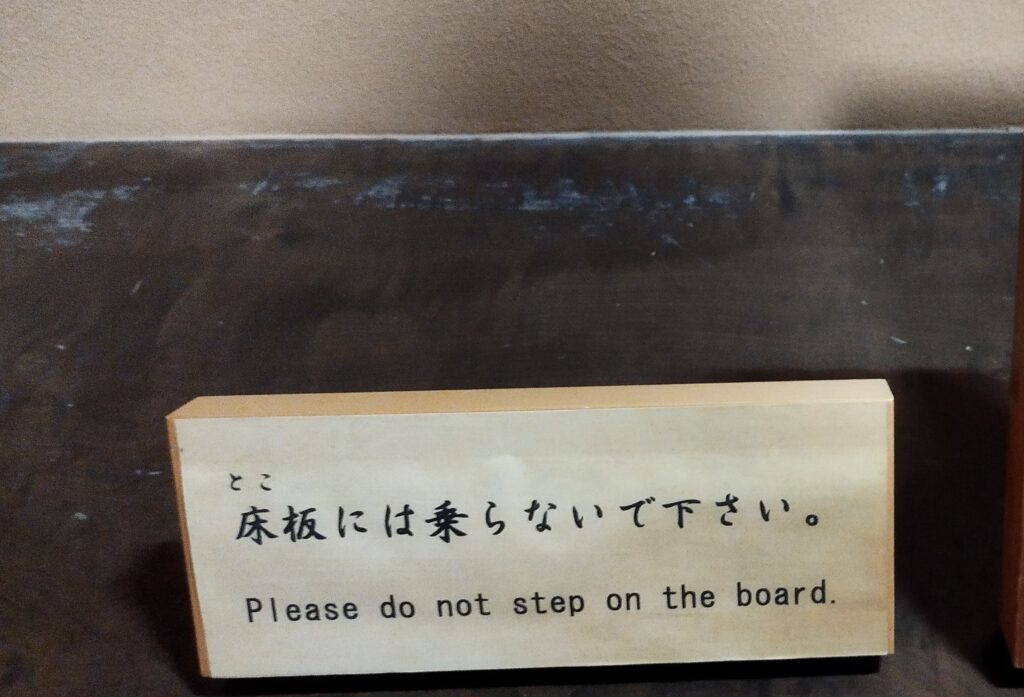
- The floorboards are made from a single piece of a 1,000-year-old maple tree, which is incredibly precious and rare.
- Maple wood is generally light cream to reddish-brown in color, with a straight, fine, and uniform grain, which gives it a unique beauty.
- Maple wood is commonly used due to its hardness, strength, durability, and impact resistance, making it a popular choice for furniture and musical instruments.
- However, this maple board is not only ancient but also precious in a double sense, as it’s rare to find and procure maple trees large enough to craft such an expansive single piece.
- The Nomura family must have been quite wealthy to have such a contraption not only in the tea ceremony room but also in the antechamber.
- While wealthy individuals often use rare and expensive materials to show off, the samurai’s way of displaying wealth may have been a bit different.
- Example, a maple tree could have been used as a distinctive accent in a ceiling, allowing waiting guests to enjoy the view of imagined autumn leaves.
- On the other hand, the use of inconspicuous floorboards may have been intended to evoke the image of autumn leaves falling into the meandering water of the garden.
- Perhaps the maple tree was chosen to avoid being pestered by many visitors, especially the lord’s lieutenants.
- Since the language of maple flowers symbolizes reservation, could it have been meant to represent a thousand years of restraint, rather than a thousand years of loneliness?
Appendix / Recommended Guides & Travel Preparation
🧭 Explore More Kanazawa & Japanese Culture Guides
💡 Recommended 3 Articles to Read After Nomura House:
- 🍵 Tea Ceremony Guiding in English (Deep dive into tea room culture!)
- 🏯 Kanazawa Castle Guiding Tips (Headquarters of the Maeda Clan)
- 🌲 Kenrokuen Garden Guiding Tips (Kanazawa’s premier landscape garden)
📋 Complete Series Directory:
- Tea Ceremony Guiding in English
- Buddhist Temples Guiding Tips
- Shinto Shrines Guiding Tips
- Japanese Castles Guiding Tips
- Kutani Porcelain Guiding Tips
- Yamanaka Lacquerware Guiding Tips
- Kenrokuen Garden Guiding Tips
- Higashi Chaya District Guiding Tips
- Nomura Samurai House Guiding Tips
- Kanazawa Castle Guiding Tips
- Shirakawa-go Guiding Tips
- Gokayama Guiding Tips
- Matsumoto Castle Guiding Tips
- Takayama Jinya Guiding Tips
- D.T. Suzuki Museum Guiding Tips
- Seisonkaku Villa Guiding Tips
- Nijo Castle Guiding Tips
- Earthquake Safety Guiding Tips
🛡️ Explore Historic Sites Safely with Peace of Mind
Historic places like the Nomura House feature steep staircases, wooden verandas, and uneven garden stepping stones. Having flexible travel insurance covers unexpected injuries or medical emergencies during your journey across Japan.
⚔️ SafetyWing – Flexible Travel Insurance for International Travelers
Contact & Inquiries
Thank you for visiting! If you have questions about visiting Kanazawa or wish to inquire about private guided tours, feel free to reach out below. Kotetsu🔶