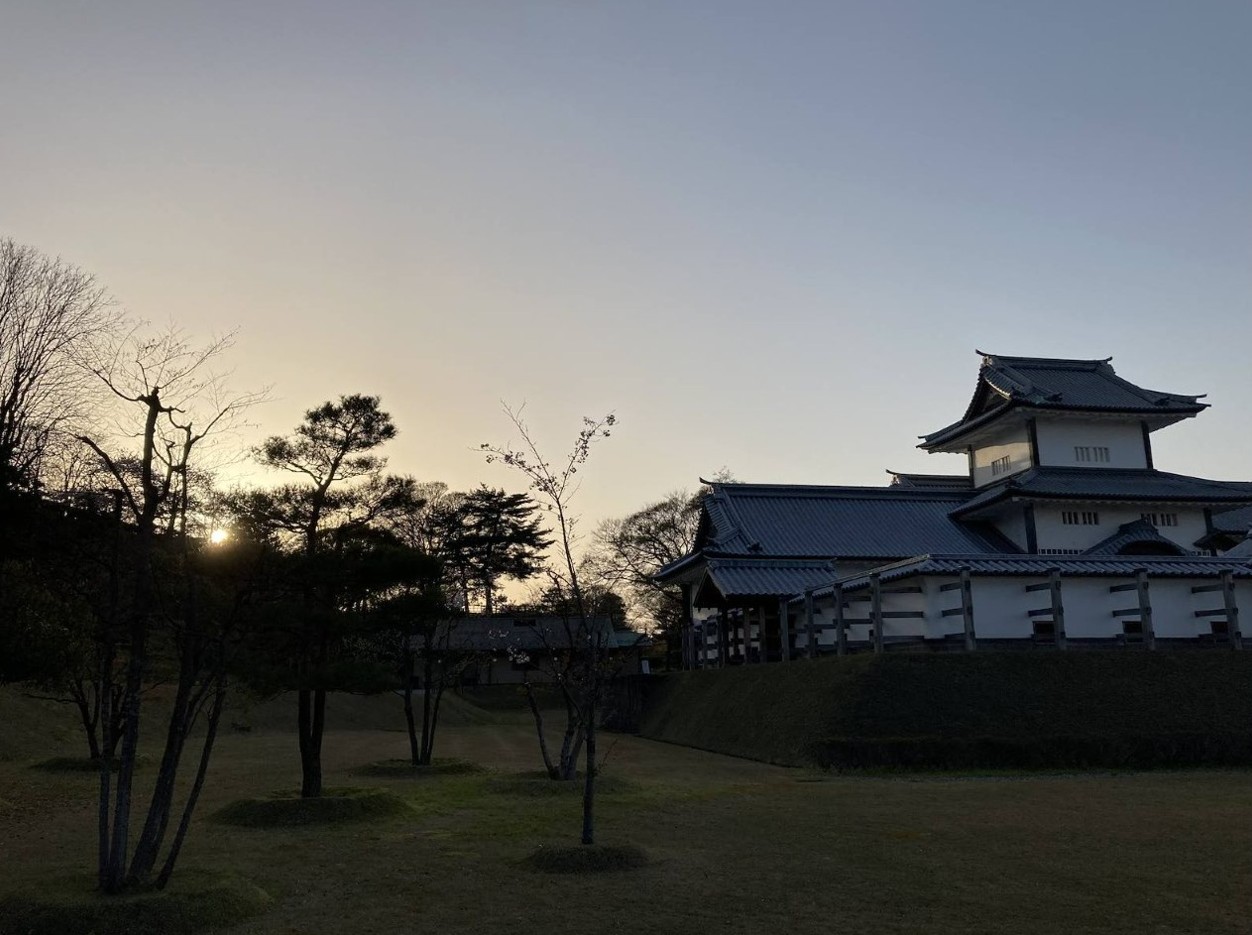
Welcome! I’m Genji, your local Japanese castle and samurai heritage insider in Kanazawa. Welcome to my insider guide for Kanazawa Castle Park (Kanazawa-jo)—the grand 400-year-old seat of the powerful Maeda Clan and Kaga Domain, delivered from an authentic local guide’s perspective!
Famed for its authentic full-scale timber restorations, fireproof “Namako” sea cucumber walls, bullet-yielding lead roof tiles, and diverse stone masonry, Kanazawa Castle holds fascinating secrets—including why its grand main keep was intentionally left unbuilt to appease the Shogun!
✨ Jump Straight to Castle Secrets & Local Guide Mysteries!
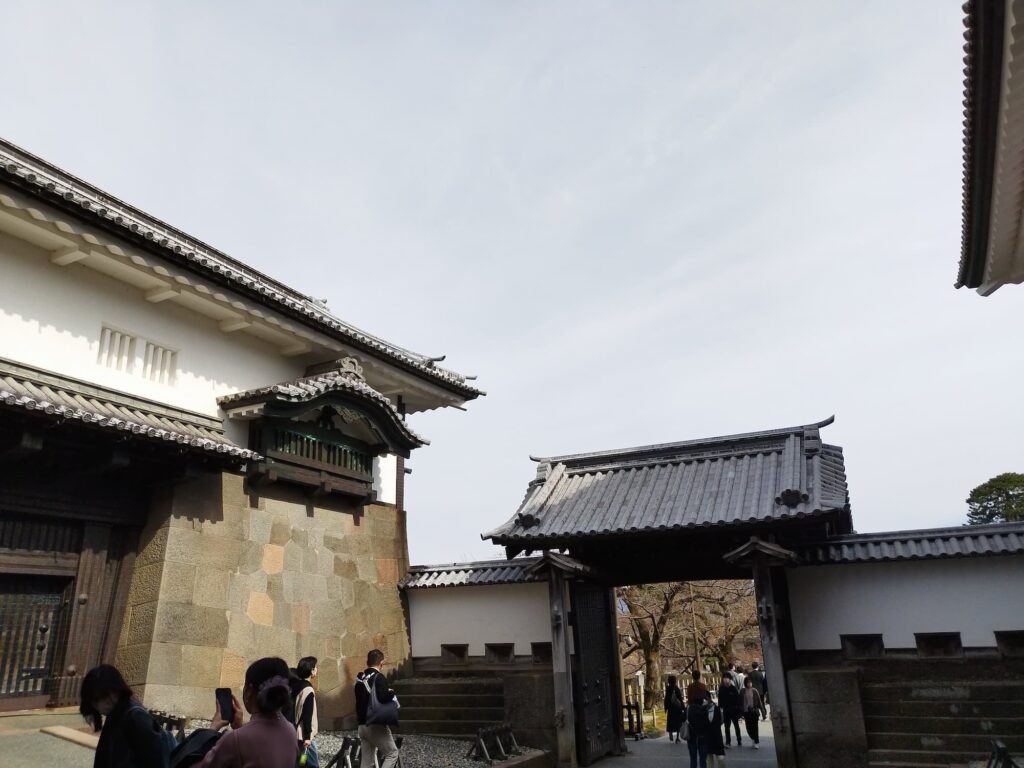
Panoramic View of Kanazawa Castle
📍 Quick Navigation: Explore Castle Highlights
- 1. Kanazawa Castle Park Overview
- 1.1 Essential History & Key Facts
- 1.2 Fun Backstories & Mysteries (11 Local Guide Q&As)
- Q1: Is This a Castle or a Park?
- Q2: What Is the Reason That Kanazawa Came to Be Called Kanazawa?
- Q3: What Is This Ground, Kanazawa Castle, in Front of Us?
- Q4: Why Is It So New? / It Looks Very New, However.
- Q5: Why Do the Roofs Look White?
- Q6: What Kind of People Lived There?
- Q7: What Makes It Different from Other Castles?
- Q8: Why Is There No Castle Tower? / Doesn’t This Castle Have a Donjon?
- Q9: Does Anyone Live in This Castle?
- Q10: Is There That Much Lightning?
- Q11: Where Is the Castle Located in Kanazawa Castle Park?
- Official Links & Resources
- Thank You & Message from Genji
1. Kanazawa Castle Park Overview
1.1 Essential History & Key Facts
- A Flatland-Mountain Castle Boasting a 400-Year History
Kanazawa Castle was originally constructed about 400 years ago in the late 16th century by Maeda Toshiie. Built on a plateau (river terrace) overlooking the city center of Kanazawa, this flatland-mountain castle (hirayamajiro) served as the political and cultural seat of the powerful Kaga Domain. - A Phoenix-Like Castle Shaped by a Cycle of Fires and Restorations
The history of Kanazawa Castle is defined by a cycle of destructive fires and grand rebuilds. Repeatedly ravaged by lightning strikes and accidental fires, the castle was faithfully reconstructed each time as a display of the lord’s authority and domain prestige. - The Strategic and Political Reasons Behind the Missing Main Keep
Although a magnificent main keep (tenshu) was built early on, it was destroyed by a lightning strike in 1602 and never rebuilt. This decision was driven by political prudence to show deference to the Tokugawa Shogunate, as well as a practical shift toward a defense system anchored by defensive turrets (yagura). - The Oldest Surviving Structure, Ishikawa Gate, and the French Revolution
The oldest surviving structure inside the castle grounds is the Ishikawa Gate, rebuilt in 1788. Coincidentally dating back to the era of the French Revolution, this impressive historical gate is designated as an Important Cultural Property of Japan. - Authentic Full-Scale Wooden Reconstruction Using Traditional Methods
Structures standing today, such as the Hishi Yagura and Gojuken Nagaya, were restored in recent decades. Rather than using modern steel or concrete, they were reconstructed entirely in authentic timber using traditional mortise-and-tenon joinery without relying on nails or bolts. - The Functional Elegance of “Namako Walls” (Sea Cucumber Walls)
Kanazawa Castle’s iconic white walls feature “Namako walls,” created by laying flat tiles and plastering the raised joints into rounded shapes. Beyond their striking geometric beauty, these walls provided exceptional fireproofing and waterproofing against North Coast winters. - Emergency Ammunition in Disguise: Lead Roof Tiles
The castle roofs are covered with specialized tiles made of wooden cores sheathed in lead, giving them a distinct whitish appearance. Beyond their visual appeal, one theory is that the lead could be removed and melted down to make musket bullets during a siege. - A “Museum of Stone Walls” Showcasing Evolving Masonry Technique
The castle grounds feature diverse styles of stone walls built across different eras and for different functions. Ranging from rough unhewn natural stones to finely cut interlocking blocks, the site is celebrated as a living “museum of stone masonry.” - A Unique Post-War History as a University Campus
After serving as a feudal domain castle and later a military base during the Meiji era, the castle grounds took on a unique post-WWII role as the campus for Kanazawa University. It holds a distinct place in history for having modern higher education housed within a historic castle site. - The Deep Historical Connection with Kenrokuen Garden
Adjacent Kenrokuen Garden was originally developed by successive Maeda lords as an outer private garden of Kanazawa Castle. Connected today by a single bridge (Ishikawa Bridge), the castle and garden form an integrated historical landscape.
1.2 Fun Backstories & Mysteries (11 Local Guide Q&As)
Q1: Is This a Castle or a Park?
- As this place is called Kanazawa Castle Park, it’s both a castle and a park.
- In Japan, many former castle grounds have been turned into public parks; they’re generally known as “castle ruins parks.”
- The large lawn in front of us used to be called the Sannomaru, the third most important section of the castle.
- The Sannomaru has had quite a varied history.
- During the Edo period, it’s said to have been home to samurai residences, tenement houses and government buildings.
- After the samurai era ended, there were military barracks here in the Meiji period. Then, after the war, it became part of the Kanazawa University campus.
- People often ask me why they don’t restore a building on such prime land and turn it into a tourist attraction, especially since there are historical records.
- I didn’t really know the reason at first, but after working as a guide here, I’ve gradually come to understand it.
- You know, nobody really wants to get too involved with someone who has a complicated past.
- It’s the same here. Even with all the historical records, the only sensible option is to leave it alone like this.
Q2: What Is the Reason That Kanazawa Came to Be Called Kanazawa?
- According to some documents, the name “Kanazawa” appears to mean “golden spring.”
- The Japanese word “sawa” is often translated as “marsh,” but since it can also mean “stream” or “spring,” “spring” is the most appropriate translation here.
- The name is said to have originated from the spring next to Kenroku-en Garden, so if you’re interested, you should stop by.
- This spring was historically known as “Kana-arai no Sawa” (Gold-Washing Brook), and legend says that while a potato farmer named Togorō was washing the potatoes he had dug up, gold fell from his hands.
- Ironically, he had no interest in money—meaning gold—so he simply gave it away.
- People have always admired those who aren’t driven by greed, and he was exactly that kind of person.
- It’s surprising that gold leaf developed in Kanazawa—a city whose roots lie in potato farmers who had no interest in money.
- Kanazawa now accounts for nearly 100 percent of Japan’s gold leaf production.
- Unlike those potato-digging farmers, modern Kanazawa people are quite greedy. But don’t get the wrong idea.
- They’re not greedy for gold or money—it’s their appetite that’s greedy, because they turn gold into gold leaf just to eat it!
Q3: What Is This Ground, Kanazawa Castle, in Front of Us?
- Kanazawa Castle was once the residence of the Maeda clan, one of the wealthiest daimyo families of the time.
- They built this magnificent castle about 400 years ago on land that had originally been the headquarters of a regional Buddhist organization.
- For roughly 260 years, across 14 generations, the Maeda clan used this place as their base to lay the foundations of modern Kanazawa culture.
- Kanazawa culture has a unique atmosphere that reflects samurai aesthetics in tea ceremony, Noh theater, and traditional crafts.
- In that sense, this place can be considered the birthplace of Kanazawa culture.
- Castles were originally fortresses built for battle, but by that time Japan was already living in peace.
- The Maeda family gathered cultural figures and cultivated a culture that still shapes the city today.
- In fact, they may have understood “culture” far more deeply than we do today.
- This highland—the Kodatsuno Plateau—was probably just wasteland in the past, wasn’t it? They cultivated that wasteland.
- They understood culture through firsthand experience. We modern people could never turn wasteland into such a rich cultural landscape, could we.
Q4: Why Is It So New? / It Looks Very New, However.
- Since many of the buildings have been restored over the past few decades, they look brand new, don’t they?
- This castle was originally built about 400 years ago, but most of the buildings were destroyed by fires many times.
- They were restored each time, but sooner or later, they would be destroyed by fire again.
- This is the fate of traditional Japanese wooden architecture, and at Kanazawa Castle you can witness this recurring history.
- I used the term “restoration” rather than “rebuilding” at the beginning, and there’s a reason for that.
- These buildings, which look brand-new, have been restored using the technology, tools, materials, and techniques of that era.
- Photographs taken just before the last fire over 100 years ago still exist, and they show the buildings exactly as they look now.
- People in Kanazawa want to make a clear distinction between these restored buildings and those rebuilt using concrete or rebar.
- Occasionally, mischievous guests point out, “How can you call this a restoration when there are electrical outlets?”
- But for the people of Kanazawa, that’s within acceptable limits. After all, even though they use silver and copper, they still confidently call it genuine gold leaf!
Q5: Why Do the Roofs Look White?
- The roofs of the castle are covered with lead plates instead of ordinary tiles.
- When exposed to rainwater for a while, lead reacts and turns white, making the roofs look as if they’re covered with snow.
- Not everything is made of lead; the roofs are built with wood and then covered with thin lead plates.
- I’m not sure why lead tiles came to be used, but they were used not only here but also at Edo Castle in Tokyo.
- One theory says they were used so the lead could be turned into bullets in emergencies, while old documents also mention that they were used to enhance the castle’s appearance. Considering the unstable times, both purposes were likely true.
- In the past, lead was also used in women’s white face powder called “oshiroi,” which is equivalent to today’s foundation.
- In essence, to make themselves look more beautiful, they regularly applied lead—which is harmful if ingested—directly onto their skin.
- I recall a story in a novel where a geisha used that poison to make an unpleasant customer drink it, or something like that.
- But when you think about it, this dangerous lead is also used in smartphone batteries today, isn’t it?
- Modern husbands might want to keep a closer eye on where their wives’ smartphones are.
Q6: What Kind of People Lived There?
- The Maeda family, a very famous daimyo family, lived here for 14 generations.
- They were extremely wealthy—said to be the second richest family in Japan after the ruling Tokugawa Shogunate.
- This region used to be called Kaga, and the phrase “Kaga Hyakumangoku Daimyo” (the Million-Koku Daimyo), reflecting the Maeda family’s wealth, is still used today.
- The “koku” in “one million koku” is a unit of rice production; one koku is the amount of rice an adult eats in a year—about 150 kilograms.
- So “one million koku” means enough wealth to feed one million people, making the Maeda family exceptionally wealthy among all daimyo.
- Ironically, it was precisely because of this wealth that the Tokugawa Shogunate suspected them of treason and kept them under surveillance for about 260 years.
- Yet despite repeated threats of having their domain abolished, they consistently showed obedience and managed to remain daimyo.
- Showing deference is important—whatever the circumstances. And the same applies to us guides.
- But in this era of widespread AI adoption, simply showing deference to guests may not be enough to survive.
- Unless we show how we differ from AI, we won’t survive. We must clearly articulate the difference—deference versus difference!
Q7: What Makes It Different from Other Castles?
- Well, that’s true. To many overseas visitors, Japanese castles may all look rather similar.
- A towering main keep, black tiled roofs, white plastered walls, stone foundations and moats here and there.
- Kanazawa Castle doesn’t look much different either, but it actually has one major distinguishing feature.
- That is the absence of a main keep, which is the symbol of Japanese castles.
- Around 150 years ago, towards the end of the samurai era, there were approximately 150 castles, but most of them were destroyed by modernisation and wartime air raids.
- Only 12 castle keep towers remain today; five are designated as National Treasures and seven as Important Cultural Properties.
- However, because Kanazawa Castle has no keep at all, it is—ironically—considered even more valuable.
- Although the Maeda clan were wealthy, they chose not to rebuild it as a sign of submission to the Tokugawa Shogunate; this very absence is what gives it historical significance.
- And since there are no historical records of the original keep, it has never been reconstructed. But even if such records existed… would the keep really be rebuilt?
- Given how much the citizens of Kanazawa admire the Maeda family, they might still say, “No keep? Perfect. Let’s keep it that way!”
Q8: Why Is There No Castle Tower? / Doesn’t This Castle Have a Donjon?
- Since it was destroyed by fire following a lightning strike some four hundred years ago, it has never been rebuilt to this day.
- It once stood on the highest point within the grounds of present-day Kanazawa Castle, but nothing remains there now; the area has become overgrown with scrub.
- There is a signpost marking the spot where it once stood, so one can only stand there and imagine what it looked like back then.
- At that time, the Sengoku warring state period—which had lasted for about a hundred years—was drawing to a close, and a peaceful era was beginning to take shape.
- For the lord of Kanazawa, who was suspected of plotting rebellion by the Tokugawa shogunate due to his considerable wealth, it would have been impossible to rebuild the castle keep, which symbolised a willingness to wage war.
- Although there seem to be calls for the reconstruction of the castle keep in the wake of the current overseas tourist boom, nothing can be built as no historical records remain.
- Some people might be thinking, ‘Don’t be so rigid—why not just build a new, impressive castle keep? There are plenty of examples of this across the country.’
- However, the Kanazawa locals’ insistence on nothing less than an authentic reconstruction is very real indeed. Even in a diorama recreating the entire castle as it was back then, the space where the castle keep should be remains empty.
- Still, some of the international tourists might think something like this:
- ‘I just don’t get the Japanese—they’ve been churning out countless Buddha statues since ancient times, none of which anyone has ever actually seen’ (laughs).
Q9: Does Anyone Live in This Castle?
- No one lives there now. This is true of all castles throughout Japan. As valuable historical assets, they are generally operated and managed by local governments.
- Until about 150 years ago, when the samurai era ended, the Maeda clan—the feudal lords—lived there, but the 14th head of the clan was forced to leave the castle.
- After that, the military of the new modern government used it as an operations headquarters and a warehouse for military supplies.
- However, following Japan’s defeat in World War II, the military was disbanded, and for a time afterward, Kanazawa University was housed there.
- After this hiatus of nearly 100 years, a restoration project began in the year 2000, and over the course of several decades, the castle was restored to its former glory.
- Since it was originally a vast castle, restoration isn’t yet complete, but work continues.
- According to a newspaper article, they’ve invested several billion yen in its restoration, so they’re clearly counting on the economic benefits.
- If that’s the case, couldn’t they take a cue from European castles—where the exterior looks like a castle but the interior is luxurious? But they can’t win in international competition by simply copying others. Since there are plenty of luxurious hotels out there, how about taking the opposite approach?
- Since this is a castle from the samurai era without electricity, how about offering an energy-efficient hotel experience—complete with candles and simple meals—that lets guests feel like feudal lords?
- Kanazawa Castle was originally designed to withstand a prolonged siege by the Tokugawa Shogunate, so why not create a unique overnight stay where guests sleep on the floor in a “hyakken nagaya” (a row of narrow, connected rooms) to experience the atmosphere of the night before battle!
Q10: Is There That Much Lightning?
- Kanazawa is the most lightning‑prone city in Japan, recording more thunderstorm days than anywhere else in the country.
- The region is known for “winter lightning,” a rare global phenomenon in which extremely powerful lightning strikes occur during snowstorms.
- Kanazawa Castle stood on an exposed plateau facing the Sea of Japan, where winter storms and low thunderclouds made lightning strikes especially frequent.
- Its large wooden buildings, including the main keep, were extremely vulnerable to fire once struck by lightning.
- Historical records show repeated lightning strikes around the castle since the era of Lord Maeda Toshiie, and in 1602 a lightning bolt ignited the main keep, spreading to a gunpowder storehouse and causing a massive explosion.
- People at the time believed it was divine punishment, and even today the violent thunder and ground‑shaking rumble of Kanazawa’s lightning can make modern visitors tremble.
- It is widely said that the keep was never rebuilt to avoid giving the Tokugawa Shogunate an excuse to attack, but after witnessing Kanazawa’s lightning, one might wonder if that was the only reason.
- In an age without lightning rods, a tall wooden keep rising above all other structures was practically the most vulnerable object in the entire region.
- The Tokugawa Shogunate’s accusations and potential attacks were certainly frightening, but something far more terrifying was always present above the castle.
- Compared to the Shogunate, whose “lightning‑fast attack” would still take months to reach Kanazawa, real lightning—capable of destroying the keep in an instant—was undeniably the greater threat.
Q11: Where Is the Castle Located in Kanazawa Castle Park?
- You’re already inside Kanazawa Castle—where countless real samurai once served their lord.
- Still, many international visitors ask, “So… where’s the castle?” even while standing right here.
- For many people, “castle” means the tower itself, and since Kanazawa Castle doesn’t have one, they don’t immediately recognize it as a castle.
- When foreign visitors arrive at a Japanese castle, they usually make a beeline straight for the keep.
- They want to climb to the top and enjoy that triumphant feeling—like reaching a mountain summit and soaking in the view.
- But the founders of Kanazawa Castle were forbidden to build a keep, since it symbolized defiance against the central government—the Tokugawa Shogunate.
- Legend has it that the lords felt the same frustration you do now, which is why they created Kenrokuen Garden right next door.
- They tried to ease their disappointment by indulging in a lavish private garden and entertaining distinguished guests there.
- We hope visitors like you will enjoy Kenrokuen and let go of any disappointment about not seeing a castle keep.
- Still, as a local guide, I must admit—this happens all the time. Most visitors become so enchanted by Kenrokuen that they forget not only their initial disappointment, but even the fact that Kanazawa Castle Park exists at all.
Official Links & Resources
Official Website: Kanazawa Castle Park (Ishikawa Prefecture)
Thank You & Message from Genji
👆 Did you enjoy exploring the history and secret backstories of Kanazawa Castle? To dive into specific gates, turrets, gardens, or storehouses, use the quick navigation buttons above!
🛡️ Travel Safety Notice: Enjoying Historical Paths with Peace of Mind
Kanazawa Castle Park and historical samurai heritage sites feature ancient stone ramps, cobbled pathways, and wooden steps. While awe-inspiring, stumbles or trips can happen. For international visitors exploring Kanazawa and Japan’s castle sites, securing real-time travel health insurance is strongly recommended for smooth medical support during your trip.
⚔️ SafetyWing – Real-Time Travel Insurance for Global Travelers (Check Details)