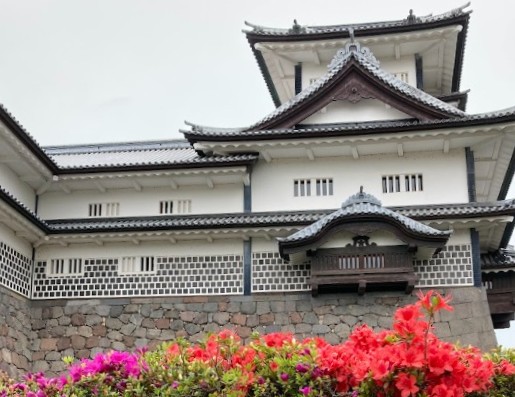
Welcome! I’m Genji, your local Japanese castle and samurai heritage insider in Kanazawa. Welcome to my insider guide for Hishi Yagura (Diamond-Shaped Tower)—the iconic three-story watchtower showcasing incredible architectural geometry with interior angles of 80 and 100 degrees!

Looking up from Sannomaru Plaza, Hishi Yagura stands as an awe-inspiring symbol of Kanazawa Castle. Serving historically as a watchtower monitoring the approach from Otemon and Ishikawa Gate, it conceals a mind-boggling secret: the entire building is built on an intentional 80-and-100-degree diamond floor plan rather than standard right angles!
✨ Jump Straight to Hishi Yagura Secrets & Local Guide Mysteries!

Hishi Yagura: The Iconic Diamond-Shaped Tower Looking Up from Sannomaru Plaza
📍 Quick Navigation: Explore Castle Highlights
5. Hishi Yagura (Diamond-Shaped Tower)
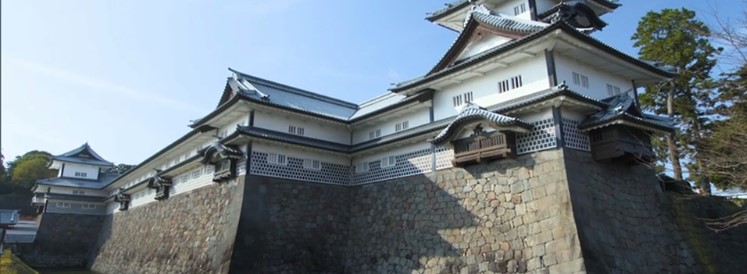
Looking Up at Hishi Yagura and Gojukken Nagaya from the Kimon (Demon’s Gate) Angle
5.1 Essential History & Key Facts
- An Unusual Diamond-Shaped Structure
The Hishi Yagura is named after its unusual diamond-shaped floor plan, with interior angles of 80 and 100 degrees rather than the usual right angles. Its pillars are also shaped and arranged to fit this distinctive geometry, demonstrating the advanced carpentry skills required to construct the building. - A Watchtower with a Prominent Presence
The Hishi Yagura served as a watchtower for monitoring the castle grounds and its approaches. Although it is not a substitute for the original main keep in terms of function, the Hishi Yagura serves as a prominent landmark within the castle grounds. - A Tower Equipped for Defense
The Hishi Yagura was not merely a lookout point. It incorporated defensive features, including stone-dropping openings that allowed defenders to attack enemies approaching the stone walls below. Its design reflects the practical military role of castle towers. - Destroyed by Fire and Later Reconstructed
The original Hishi Yagura was destroyed by fire in the late nineteenth century. The present structure was reconstructed in 2001, based on historical materials, old photographs, and archaeological research. It is therefore a modern reconstruction rather than an original Edo-period building. - Part of a Larger Defensive Complex
The Hishi Yagura is connected to the Gojukken Nagaya, a long building that links it with the Hashizume-mon Tsuzuki Yagura. Together, these structures formed part of the castle’s defensive system. The Gojukken Nagaya also served as a storehouse, illustrating how castle buildings could combine practical and military functions.
5.2 Fun Backstories & Mysteries (3 Local Guide Q&As)
Q1: Is There Anything Special About This Hishi-yagura?
- Although it is not obvious from the outside, this Hishi-yagura has a unique structure.
- As its name suggests, it is diamond-shaped rather than square or rectangular.
- When viewed from above, one of its corners forms an obtuse angle of 100 degrees rather than a right angle.
- This unusual design faces the north-east side of the castle.
- One theory is that the wider angle improved visibility for surveillance.
- But would an extra 10 degrees really make that much difference?
- Another theory relates to the north-east, traditionally known in Japan as the “demon gate.”
- Perhaps they wanted to reinforce that unlucky direction.
- If so, that certainly sounds like samurai spirit. I admire their courage.
- After all, most people today would probably use an acute angle to deflect bad luck rather than an obtuse angle to face it head-on!
Q2: What Is the Interior of the Hishi-yagura Like?
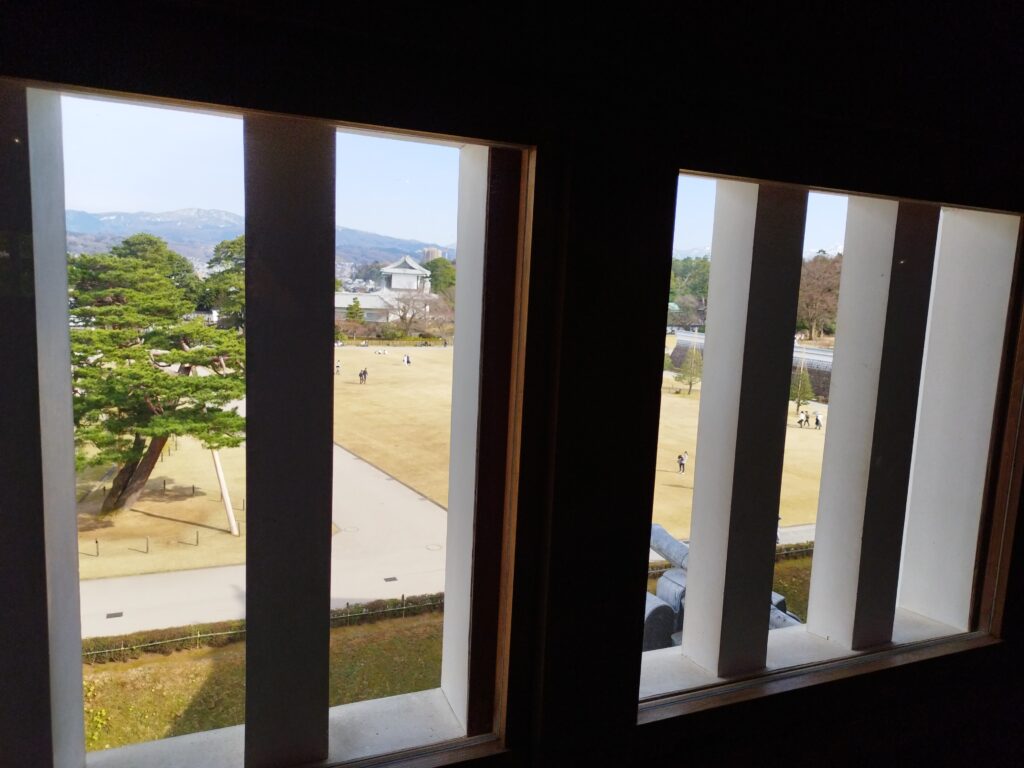
View Facing Toward Ishikawa Gate from Inside Hishi Yagura (Spring Afternoon)
- Once inside the Hishi-yagura, you can see that the floorboards near the corner form an obtuse angle—that is, an angle wider than 90 degrees.
- Of course, you can’t tell the exact angle just by looking. However, the information board shows diagrams of the floor plan, with angles of 100 and 80 degrees.
- You can also go up to the second floor and look out in two directions to appreciate how the unusual shape of the tower provides a wider field of view.
- On the ground floor, there is also an exhibition explaining the tower’s architectural features, which is well worth a look if you’re interested in traditional Japanese architecture.
- For example, you can see a diagonal reinforcing beam inserted where the beams intersect—a feature you wouldn’t normally expect to see in a building with conventional right-angled corners.
- And, naturally, the angles at these intersections are 80 and 100 degrees.
- I suppose the unusual geometry requires some extra reinforcement. (The exact structural reason would need to be confirmed.)
- I’ve always wondered why a 90-degree angle is called a “right angle” in English. Now I think I understand!
- A right angle must be the right angle, then!
- Just as this obtuse angle has been reinforced by a diagonal beam, my obtuse mind has finally been reinforced by the right angle!
Q3: How Do People Deal with the Unlucky Direction in a Building?
- In Japan, the northeast direction is called “Kimon”, and this diamond-shaped turret was built to face that direction.
- It is also known as the “demon’s gate” and is considered an unlucky direction in Japanese culture.
- Japanese buildings sometimes have L-shaped indentations at the northeast to ward off evil spirits.
- In Japan, there has been a tendency to dislike complete symmetry, as it is believed to invite evil spirits since ancient times.
- Therefore, for example, shrines and temples were often intentionally designed to be asymmetrical, avoiding perfect left-right symmetry.
- If you think about it, humans too can invite a lot of unhappiness when they fall into perfectionism.
- That’s why Kanazawa Castle had a L-shaped indentation near the diamond-shaped turret.
- Thanks to that, Kanazawa didn’t experience air raids during World War II.
- However, recently, I have a slight concern after Kanazawa Castle was completely restored.
- The concern is that this indentation area too has been restored so perfectly and beautifully that it might invite evil spirits.
Official Links & Resources
Official Website: Kanazawa Castle Park (Ishikawa Prefecture)
Thank You & Message from Genji

👆 Did you enjoy exploring the geometry and secret backstories of Hishi Yagura? To dive into other iconic castle structures, use the quick navigation buttons above!
🛡️ Travel Safety Notice: Enjoying Historical Paths with Peace of Mind
Kanazawa Castle Park and historical samurai heritage sites feature ancient stone ramps, cobbled pathways, and wooden steps. While awe-inspiring, stumbles or trips can happen. For international visitors exploring Kanazawa and Japan’s castle sites, securing real-time travel health insurance is strongly recommended for smooth medical support during your trip.
⚔️ SafetyWing – Real-Time Travel Insurance for Global Travelers (Check Details)