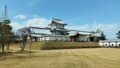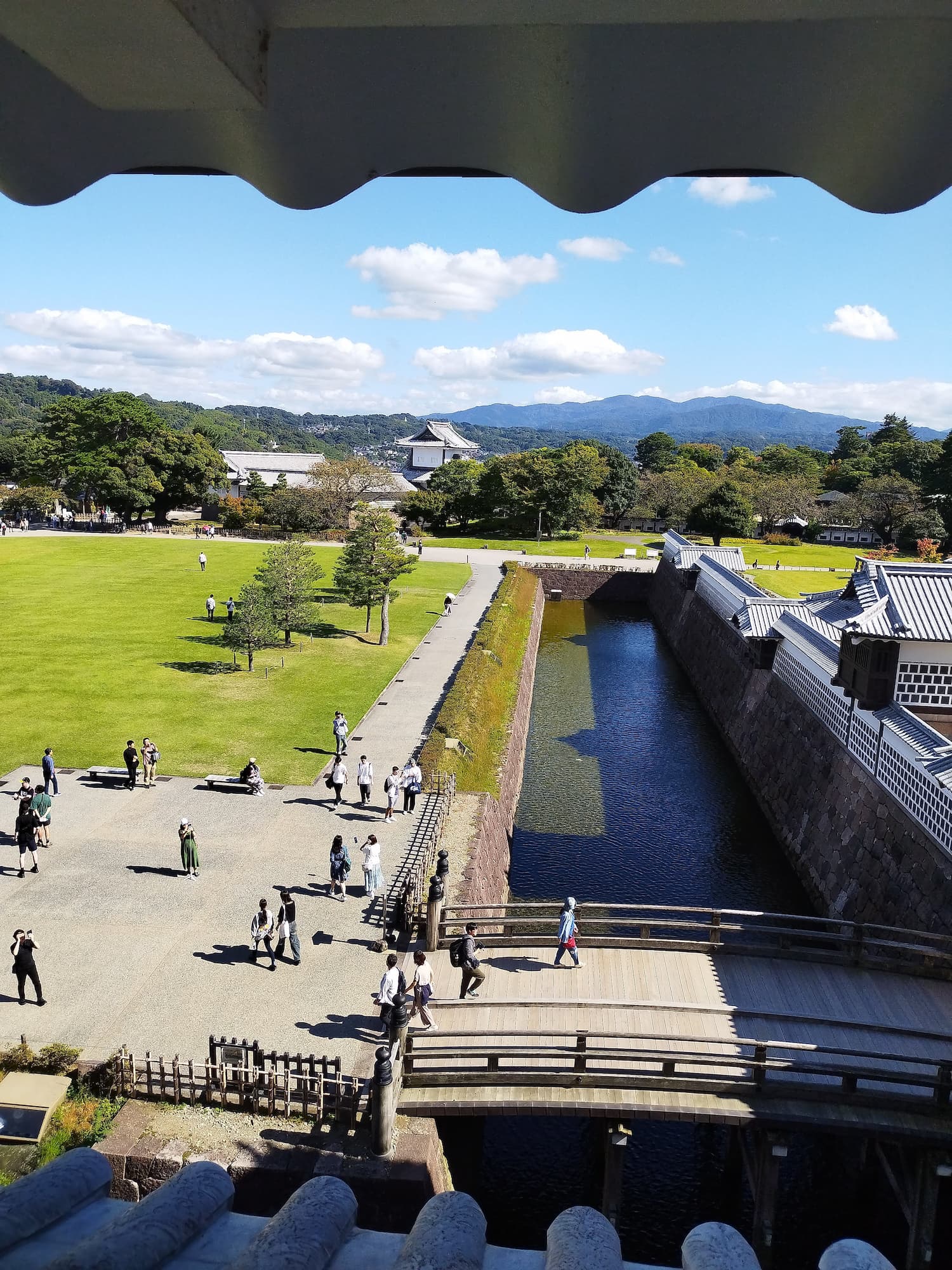
Welcome! I’m Genji, your local Japanese castle and samurai heritage insider in Kanazawa. Welcome to my insider guide for Gojuken Nagaya (Fifty-Ken Storehouse)—the massive 90-meter-long defensive storehouse linking Hishi Yagura and Hashizume-mon Tsuzuki Yagura!

Stretching commandingly across Sannomaru Plaza, Gojuken Nagaya served during peacetime as a multi-purpose storehouse for weapons and supplies. In times of war, it was designed to transform into a massive two-story defensive fortress wall guarding the Ninomaru Citadel—a true masterpiece of traditional Japanese wooden architecture!
✨ Jump Straight to Gojuken Nagaya Secrets & Local Guide Mysteries!

Panoramic View of Gojuken Nagaya: The 90-Meter Long Defensive Storehouse
📍 Quick Navigation: Explore Castle Highlights
6. Gojukken Nagaya (Fifty-Ken Storehouse)
6.1 Essential History & Key Facts
- A Classic Feature of Japanese Castles
The Gojikken Nagaya is a type of tamon-yagura, a long, roofed defensive building commonly found in Japanese castles. It connects Hishi-yagura and Hashizume-mon Tsuzuki-yagura. - A Faithful Reconstruction
Reconstructed in 2001, the building was based on historical drawings, old photographs, and archaeological findings. Traditional Japanese wooden construction techniques were used to recreate the historic structure. - More Than Just Looking at a Castle
Inside, you can see detailed displays explaining how the building was reconstructed, including traditional carpentry techniques. This makes it possible to learn not only what the building looked like, but also how it was built.
6.2 Fun Backstories & Mysteries (4 Local Guide Q&As)
Q1: What Is the Purpose of This Long, Horizontal Building?
- This long, wall-like structure is called a tamon-yagura or nagaya, a common feature of Japanese castles.
- It connects the turrets at either end, forming part of the castle’s defences.
- Its spacious interior also served as a storehouse for weapons and food, and could accommodate soldiers when necessary.
- It could also be used to attack the enemy, although it has few openings for firing firearms.
- Like many such structures, it has stone-dropping openings, known as ishiochi, for attacking enemies trying to climb the stone walls.
- Put simply, it was a long, fortress-like structure built to defend the castle. As it now hosts various exhibitions, much like an art gallery, I sometimes wonder whether we are properly conveying the true nature of this defensive structure.
- Occasionally, some visitors mistakenly believe that samurai used to sleep here, so I do wonder whether it might be better to recreate life in the castle more realistically.
- But that wouldn’t do! Although it was built for wartime, peace prevailed for so long that it must have served little more than as a storeroom.
- Of course, we can’t very well show visitors around a mere storeroom—that wouldn’t fulfil its defensive function.
- What kind of defence, you ask? That’s the job of the guiding staff here!
Q2: What Is Interesting About This Building?
- This is called the Gojukken Nagaya, a long building that connected two turrets and served both as a storehouse and a defensive structure.
- “Gojukken” refers to a length of about 90 metres, while “nagaya” means a long, connected building.
- One of the distinctive features of this building is the authenticity of its reconstruction.
- Although the original building was destroyed by fire in 1881, it was reconstructed in 2001 based on historical documents, old photographs and other evidence.
- Traditional materials and carpentry techniques were used as faithfully as possible, allowing visitors to appreciate the craftsmanship firsthand.
- But if we’re talking about authenticity, you might think, “Surely buildings that have survived in their original form at other castles are more authentic than this, aren’t they?”
- Well, the authenticity I’m talking about has another dimension. Unfortunately, Kanazawa Castle, with its many wooden buildings, suffered repeated fires and reconstructions over the centuries.
- I imagine that whenever a building was rebuilt, people would have come to see it, much as visitors do today. That’s the kind of historical realism I want to highlight.
- And perhaps some of you can even see a bit of historical realism in me, your guide.
- You might be thinking, “He looks just like a low-ranking samurai—or maybe a foot soldier!”
Q3: What Is This Floor Made Of?
- The floorboards are made of two types of wood: cedar and Noto Hiba, depending on the location.
- Noto Hiba is a Japanese conifer known as Hinoki-asunaro. The same tree is called Aomori Hiba in Aomori Prefecture.
- It is known for its durability, resistance to moisture, and natural protection against insects and decay.
- These qualities make it an excellent material for traditional wooden buildings.
- In other words, it is not just beautiful wood; it is also highly practical and valuable.
- So, when I explain this building, I often mention that the Maeda family used such high-quality materials even for a storehouse.
- But the more I talk about these expensive materials, the more pressure I feel!
- I used to keep my distance from people who were expensive to socialize with, even when I was young.
- But who knew that at my age, I would end up paying such a high social cost?
- In order to create even a little space between my feet and the floorboards, I have to wear two pairs of socks! What a waste of money!
Q4: What Kind of Wood Is This Large Beam Made Of?
- As you saw in the earlier display, different types of wood were selected for different parts of this building.
- These large beams are mainly made of pine.
- Pine is strong and flexible, making it suitable for supporting heavy structures.
- It can also be used in long, thick sections, which makes it particularly useful for traditional wooden buildings.
- For these reasons, pine has been widely used for structural beams in Japanese architecture.
- However, as a guide who often talks about the beautiful pine trees in Kenrokuen Garden, I sometimes feel something doesn’t quite fit.
- Perhaps it’s because the image of pine trees in the garden—with their elegant, delicate, twisting branches—is so different from these thick, straight beams.
- But recently, I finally realized what was bothering me.
- You know that peculiar feeling you get when you have a cute pet Java sparrow playing in your room, and then you’re served chicken wings for dinner?
- Looking up at these beams, I feel exactly the same way. How could they cut up and skewer such beautiful pine trees to make these beams!
Official Links & Resources
Official Website: Kanazawa Castle Park (Ishikawa Prefecture)
Thank You & Message from Genji

👆 Did you enjoy exploring the craftsmanship and secret backstories of Gojuken Nagaya? To dive into other iconic castle structures, use the quick navigation buttons above!
🛡️ Travel Safety Notice: Enjoying Historical Paths with Peace of Mind
Kanazawa Castle Park and historical samurai heritage sites feature ancient stone ramps, cobbled pathways, and wooden steps. While awe-inspiring, stumbles or trips can happen. For international visitors exploring Kanazawa and Japan’s castle sites, securing real-time travel health insurance is strongly recommended for smooth medical support during your trip.
⚔️ SafetyWing – Real-Time Travel Insurance for Global Travelers (Check Details)