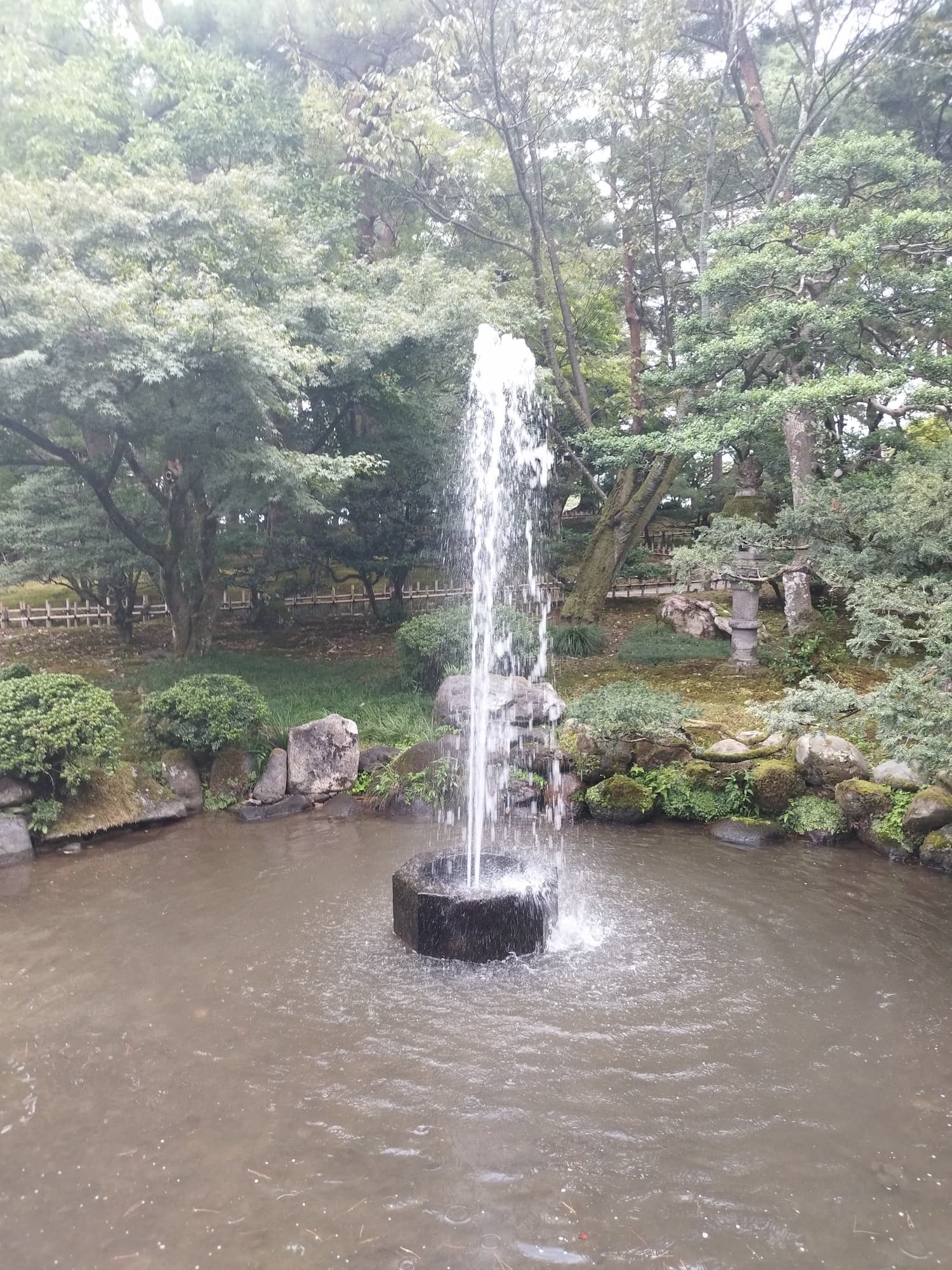
Welcome! I’m Mine, your local Japanese garden insider in Kanazawa. Welcome to the official feature page for Japan’s Oldest Fountain (Funsui)—a remarkable mid-19th-century engineering marvel in Kenrokuen Garden that shoots water 3.5 meters high purely through natural gravity pressure, without using a single electric pump!

Driven by the 5-meter elevation difference from Kasumiga-ike Pond via the historic Tatsumi Waterway’s reverse-siphon technology, this fountain is both a landmark of samurai hydraulic engineering and one of the most profitable green attractions in garden history.
✨ Jump Straight to the Secrets & Mysteries of Historic Fountain!
📍 Quick Navigation: Jump to Other Highlights
7. Historic Fountain (Funsui)
7.1 Essential History & Key Facts
- Japan’s Oldest Surviving Fountain
Built in 1861 during the late Edo period, this is considered the oldest surviving fountain in Japan. - Prototype for Kanazawa Castle Water System
It was reportedly created as a prototype for a water‑supply system planned for Kanazawa Castle, including the idea of installing a fountain inside the castle. - Gravity-Powered Fountain Without Electricity
Since electricity and pumps did not exist at the time, the fountain was designed to operate entirely by gravity using water from Kasumiga Pond, located about five meters higher. - Reverse-Siphon Hydraulic Engineering
It uses a reverse‑siphon “fusegoshi” system, where water flows through a pipe that dips once before rising—an important example of hydraulic engineering from the period. - Height Controlled by Natural Water Pressure
Because it relies solely on natural water pressure, the fountain’s height changes with the water level of Kasumiga Pond, making it a rare surviving example of pre‑modern engineering.
7.2 Fun Backstories & Mysteries
Q1: Why Is There a Fountain in This Historic Garden?
- As you say, a fountain might seem out of place in a garden with more than three hundred years of history.
- It’s said that this fountain is a remnant of a trial project carried out about 150 years ago to test a fountain for Kanazawa Castle.
- That was during the samurai era, long before electricity, so they had to test whether water could really be raised using only physical mechanisms.
- Fortunately, four hundred years earlier, water had been channelled from the upper river through an underground tunnel to Kenroku-en, so they knew it was possible.
- If there is an elevation difference between the water source and the destination, water can be conveyed using the inverted‑siphon principle, so they applied that idea.
- So the water here is pushed upward by the pressure created by the height difference between this fountain and the pond above it.
- The information board says this is Japan’s oldest fountain, and while that’s true, as a guide I sometimes find myself at a loss for words.
- Even if it’s the oldest in Japan, at only about 150 years, I wonder if it really resonates with Western visitors who have enjoyed fountains since the Roman Empire.
- So every now and then, I feel like explaining it this way.
- This is the most profitable fountain in Japanese history—after all, it earns admission fees from millions of visitors every year without paying for an electric pump!
Q2: Could You Explain the Mechanism That Uses Water Pressure to Lift Things a Little More Clearly?
- The secret is that the pond above us is about five meters higher than this fountain.
- Water flows from the pond through underground pipes, and gravity creates pressure as it moves downward.
- That pressure is strong enough to push the water back up through this fountain nozzle.
- In other words, the fountain doesn’t need a pump or electricity. Gravity does all the work.
- This kind of engineering was not new to the people of Kanazawa.
- Back in 1632, they had already built an 11-kilometer waterway, including more than four kilometers of underground tunnels.
- They even used specially made underground stone pipes to carry water across a moat and up into Kanazawa Castle.
- So you could say that the people of Kanazawa were quite advanced in hydraulic engineering, even 400 years ago.
- Even so, the height of the fountain varies depending on the water level in the pond above—that is, the water pressure.
- I sometimes think this fountain is just like a company employee. It works under constantly changing pressure. But sometimes I do feel a little envious. It doesn’t have a boss constantly nagging it! (laughs)
Official Links & Resources
Thank You & Message from Mine

👆 Did you enjoy learning about the gravity-powered secrets of Japan’s Oldest Fountain? To explore other iconic highlights like Midori-taki Waterfall or the Yamato Takeru Statue, use the navigation buttons above!
🛡️ Travel Safety Notice: Enjoying Historical Paths with Peace of Mind
Kenrokuen and other historical Japanese landscapes feature ancient stone steps, stepping stones, and natural gravel paths. While breathtaking, unexpected trips or stumbles can occur. For international visitors exploring Kanazawa and Japan’s heritage sites, securing real-time travel health insurance is strongly recommended for seamless medical support during your trip.
⚔️ SafetyWing – Real-Time Travel Insurance for Global Travelers (Check Details)