Welcome! I’m Yui, your local satoyama and nature insider in Japan. How does a roof made purely of dried grass protect a mountain farmhouse against two meters of winter snow and scorching summer heat?
Dating back to prehistoric Jomon pit dwellings, thatch roofing (kayabuki) is one of Japan’s oldest architectural traditions. In Shirakawa-go, layers of hollow pampas grass (susuki) nearly one meter thick act as natural insulation and a breathable dehumidifier—though they also carry a serious fire risk. Here, I’m sharing 10 essential facts and humorous insider stories (including a tricky pronunciation trap and a Margaret Thatcher joke) you won’t find on standard tours!
✨ Jump Straight to Thatch Roof Facts & Secret Stories!
If these stories spark your curiosity, stand beside the eaves of a Gassho-zukuri farmhouse and look up at the sheer thickness of the layered grass when you visit Shirakawa-go. We’re excited to welcome you—see you in Shirakawa-go!
📍 Table of Contents (Click to Jump)
11. Thatching & Roof Maintenance (Overview)
11.1 Essential History & Key Facts
- Ancient Roots Dating Back to Jomon Pit Dwellings
Thatch roofing is believed to have been used on pit dwellings in the Jomon period, making it one of the earliest Japanese roof styles. - Transition to Tile Roofs and Rural Sumptuary Bans
Because thatch is highly flammable, many roofs in Japan gradually transitioned to tile, though tile roofs were once prohibited in some rural areas because they were considered a luxury. - Regional Plant Selection Behind the Term “Thatch”
“Thatch” is a general term for plants used as roofing material, and each region chooses the species that best suits its climate. - From Durable Kariyasu Grass to Pampas Grass (Susuki)
In Shirakawa-go’s gassho-zukuri houses, the more durable kariyasu grass was once a major thatch material, but today pampas grass (susuki) is more commonly used. - Systematic Cultivation in Village Thatch Fields (Kayaba)
Pampas grass grows wild in sunny mountain fields across Japan, yet many villages cultivate it systematically in nearby “thatch fields,” or kayaba. - 20-to-30-Year Re-Thatching Cycle for Pampas Grass Roofs
Thatch roofs made with pampas grass are slightly less durable than those made with reeds and typically require re-thatching every 20 to 30 years. - Meter-Thick Thatch Layers Acting as Natural Insulation
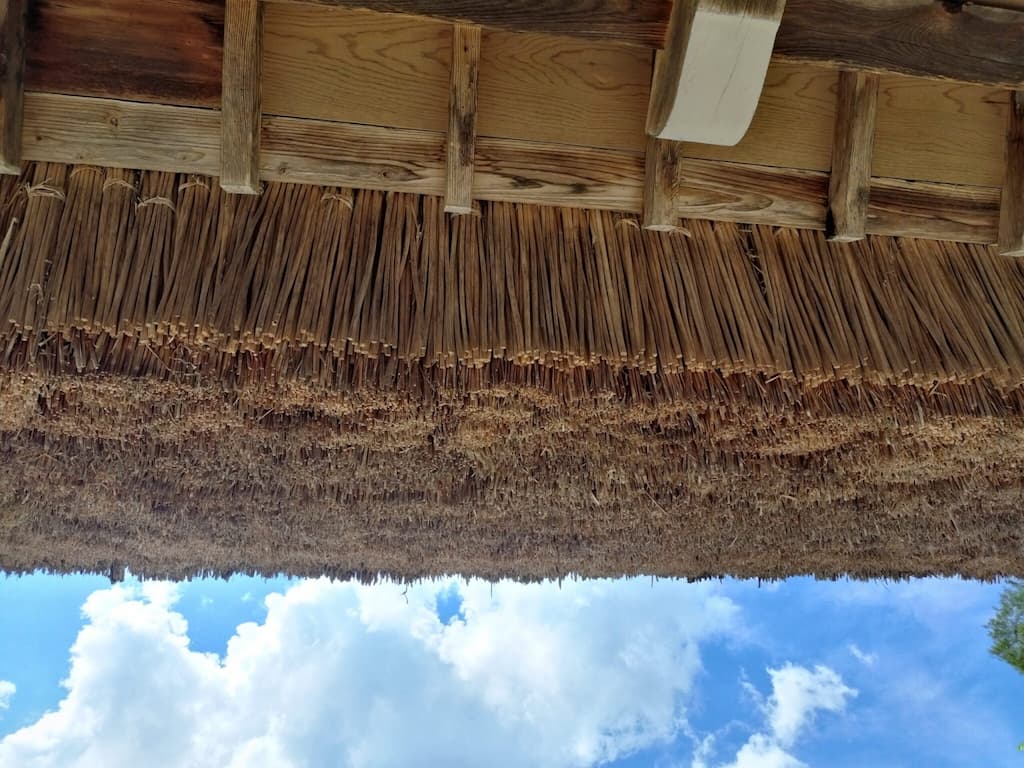
A thick layer of thatch—sometimes nearly one meter deep—acts as natural insulation, keeping homes warm in winter and cool in summer. - Breathable Bundle Gaps Preventing Attic Moisture
The natural gaps between thatch bundles allow air to circulate through the attic, helping to prevent moisture buildup. - Natural Ventilation Preserving Structural Longevity
This ventilation system also acts as a natural moisture-control system, helping preserve the roof’s structure over time. - Impressive Scale and Thickness Seen from the Eaves
Standing beside a gabled house and gazing up at its roof, one can truly appreciate the sheer volume and thickness of the thatch.
11.2 Fun Backstories & Mysteries
Q1. What are these roofs made of?
This is easily the most common question travelers ask when standing beside a Gassho-zukuri farmhouse. The first half (1–6) covers the shift from kariyasu to hollow susuki grass and its fire vulnerability, while the second half (7–10) shares a guide’s risky pronunciation battle with “pampas grass” vs. “Pampers.”
- Today, the roofs in Shirakawa-go are primarily made using pampas grass (susuki). However, this wasn’t always the case. Traditionally, a grass called kariyasu was the main roofing material.
- Kariyasu grew in the mountain areas surrounding the village, where local families maintained their own fields to produce roofing materials.
- Over time, as kariyasu became harder to obtain, pampas grass gradually became a more common alternative. It grows quickly and is relatively easy to find.
- Pampas grass grows to about one to two meters tall and has hollow stems. Once dried, it becomes lightweight and surprisingly durable.
- By layering it many times, they create a thick roof, sometimes nearly one meter thick. It traps a large amount of air, providing excellent insulation and keeping the house cool in summer and warm in winter.
- However, dried pampas grass is highly flammable, and the village has historically suffered severe damage from fires.
- It’s nowhere near that level of damage, of course, but as a guide, I face a new kind of damage risk myself—pronunciation!
- Since susuki is often referred to as pampas grass in English—a name derived from the Pampas, the vast grasslands of South America—I always try to pronounce it carefully.
- If I get the pronunciation wrong and say pamper grass, you might imagine a VIP grass getting the royal treatment at a spa! Worse still, if it sounds like Pampers, I have to warn you: Please don’t put this anywhere near your baby! Its leaves are sharp enough to give you a nasty cut!
- But when I think about it, all I have to do is pronounce it correctly. Maybe I’m being a little too hard on myself over a blade of grass!
Q2. What Is ‘Kaya’?
Visitors who read local brochures often ask what the Japanese word kaya actually refers to. The first half (1–5) explains how kaya and English “thatch” are umbrella terms for regional roofing plants, while the second half (6–10) explores why bringing up Margaret Thatcher (“the Iron Lady”) can spark an internet wildfire.
- First of all, kaya is not the name of a specific plant. It’s a general term for various grasses and other plants traditionally used for roofing.
- Many people think kaya simply means pampas grass, or susuki. But that’s not quite correct. Susuki is just one of several plants that can be used for thatching.
- Depending on the region, people have used different materials, such as pampas grass, reeds, rice straw, and other grasses. They chose whatever was available locally and suited the climate.
- In English, we use the word thatch for these roofing materials. A roof covered with thatch is called a thatched roof.
- The process of covering a roof with thatch is called thatching. So, we have thatch, thatching, and thatched roofs. They’re all related, but used in slightly different ways.
- If guests are unfamiliar with the word “thatch,” I sometimes introduce Margaret Thatcher, the former British Prime Minister. As in Japan, thatched roofs were once common in Britain, and many people worked as thatchers.
- The surname Thatcher literally means “a thatcher”—someone who makes or repairs thatched roofs. In other words, her family name comes from an old occupation.
- The problem is that this joke doesn’t always land. Perhaps there’s a mismatch between her image as the “Iron Lady” and the charming, rustic image of these thatched-roof houses. Or perhaps some people simply don’t like her politics.
- So these days, I save the Thatcher joke for the right audience. After all, it would be terrible if someone misunderstood my explanation and posted a negative comment about me on social media.
- Of course, thatched roofs are vulnerable to fire, but a real fire is not quite as simple as people might imagine. But a misunderstanding on the internet? That can spread like wildfire!
Official Links & Resources
UNESCO World Heritage Centre: Historic Villages of Shirakawa-go and Gokayama
Thank You & Message from Yui
👆 Thank you for reading to the end! If you have any questions, customized itinerary inquiries, or travel planning feedback, please feel free to reach out anytime.
🛡️ Travel Safety Notice: Enjoying Historical Paths with Peace of Mind
Shirakawa-go and other rural Japanese heritage sites feature uneven stone steps, snow-covered footpaths, and historic steep timber staircases. While breathtaking, unexpected trips or stumbles can occur. For international visitors exploring Japan’s countryside, securing real-time travel health insurance is strongly recommended for seamless medical support during your trip.
⚔️ SafetyWing – Real-Time Travel Insurance for Global Travelers (Check Details)