Welcome! I’m Yui, your local satoyama and nature insider in Japan. Looking down on Ogimachi Village from the hillside viewpoint, have you ever wondered why every single Gassho-zukuri farmhouse faces the exact same north-south direction?
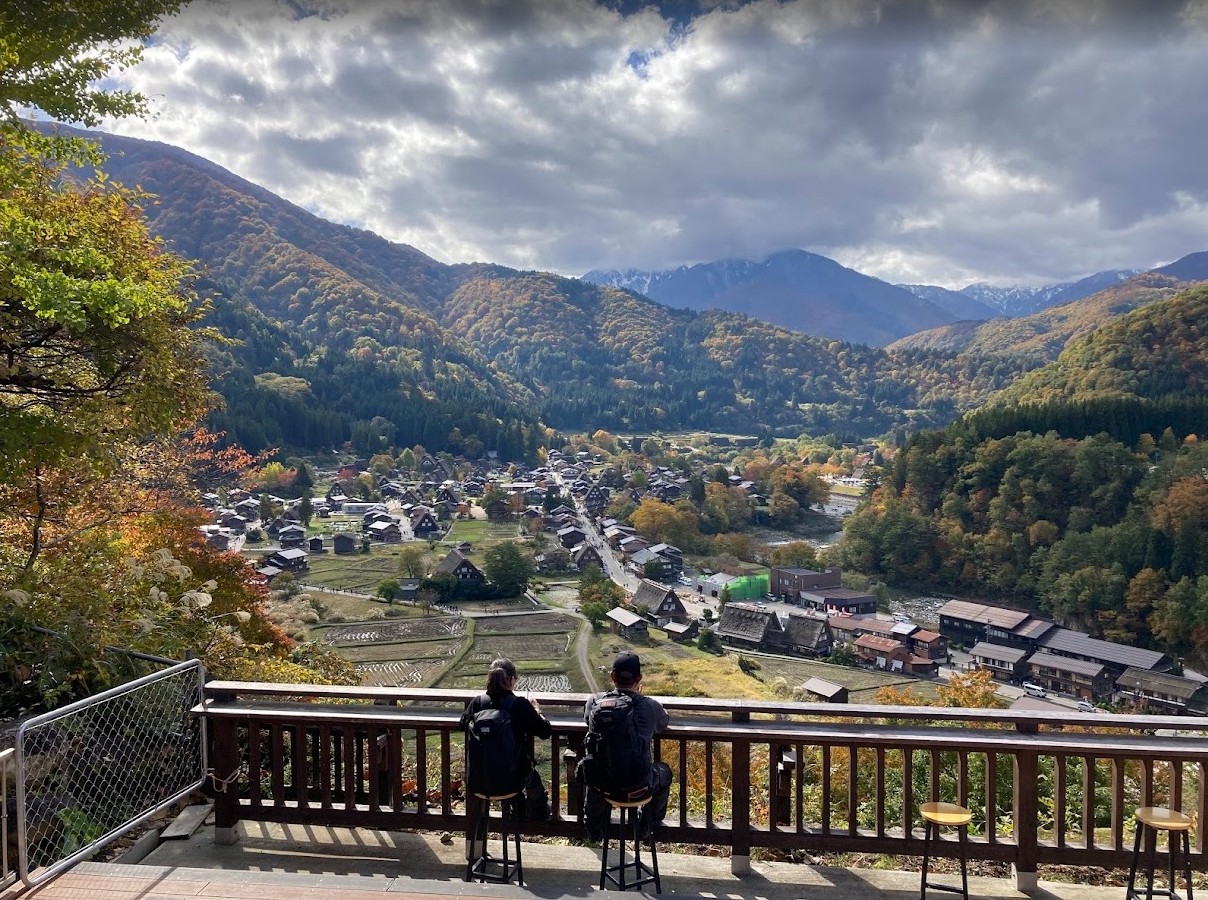
From the Ogimachi Castle Ruins and adjacent observation deck, the rational urban planning of Shirakawa-go becomes crystal clear—aligned with prevailing valley winds and the sun’s east-west path to maximize ventilation, sunlight, and protection from storms. Together with the pragmatic history of Ogimachi Castle itself, here are 10 essential facts and humorous insider stories you won’t find on standard tours!
✨ Jump Straight to Viewpoint Facts & Secret Stories!
If these stories spark your curiosity, take a moment to notice the varying roof angles and the quiet mountain fortress ruins right beside the busy observation deck when you visit Shirakawa-go. We’re excited to welcome you—see you in Shirakawa-go!
📍 Table of Contents (Click to Jump)
9. Castle Site & Viewpoint (Overview)
9.1 Essential History & Key Facts
- Panoramic Bird’s-Eye View Accessible by Shuttle Bus or on Foot
On high ground in the south of Shirakawa-go, the castle ruins and observation deck offer a recommended spot for a bird’s-eye view of the entire area, accessible by shuttle bus or on foot. - Uniform North-South Alignment of Gassho-Zukuri Houses
Looking down from there, you can see the main street in the middle, with many gassho-zukuri houses beautifully lined up around it, their gable ends—sides with windows—all facing north-south. - Valley Wind Corridor Boosting Cross-Ventilation
This village is located in a long, narrow, crescent-shaped valley running from north to south, with the wind consistently flowing along the river in the same direction, which improves window ventilation. - Minimal Gable Profile Reducing Storm and Wind Damage
At the same time, the north-south winds can often be so strong and damaging that the gable ends, having the least surface area, are oriented in the same direction to reduce wind damage. - Solar Orientation Maximizing Natural Daylight
This window orientation considers the sun’s movement, allowing plenty of sunlight and showcasing the village’s practical design. - Ogimachi Castle’s Pragmatic Design Using Natural Slopes
Unlike many Japanese castles built to demonstrate authority, Ogimachi Castle was constructed on a hill, utilizing the steep slopes on three sides as natural moats and keeping its size minimal for practical purposes, showcasing the same rational mentality seen in gassho-zukuri. - Compact Single-Enclosure Lookout Over Historic Trade Routes
The castle is one of the smallest, with only a single enclosure, but it overlooks a key transportation route in the area, making it an ideal vantage point for monitoring movement from neighboring regions and evoking the feeling of a sentry in the samurai era. - Only About 100 Surviving Farmhouses Out of Nearly 2,000
There used to be nearly 2,000 gassho-zukuri houses, but most were lost to modernization, including dam construction and redevelopment, leaving only about a hundred today—resembling dwarf houses from a fairy tale or mythical stages that can only be found here. - Lively Observatory Dining vs. Poetic Tranquility at the Castle Ruins
On the heights of this observatory, you can enjoy the luxury feeling of photography, souvenir shops, and a restaurant overlooking this spectacular view, and the tranquil feeling of a poet like Homer at the ruins of the castle right next door. - Varying Roof Angles Reflecting Climate Change and Economic Shifts
From this vantage point, you can see that some houses have different roof angles, reflecting the influence of global warming and economic downturn—less snowfall and a shift away from reliance on sericulture—while the unchanged wind flow shaped by the geographic topology remains constant.
9.2 Fun Backstories & Mysteries
Q1. Why are we so drawn to this landscape?
While gazing out over the panoramic view of Ogimachi Village, visitors often share how deeply moved they feel by the scenery. The first half (1–6) explores the hidden economic and climate realities behind those iconic roofs, while the second half (7–10) pitches a tongue-in-cheek tourism slogan for a global climate summit.
- This observation deck is one of the most popular spots in Shirakawa-go. If you’ve looked at tourist websites before coming here, you’ve probably seen this view already.
- As you can see, it’s not particularly high up. Yet there is something about this landscape that feels both nostalgic and comforting. To many visitors, it looks like a fairy-tale village tucked away in the mountains, or perhaps a mythical world quietly watched over by the gods.
- But this beautiful view doesn’t tell the whole story.
- The people who live here face challenges that most visitors never see. Maintaining traditional thatched roofs is extremely expensive, and as a result, more houses are now being built with conventional roofing materials.
- Snowfall patterns are changing as well. In the past, the steep 60-degree roof angle was essential for shedding the region’s heavy snow. Today, with less snowfall than before, gentler roof angles have become increasingly practical.
- There are places around the world where the effects of climate change can actually be seen. This viewpoint may be one of them.
- By tracking changes in roof designs over time, Shirakawa-go could even serve as a living indicator of climate change.
- In fact, why not promote this World Heritage site as the venue for an international climate summit?
- After all, Shirakawa-go sits at an elevation of about 600 meters above sea level. If rising sea levels ever reached high enough to submerge this village, it would probably mean the end of the world anyway!
- Until then, we can keep taking measurements and monitoring the situation right here.
Now that’s what I call a memorable tourism slogan!
Q2. When was this observation deck built?
Visitors often ask about the history of this viewpoint while taking photos. The first half (1–7) uncovers the strategic Warring States fortress that once guarded the mountain passes—and the secret saltpeter trade below the village—while the second half (8–10) compares that explosive tension to keeping tour guests happy.
- This observation deck is relatively new as a tourist facility, but the hill itself has a much longer history. During the Warring States period, a small mountain fortress known as Ogimachi Castle once stood here.
- Unlike the large Japanese castles you may have seen elsewhere, Ogimachi Castle was extremely small. It consisted of just a single fortified enclosure protected by earthworks, dry moats, and steep slopes.
- There was no castle tower or grand residence. It was not intended to be a place where a lord lived permanently.
- Its main purpose was to monitor the Shirakawa Highway, an important route that followed the Shogawa River through the mountains. From here, guards could monitor travelers and keep an eye on the surrounding mountain passes.
- Although Shirakawa-go looks like a remote mountain village today, it was once a strategically important location. Anyone traveling through this region had to pass through a limited number of mountain routes.
- In other words, controlling these routes meant controlling the movement of people, goods, and potentially even enemy forces.
- From this viewpoint, the village appears peaceful and timeless. Yet beneath many of these gassho-style houses, people once produced saltpeter, one of the key ingredients needed to make gunpowder.
- Because of this valuable industry, the guards at Ogimachi Castle may have kept a close watch for spies or suspicious visitors sent by rival domains.
- In a sense, this quiet village was literally a powder keg. One careless mistake could have led to an explosive situation.
- As a tour guide, I can understand that kind of tension. After all, even a lovely guest could explode with a single rude comment from me.
Well… except for you, of course.
Official Links & Resources
UNESCO World Heritage Centre: Historic Villages of Shirakawa-go and Gokayama
Thank You & Message from Yui
👆 Thank you for reading to the end! If you have any questions, customized itinerary inquiries, or travel planning feedback, please feel free to reach out anytime.
🛡️ Travel Safety Notice: Enjoying Historical Paths with Peace of Mind
Shirakawa-go and other rural Japanese heritage sites feature uneven stone steps, snow-covered footpaths, and historic steep timber staircases. While breathtaking, unexpected trips or stumbles can occur. For international visitors exploring Japan’s countryside, securing real-time travel health insurance is strongly recommended for seamless medical support during your trip.
⚔️ SafetyWing – Real-Time Travel Insurance for Global Travelers (Check Details)