Welcome! I’m Yui, your local satoyama and nature insider in Japan. Why did Shirakawa-go villagers call silkworms “o-kaiko-sama”—with the same honorific reserved for respected deities and elders?
In a mountain valley with limited farmland, sericulture (silkworm farming) was the economic lifeline of Shirakawa-go. Stepping into a farmhouse attic, you’ll discover wooden spinning wheels, nets, and lattice cocooning frames (mabushi) engineered around a silkworm’s natural instinct to climb upward. Here, I’m sharing 10 essential facts and humorous insider stories you won’t find on standard tours!
✨ Jump Straight to Sericulture Facts & Secret Stories!
If these stories spark your curiosity, take a close look at the rotating cocoon frames and spinning tools displayed in the attics when you visit Shirakawa-go. We’re excited to welcome you—see you in Shirakawa-go!
📍 Table of Contents (Click to Jump)
8. Sericulture & Silk Legacy (Overview)
8.1 Essential History & Key Facts
- Gratitude and Respect Embodied in the Name “O-kaiko-sama”
Silkworms, which provided valuable supplementary income to the modest farm earnings, were respectfully called ‘o-kaiko-sama’ (meaning ‘Mr./Mrs. Silkworm’), reflecting the local mentality of gratitude and reverence for everything nature provides. - Sericulture vs. Silk Spinning in Raw Silk Production
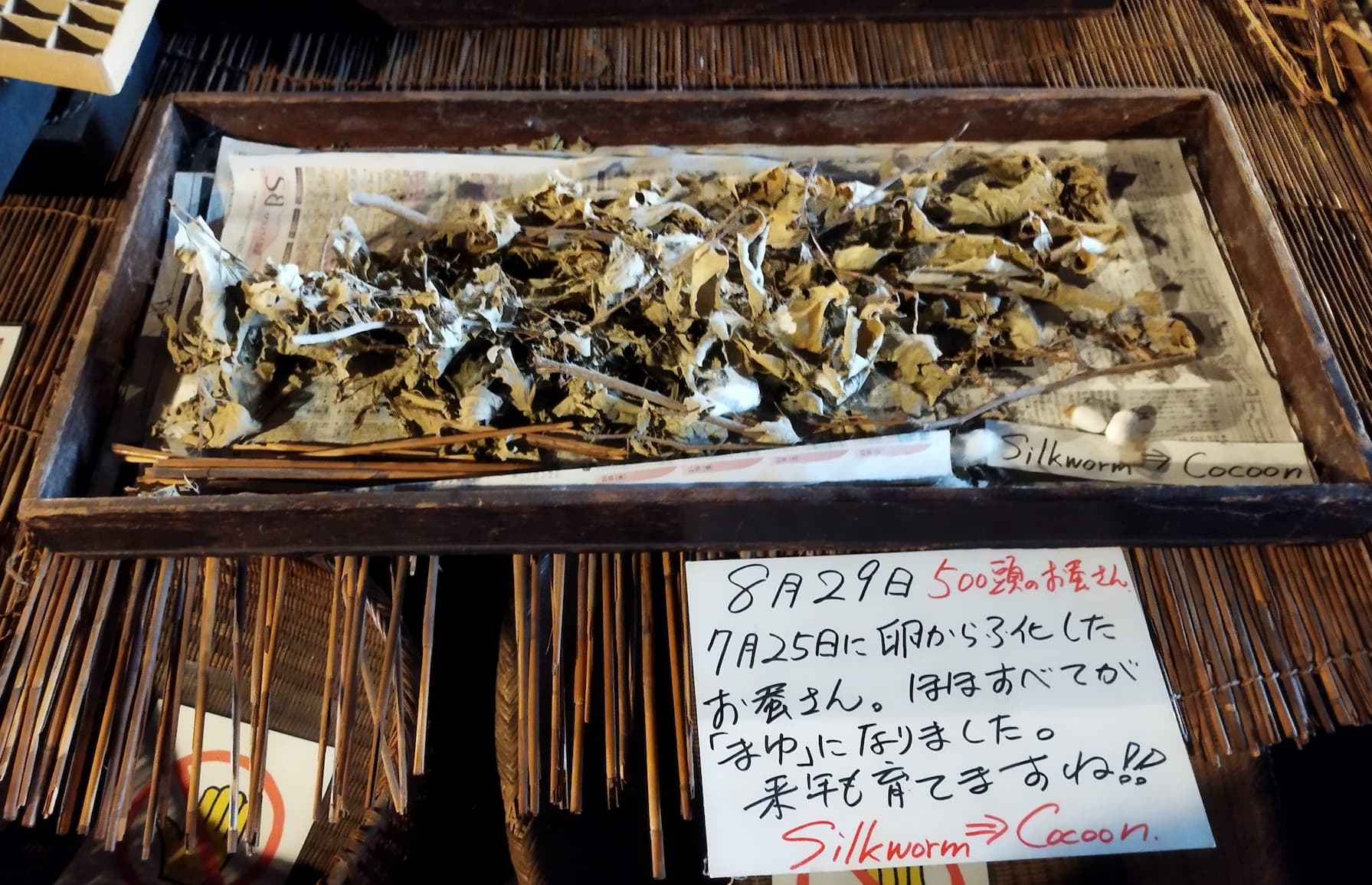
Raw silk production can be divided into two main stages: sericulture, where silkworms are raised from eggs until they form cocoons, with tools for this process displayed here, and spinning, where raw silk is extracted from the cocoons. - A Short 50-Day Lifecycle Preserved in Attic Displays
During their short 50-day life, silkworms hatch from eggs, feed on mulberry leaves, and mature to form cocoons, the remnants of which visitors can see through displays of panels and various tools. - 24-Hour Environmental Care for Delicate Silkworms
Since the quality of silk was greatly affected by the health of silkworms, the attic required 24-hour attention to maintain the right amount of mulberry leaves, temperature, and humidity, as silkworms were extremely sensitive and delicate. - Four-Stage Metamorphosis and Timing of Cocoon Shipment
The silkworm undergoes complete metamorphosis in four stages: egg, larva, pupa, and adult. After molting four times and forming a cocoon to become a pupa before reaching adulthood, the cocoon is shipped to the next silk manufacturer. - Nearly One Kilometer of Silk Thread from a Single Cocoon
After the cocoons are dried with steam heat and stored for a certain period, they are unraveled in boiling water and transformed into silk yarn, with each cocoon producing nearly one kilometer of thread. - Dramatic Growth That Inspired Classic Movie Monsters
Silkworms undergo such dramatic changes in size and form from birth to cocoon-making that they have inspired monster designs in movies. Their weight increases by about 10,000 times, and their silk glands, which produce the silk threads, grow more than 100,000 times. - Ingenious Nets and Lattice Boards Utilizing Climbing Instincts
Utilizing the silkworms’ natural tendency to climb, two special devices were invented: a net with holes that allows them to climb through, separating their droppings below, and lattice-shaped boards that encourage them to move up into small compartments to spin their cocoons, resulting in neatly aligned cocoons without manual labor. - Male vs. Female Silkworm Silk Output Without Discrimination
Male silkworms produce higher-quality silk and about 20% more than females, but there seems to be no records showing that female silkworms were avoided due to this disadvantage, even during the class-based Samurai period. - Schoolroom Memories and the Rain-Like Sound of Mulberry Feeding
Although the sericulture industry has declined, many people experienced raising silkworms, mainly at school, and vividly remember the sound of silkworms devouring mulberry leaves—much like the sound of light rain or distant waves. Some children even ate their meals quietly after hearing it.
8.2 Fun Backstories & Mysteries
Q1. What is this lattice-like board (mabushi)?
Visitors often point to the wooden or straw grid frames in the attic and ask what they were used for. The first half (1–6) explains the clever engineering behind traditional and rotating mabushi frames, while the second half (7–10) compares a silkworm’s upward climb to the modern mortgage trap.
- This frame, called a mabushi, is made of wood or woven straw, with small compartments where silkworms spin their cocoons.
- Silkworms cannot spin cocoons on a flat surface, so they need the mabushi as a scaffold, much like the scaffolding used in construction.
- Silkworms naturally climb upward. When the frame is placed above them, they climb into the individual compartments and spin their cocoons there.
- However, removing the finished cocoons without damaging them is time-consuming and labor-intensive, so a new device was developed. This new type rotates vertically, like a Ferris wheel.
- Placed among the silkworms, it allows them to climb into the highest available compartments and spin their cocoons there. As the upper compartments fill with silkworms, their weight makes the frame rotate downward, bringing the empty lower compartments to the top.
- The other silkworms then fill the new upper compartments, repeating the process until every space is neatly filled with cocoons—with little manual effort.
- That’s a brilliant idea! But doesn’t it make you think of human nature—and feel a little sad? Like silkworms, humans have an upward drive. When we see an opportunity, we want to climb up and build a comfortable, cocoon-like home for ourselves.
- But the mortgage on that dream home can gradually push us among the working poor, sometimes making us feel we’ve fallen to the bottom of society—just like the silkworms being carried downward by this rotating mabushi.
- What’s more, after working so hard to build our cozy cocoon, we may never get to enjoy living in it. Someone else might take it away from us—just like what happens to silkworms.
- We increasingly hear stories of husbands getting divorced later in life, grumbling like this:
“My cozy cocoon-like home is about to be taken over by my tycoon-like wife!”
Q2. What is a silkworm?
For guests who have never seen a silkworm up close, this basic question opens up thousands of years of fascinating history. The first half (1–7) covers how domesticated silkmoths shaped life in Shirakawa-go, while the second half (8–10) compares silkworms to modern AI.
- Despite its name, a silkworm is not actually a worm, but the caterpillar of a domesticated silkmoth.
- These tiny larvae eat nothing but mulberry leaves and grow rapidly, shedding their skin four times in about a month.
- Once fully grown, each silkworm spins a protective cocoon from a single continuous filament of silk, which can reach up to 1,500 meters in length.
- Thousands of years ago, people in ancient China discovered how to reel this delicate filament into silk thread and weave it into fine, lustrous fabric.
- Through thousands of years of selective breeding, domesticated silkmoths lost their ability to fly, while silkworms became completely dependent on humans to survive.
- Eventually, sericulture spread to Japan and became a vital livelihood in snowy mountain regions like Shirakawa-go, where rice farming was limited.
- By the late 19th century, raising these delicate creatures in the attics of gassho-zukuri houses had become the village’s major industry.
- Looking at the history of sericulture, I can’t help thinking of modern AI. Interestingly, AI doesn’t have to stand only for Artificial Intelligence; we can also play with words like Agriculture and Artistic.
- Both silkworms and AI consume enormous amounts of data and mulberry leaves every day, yet provide wonderful things for humanity.
- But don’t you think silkworm AI is better than modern AI? Unlike today’s AI, it never goes out of control. After all, silkworm AI has no wings!
Official Links & Resources
UNESCO World Heritage Centre: Historic Villages of Shirakawa-go and Gokayama
Thank You & Message from Yui
👆 Thank you for reading to the end! If you have any questions, customized itinerary inquiries, or travel planning feedback, please feel free to reach out anytime.
🛡️ Travel Safety Notice: Enjoying Historical Paths with Peace of Mind
Shirakawa-go and other rural Japanese heritage sites feature uneven stone steps, snow-covered footpaths, and historic steep timber staircases. While breathtaking, unexpected trips or stumbles can occur. For international visitors exploring Japan’s countryside, securing real-time travel health insurance is strongly recommended for seamless medical support during your trip.
⚔️ SafetyWing – Real-Time Travel Insurance for Global Travelers (Check Details)