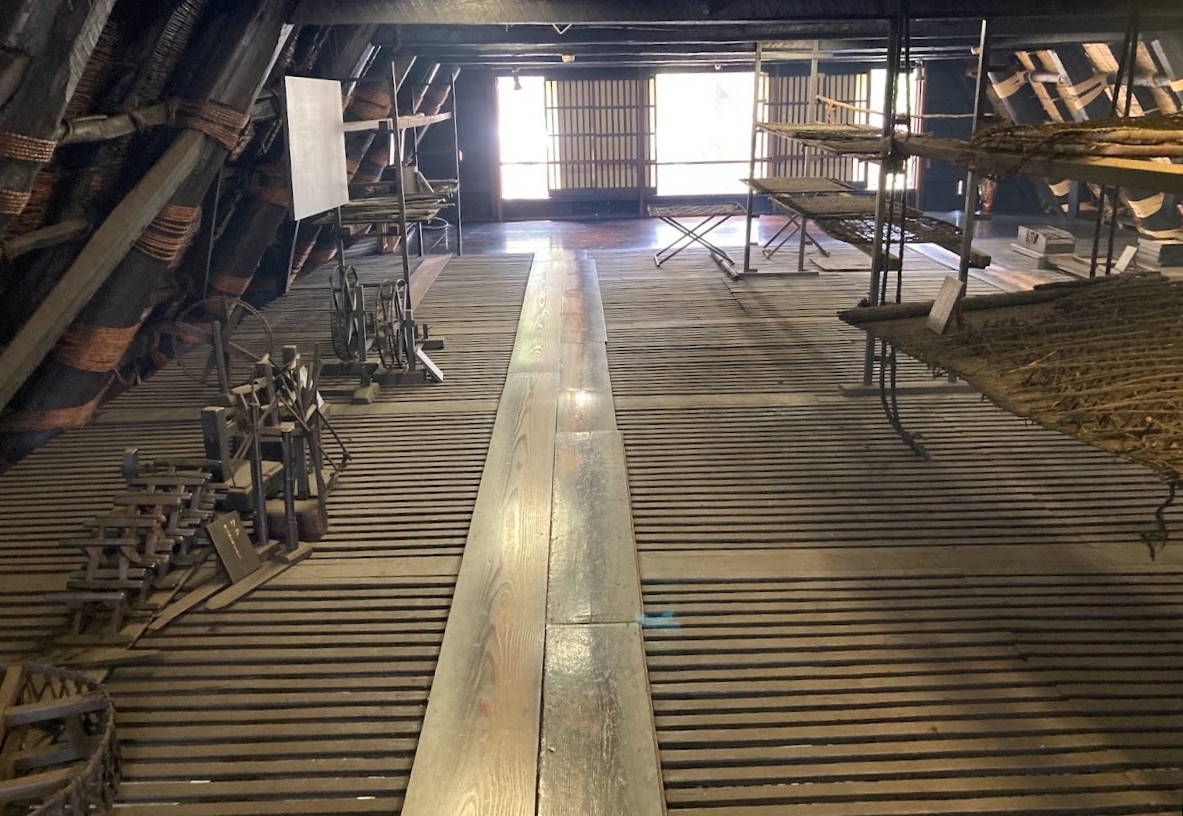
Welcome! I’m Yui, your local satoyama and nature insider in Japan. Did you know that the massive, multi-story attic above a Gassho-zukuri farmhouse wasn’t just for storage—it was actually a high-efficiency silk production factory?
While ordinary Japanese attics are small storage lofts, Shirakawa-go’s vast, multi-tiered attics served as the economic engine of the village through sericulture (silkworm farming). By cleverly harnessing rising warmth and smoke from the downstairs hearth along with natural light and ventilation from gable windows, villagers created an ingenious, zero-energy mass-production system. Here, I’m sharing essential facts and humorous insider stories you won’t find on standard tours!
✨ Jump Straight to Attic Workspace Facts & Secret Stories!
If these stories spark your curiosity, be sure to climb up the steep wooden stairs into the sunlit upper levels of a farmhouse during your Shirakawa-go trip. We’re excited to welcome you—see you in Shirakawa-go!
📍 Table of Contents (Click to Jump)
6. Attic Workspaces (Overview)
6.1 Essential History & Key Facts
- Upper Stories Engineered Specifically as Workspaces
The upper floors, starting from the second, were efficiently designed and utilized as workspaces, with a mezzanine floor sometimes reserved for servants’ families. - Multi-Tiered Attics Maximizing Productive Floor Area
The attic of a typical Japanese house is small and used only for storage, but here, the attic is spacious, and by dividing it into multiple stories, it maximizes the available workspace. - Driven by Market Competitiveness and Economic Efficiency
The attics here have evolved to enhance the productivity of the highly profitable sericulture work, making it more competitive in the marketplace by applying the same economic principles as modern business. - Streamlined Vertical Workflow Across Two to Five Levels
Dividing the attic into two to five layers creates more workspace, but it also increases the time spent moving between floors, so the workflow layout was carefully arranged to maximize efficiency. - Smart Floor Placement by Silkworm Growth Stage
For example, young silkworms were raised on the lower floor near the living area because they required constant monitoring and care, while adult silkworms were moved to the upper floor as they required less labor. - Natural Humidity Gradation from the First-Floor Hearth
Furthermore, the heat and smoke rising from the hearth on the first floor gradually and naturally adjusted the humidity on each floor as one ascended, allowing different floors to be used with varying humidity levels depending on the stage of silkworm growth. - Warm, Dry Microclimate Maintained by Thatch Ventilation
Likewise, the heat and smoke rising from below are gradually expelled outward through the thatched roof, staying in the attic to maintain a stable warmth and dryness, creating an ideal environment for raising silkworms, which are sensitive to cold and moisture. - Zero-Energy Lighting and Airflow via Gable-End Windows
The gable-end design allows sunlight and air to enter the attic through windows on both sides, creating a bright and well-ventilated space without the need for air conditioning equipment. - Forerunner of Japan’s Low-Cost Mass Manufacturing Success
This vast and unique attic, seen only here, can be seen as a premonition of Japan’s later manufacturing and economic success, as it developed the nation’s largest mass production system for sericulture at the time, using a remarkably ingenious low-cost system that wisely leveraged the natural environment. - Historic Tools on Display and Secret Underground Saltpeter
You can see the equipment used for raising silkworms, as well as tools for farming and mountain work, offering a glimpse into life in those days. Additionally, some families secretly produced raw materials for gunpowder underground, providing another major source of income.
6.2 Fun Backstories & Mysteries
Q1. Is the interior of gassho-zukuri houses the same as the exterior?
This question often comes up while walking along streets lined with similar-looking gassho-zukuri farmhouses. The first half (1–6) covers the structural reasons behind their shared design, while the second half (7–10) is a playful, humorous take.
- Yes. Gassho-zukuri houses are built to withstand the harsh natural conditions of Shirakawa-go.
- Their design also reflects the need to improve the productivity of sericulture, which provided valuable cash income for families in a village with limited farmland.
- Both were essential for life here, so the basic structure of these farmhouses is quite similar, although the attic used for sericulture deserves special attention.
- The exposed framework of posts and beams, tied together with rope, gives the building flexibility to withstand strong winds and earthquakes.
- Over many years, smoke from the hearth has given the wooden beams a dark sheen and a unique luster, creating what feels like a natural work of art.
- Moreover, the design makes the most of natural light and airflow, creating a bright, open, and relaxing atmosphere, even without electricity.
- Just put a rustic wooden table by the window, and you could instantly turn this place into a stylish restaurant!
- After all, if this place was designed to provide the perfect environment for delicate creatures like silkworms, surely it must be comfortable enough for humans, too!
- How about calling it the “Cocoon Restaurant,” with mulberry leaf jam on the menu?
- And when you return home, I hope you’ll start a few online threads about your visit. After all, producing fine threads has always been the specialty of this house! (laughs)
Q2. Was this attic used for storage?
Because these attics today look like museum display rooms, visitors occasionally ask if they were originally built for storage. The first half (1–3) explains their history as sericulture workspaces, while the second half (4–10) takes a humorous detour comparing them to Egyptian pyramids.
- This attic is currently used to display traditional work tools, but it was originally used to raise silkworms for the sericulture industry.
- Over the centuries, it evolved into the large multi-story attic we see today in order to maximize profitability from sericulture. However, as the industry gradually lost its competitive edge, silkworms all but disappeared from this attic over the past hundred years.
- The items displayed here are reminders of the golden age of sericulture, when the income from this industry was enough to support a large, multi-generational family and maintain this enormous attic.
- Ironically, although Shirakawa-go lost out in the global silk market, it found new life in the global tourism market, preserving its former glory in a different form.
- In a way, it reminds me of the pyramids of Egypt, which still attract visitors from around the world long after the civilization that created them has passed.
- Both this attic and the pyramids are known for their dramatic slopes and mysterious appearance, making visitors wonder, “What on earth is this?”
- And when visitors step inside, they may notice another similarity. This attic was once a prosperous kingdom, and what they see today are the remains of its former glory.
- The forgotten rulers of this vanished kingdom were the moths. Destined to be sacrificed for silk production, they were never allowed to live out their full lives.
- Since the adult stage of a silkworm is called a moth in English, perhaps we could promote this attic as a unique attraction called “The Japanese Pyramid: Mausoleum of Moths.”
- During the tour, you may even find yourself naturally putting your hands together in gassho, just as Japanese people do when offering a prayer.
Official Links & Resources
UNESCO World Heritage Centre: Historic Villages of Shirakawa-go and Gokayama
Thank You & Message from Yui
👆 Thank you for reading to the end! If you have any questions, customized itinerary inquiries, or travel planning feedback, please feel free to reach out anytime.
🛡️ Travel Safety Notice: Enjoying Historical Paths with Peace of Mind
Shirakawa-go and other rural Japanese heritage sites feature uneven stone steps, snow-covered footpaths, and historic steep timber staircases. While breathtaking, unexpected trips or stumbles can occur. For international visitors exploring Japan’s countryside, securing real-time travel health insurance is strongly recommended for seamless medical support during your trip.
⚔️ SafetyWing – Real-Time Travel Insurance for Global Travelers (Check Details)