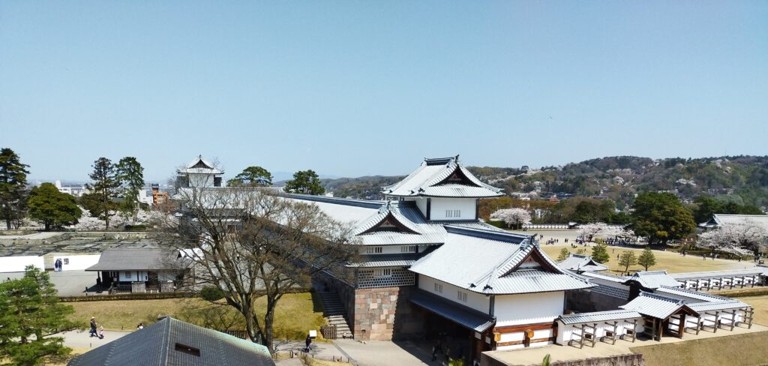
Welcome! I’m Genji, your local Japanese castle and samurai heritage insider in Kanazawa. Welcome to my insider guide for The Yagura Ruins (Ushitora, Tatsumi & Inui Turret Sites)—the strategic vantage points located at the corners of Honmaru, named after traditional Japanese zodiac directions!
Perched atop the highest elevated stone walls of the Honmaru citadel, three towering three-story watchtowers once stood here, monitoring for distant approaching enemies and fires. Named after the traditional zodiac compass directions—Ushitora (Northeast), Tatsumi (Southeast), and Inui (Northwest)—these sites reveal Edo-period spatial awareness and dual defensive strategies!
✨ Jump Straight to Yagura Ruins Secrets & Local Guide Insights!
📍 Quick Navigation: Explore Castle Highlights
13. Yagura Ruins (Ushitora, Tatsumi & Inui Turret Sites)
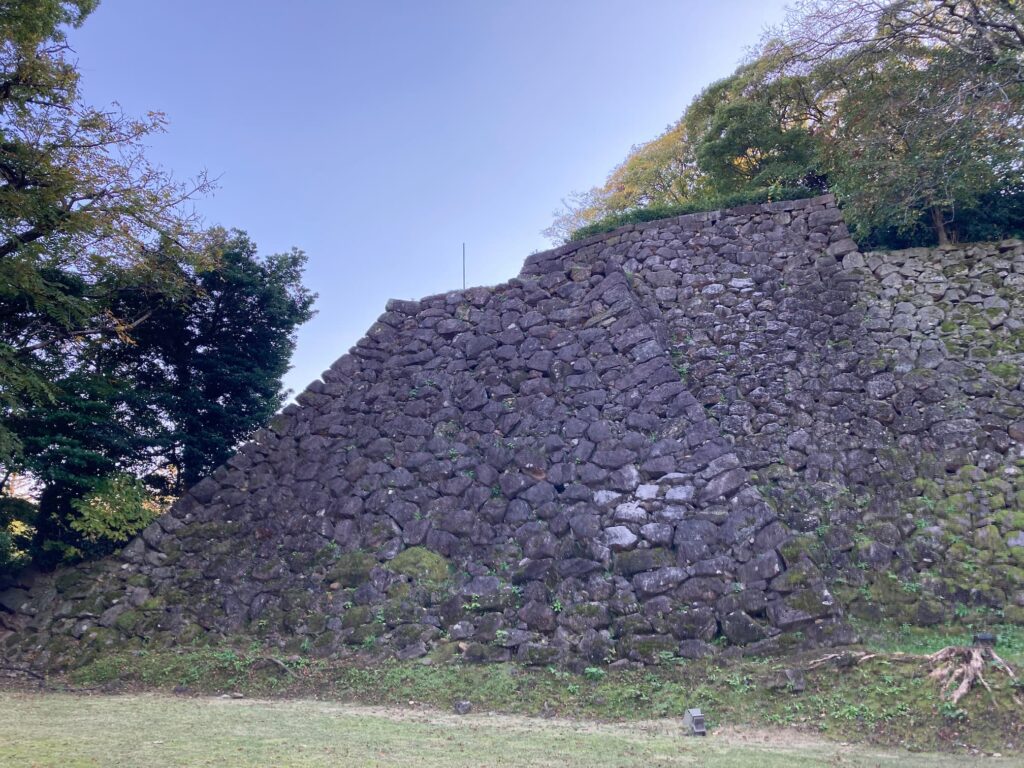
The Early Stone Walls That Supported the Ushitora Turret
13.1 Essential History & Key Facts
- Defensive Positions
The three turret sites remind us that the castle’s defenses depended not only on its walls, but also on where its watchtowers stood. - Watching for External Threats
The Ushitora and Tatsumi turrets stood on the eastern and southern sides of the Honmaru, helping guard approaches from the Kenrokuen and Kodatsuno areas, which were considered vulnerable routes for an attack. - The Inui Turret Role
Unlike the turrets watching for threats from outside, the Inui Turret was used to keep watch over the castle itself, including the Ninomaru. - The Meaning of the Names
The names Ushitora, Tatsumi, and Inui refer to traditional Japanese compass directions: northeast, southeast, and northwest, respectively. - A Lesson in Security
History offers many examples of kingdoms and organizations brought down by betrayal from within. The Inui Turret reminds us that protecting a castle meant watching not only the enemy outside, but also what was happening inside.
13.2 Fun Backstories & Mysteries
Q1.“What was this observation deck used for?”(Inui Turret)
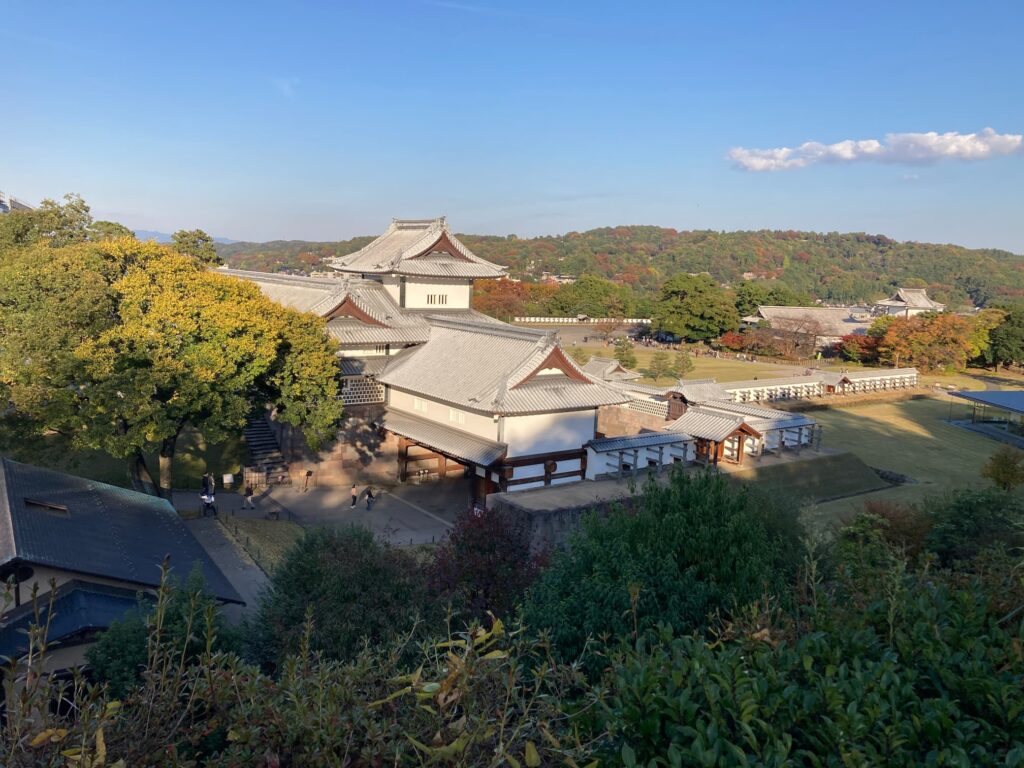
Is This the Shadow of a Wife’s Burning Anger? — View of the Inui Turret Site
Based on questions I’m often asked when standing at the Inui Turret Ruins, I’ve put together this story that weaves in historical explanations. The first half (1–5) covers the serious history, while the second half (6–10) brings out the lighthearted fun!
❶ Today, this spot is used as an observation deck, but there used to be a two-story turret here.
❷ Many castle turrets were built to watch for enemies outside, but I think this one also played an important role in keeping an eye on what was happening inside the castle.
❸ After all, throughout history, many kingdoms and governments have fallen not because of foreign enemies, but because of betrayal from within.
❹ Unfortunately, this turret was destroyed in the great fire of 1759 and was never rebuilt.
❺ By that time, the castle’s political center had already moved from the main enclosure to the second enclosure, so there was less need to rebuild it.
❻ But perhaps this place was still used for keeping an eye on things, even after the turret disappeared.
❼ By then, Japan was enjoying a long period of peace, so perhaps the biggest thing to watch out for was fire!
❽ Or perhaps it was used by wives to keep an eye on their husbands and make sure they weren’t having affairs!
❾ When I tell this joke, many female guests burst out laughing. That’s when I realize that this surveillance system is truly universal!
❿ After all, wives watching like hawks to make sure their husbands aren’t playing with fire are probably scarier than any actual fire, anywhere in the world!
Q2. What was this place used for? (Ushitora Turret)
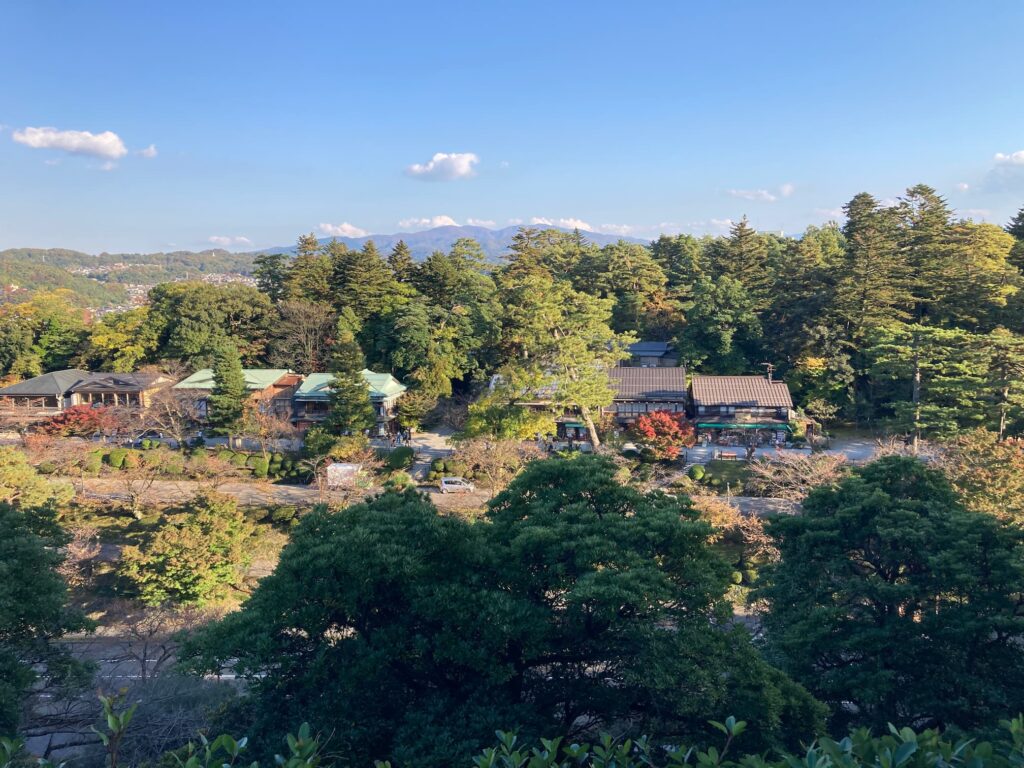
History Is Written by the “Visitors”? — View of the Ushitora Turret Site
Based on a question I’m often asked while looking down at Kenrokuen Garden and the road below from the Ushitora Turret site, I put together this script weaving in the historical situation Kanazawa Castle faced at the time.
The first half (1–6) is the serious part, and the second half (7–10) is the playful part.
- This is the site of a turret that once stood at the northeastern corner of the Honmaru, the main enclosure where Kanazawa Castle’s main keep once stood.
- This turret was strategically positioned to keep watch over the approaches to the castle from the direction of what is now Kenrokuen Garden.
- The elevated ground where Kanazawa Castle and Kenrokuen Garden now stand was once part of a single, gently sloping plateau, with no major natural barrier between them.
- To strengthen the castle’s defenses, a wide moat was created between the castle and what is now Kenrokuen Garden.
- Looking down from here, you can see what looks like a gorge, but this road was once a wide moat filled with water.
- The Maeda family had to be prepared for a possible attack by the Tokugawa shogunate, which was wary of powerful regional lords like them.
- Interestingly, many guests often ask me, “Did a war actually happen here?”
- I suppose they simply cannot imagine that such a tense history existed, given the incredibly peaceful scenery we see here today.
- It is often said that “History is written by the victors.” But since no battle was fought here between the Maeda clan and the Tokugawa shogunate, there were no victors here.
- There are no victors here—only visitors like you!
Q3. What was this watchtower used for? (Tatsumi Turret)
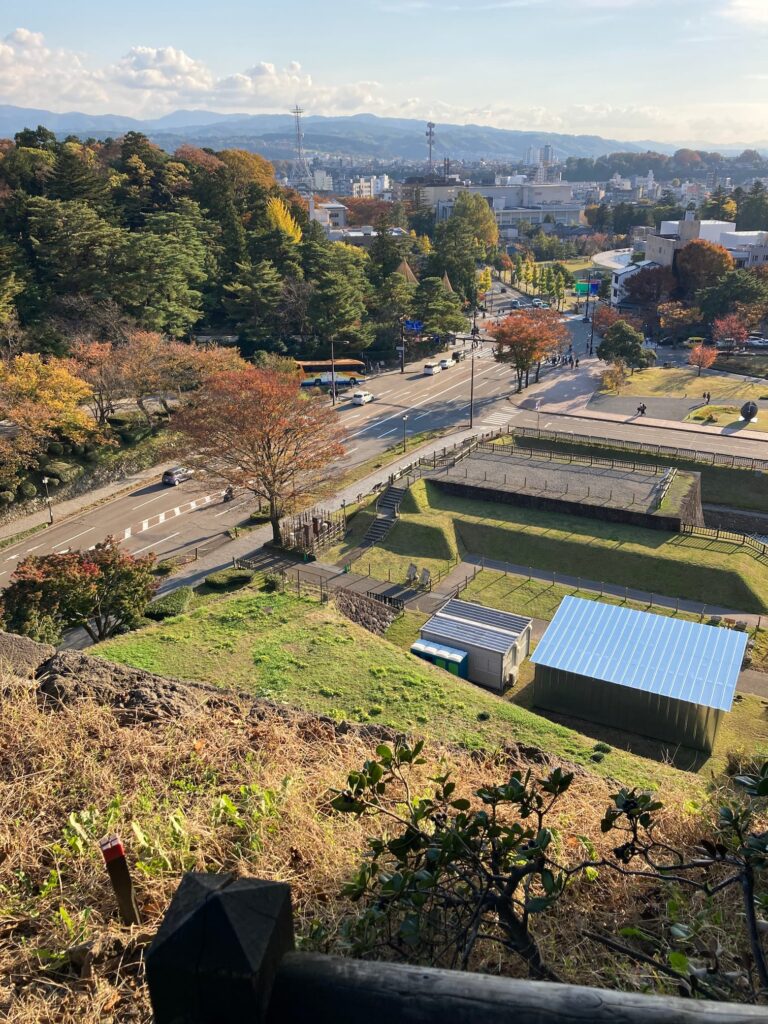
Can you hear the voice of the people? — View of the museum from the Tatsumi Turret site
Also based on something I experience often on tours, the first half (1–5) covers the key features of the Tatsumi Turret, leading into a playful twist in the second half (6–10).
- This is the site of a turret that once stood at the southeastern corner of the Honmaru, where Kanazawa Castle’s main keep once stood.
- It was one of several important turrets surrounding the Honmaru, and stood at one of the highest points within the castle.
- From here, the turret commanded a wide view of the southern part of the castle town, making it a strategic observation point.
- It was also a prominent structure that could be seen from the castle town below, symbolizing the authority and prestige of the Maeda lords.
- We don’t know exactly what they were monitoring, but perhaps the turret was also used to keep an eye on the lives of ordinary people living in the castle town.
- The Maeda lords were respected by their subjects, and perhaps they wanted to know how ordinary people were doing.
- Perhaps they were practicing the old saying, “The voice of the people is the voice of God,” by occasionally looking down on the town and listening to the people’s voices.
- Actually, as a tour guide, there are times when I feel exactly the same way.
- Looking down from here, you can see the modern art museum, one of Kanazawa’s most popular attractions and a source of pride for the city. But surprisingly, quite a few international guests tell me they aren’t really into modern art!
- “Oh, I had no idea! I’ll have to rethink our afternoon plans!” I sometimes find myself thinking. After all, for a tour guide, the guest’s voice is the voice of God!
Official Links & Resources
Official Website: Kanazawa Castle Park (Ishikawa Prefecture)
Thank You & Message from Genji
🎉 Thank you for exploring the complete Kanazawa Castle series! Use the navigation buttons above to revisit any iconic castle structure whenever you plan your tour!
🛡️ Travel Safety Notice: Enjoying Historical Paths with Peace of Mind
Kanazawa Castle Park and historical samurai heritage sites feature ancient stone ramps, cobbled pathways, and wooden steps. While awe-inspiring, stumbles or trips can happen. For international visitors exploring Kanazawa and Japan’s castle sites, securing real-time travel health insurance is strongly recommended for smooth medical support during your trip.
⚔️ SafetyWing – Real-Time Travel Insurance for Global Travelers (Check Details)