Welcome! I’m Yui, your local satoyama and nature insider in Japan. Are you curious about what makes the iconic World Heritage architecture of Gassho-zukuri so extraordinarily unique?
Forget dry architectural manuals! Here, I’m sharing essential facts, structural secrets, and fascinating backstories about Gassho-zukuri timber framing, rope-bound joinery, and heavy-snow survival mechanisms that you won’t find on standard travel sites or AI tours.
✨ Jump Straight to Architectural Facts & Secret Stories!
If these architectural secrets spark your curiosity, be sure to step inside one of these giant timber structures during your Shirakawa-go trip. We’re excited to welcome you—see you in Shirakawa-go!
📍 Table of Contents (Click to Jump)
2. Gassho-Zukuri Architecture (Overview)
2.1 Essential History & Key Facts
- Environmental Optimization Over Aesthetics
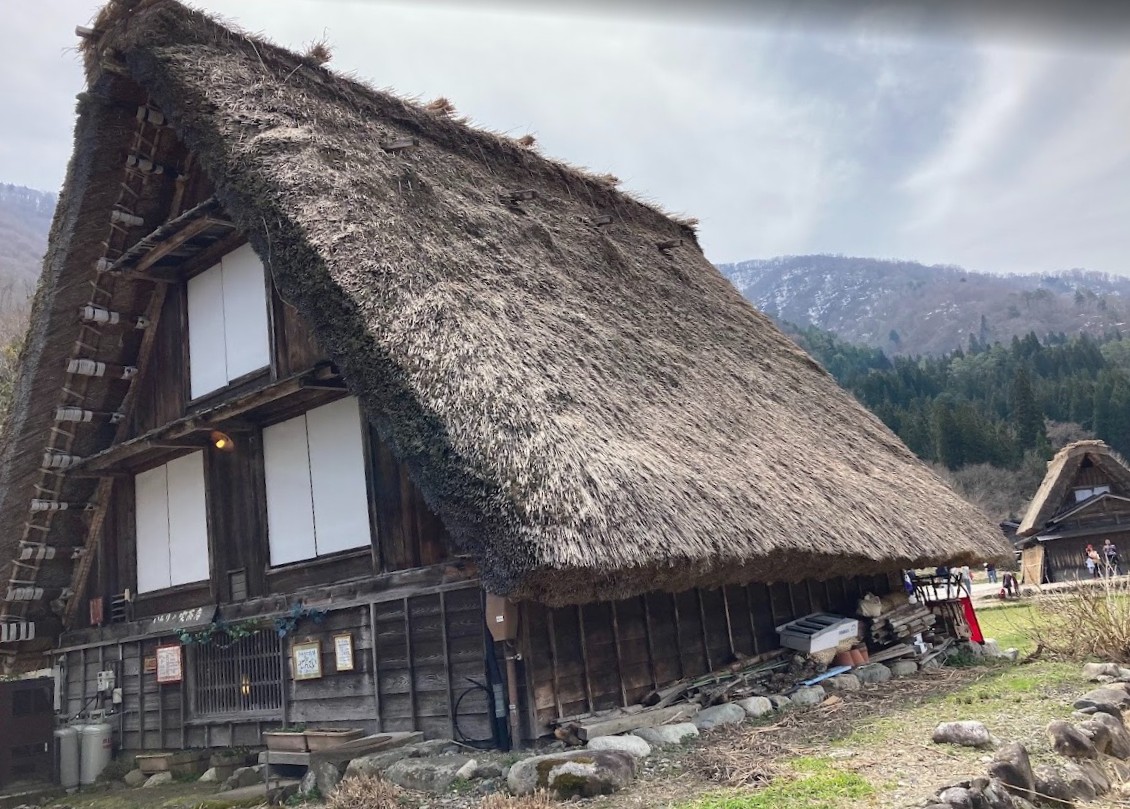
Although the Gassho style architecturally belongs to the A-frame, its concept was not born from aesthetic ideas but rather from the need to optimize the harsh natural environment. - Calculated Roof Angle for Snow & Sericulture Space
The steep roof angle was established over a long period of time to prevent the house from collapsing due to snow accumulation and to maximize the space available for sericultural work inside the building. - Name Derived from Hands Joined in Prayer
“Gassho” means to put one’s hands together in prayer, and it is said to derive from the mountain-like roof shape that reminds us of the deep piety of the people here. - Thick Thatch Roof Insulation & Soundproofing
The roof is covered with several layers of locally harvested thatch, less than one meter thick, which provides excellent sound insulation and heat retention, offering warmth in winter and coolness in summer. - Open Multi-Tiered Layout for Maximum Productivity
The floors above the first floor for residential use are divided into multiple stories to maximize productivity for indoor work at night and in winter, and there are no partitions to ensure ample light and ventilation. - Flexible Rope Assembly Resistant to Earthquakes & Storms
The building is assembled with ropes, creating a flexible structure that disperses external pressure and is resistant to windstorms and earthquakes. - Natural Pest Control and Wood Preservation via Irori Smoke
A sunken hearth is placed on the first floor, and the smoke from it helps protect the building from pests and rot by fumigating the interior before exiting through the floor and thatched roof. - North-South Orientation for Solar & Wind Efficiency
Considering wind flow and sunlight on the roofs, the houses were built to face north-south and be aligned to avoid crowding. - Community Thatching Tradition ‘Yui’ and Modern Changes
The thatching of roofs is replaced every 20 to 30 years by a group of village residents, a practice that is becoming rarer due to the decreasing population and the increasing reliance on specialized contractors. - Annual Fire Drills Protecting Flammable Heritage
Nowadays, visitors can observe large annual fire drills, where water is discharged all at once, conducted due to the vulnerability of thatched roofs to fire, not for entertainment.
2.2 Fun Backstories & Mysteries
Q1. Why is it called gassho-zukuri?
This is another frequently asked question. The first half (1–7) is the serious part covering the features of gassho-zukuri houses and how to describe them, while the second half (8–10) is a more playful, humorous take.
- Many other villages in Japan are said to have once had houses like these. Gassho-zukuri houses were designed to adapt to the harsh natural environment.
- This steep roof prevents heavy winter snow from accumulating.
- With little farmland, they needed large work areas on the second floor and in the attic to raise silkworms for income.
- Since many Japanese villages had similar environments, gassho-zukuri houses were once quite common.
- However, as sericulture became unprofitable in modern times, many gassho-zukuri houses were abandoned and villagers left.
- What was unique was that they barely managed to prevent the destruction of their houses and the decline of their community. Even among patient farmers, the people here may have been exceptionally patient.
- Legend has it that their ancestors, defeated in a power struggle, were driven from the capital long ago and settled here like hidden Christians.
- With nowhere else to go, they had no choice but to adapt and survive here, no matter how much the environment changed.
- I can’t help comparing this with human history, in which people have always sought to conquer fertile lands and strategically important locations by any means necessary.
- Perhaps the true World Heritage worth preserving is not just these buildings, but the DNA and spirit of the Shirakawa-go people, who were determined never to invade others.
Q2. How old are these houses?
This question often comes up while walking around together or waiting for the shuttle bus to the observatory. The first half (1–6) is the serious part about the age of the houses and how to explain it, and the second half (7–10) is the playful part.
- The oldest gassho-zukuri houses are believed to date back about 300 years, to the late 17th century.
- However, most of the surviving houses were built during the late Edo and Meiji periods, roughly 100 to 200 years ago.
- Not all houses here are gassho-zukuri. Some traditional houses have also stood for more than 100 years.
- Of course, these old wooden houses need regular maintenance and renovation to remain standing.
- For example, their thatched roofs need to be replaced periodically, and structural parts must also be repaired when necessary.
- So, although the houses look very old, their present condition is the result of generations of careful maintenance.
- Apart from famous temples and shrines, it’s remarkable that ordinary wooden houses can survive for over a hundred years and be passed down through generations.
- As the saying goes, “Old is gold.” In Japan, we also put our hands together to show respect and gratitude for people who have overcome hardships and for the things associated with them.
- As a guide, I sometimes feel like putting my hands together in respect for these gassho-zukuri houses that have weathered centuries of hardship.
- But lately, I’ve started wondering: Is it really just out of respect? Or am I simply asking these houses to keep sending me more guests and more guiding jobs?
Official Links & Resources
UNESCO World Heritage Centre: Historic Villages of Shirakawa-go and Gokayama
Thank You & Message from Yui
👆 Thank you for reading to the end! If you have any questions, customized itinerary inquiries, or travel planning feedback, please feel free to reach out anytime.
🛡️ Travel Safety Notice: Enjoying Historical Paths with Peace of Mind
Shirakawa-go and other rural Japanese heritage sites feature uneven stone steps, snow-covered footpaths, and historic steep timber staircases. While breathtaking, unexpected trips or stumbles can occur. For international visitors exploring Japan’s countryside, securing real-time travel health insurance is strongly recommended for seamless medical support during your trip.
⚔️ SafetyWing – Real-Time Travel Insurance for Global Travelers (Check Details)