 峰(Mine)
皆さん、こんにちは!日本庭園・和服ウオッチャー&ガイドのミネです。兼六園のほぼ中央に位置し、庭園の「心臓」とも言える広大な『霞ヶ池(かすみがいけ)』の英語案内ページへようこそ!
琵琶湖を模した縮景(しゅっけい)の美しさや、不老長寿の願いが込められた蓬莱島(亀島)、そして金沢城を守る水系循環の中心としての役割など、霞ヶ池にはガイドで語るべき見どころが凝縮されています。
現場でサッと使える短文フレーズから、池のスケール感や防衛上の秘密、ゲストをクスッと笑わせる裏話まで網羅しました。目的の項目ボタンからご自由にご活用ください。
📍 Quick Navigation: 各章へジャンプ
5.霞ヶ池(かすみがいけ)
“Kasumiga-ike Pond”
ここでは兼六園の中心に位置する霞ヶ池をカバーします。ここもお好みで下記ボタンからも直接アクセスできます。
5.1 基本情報
このスポットで最低限押えておきたいポイントです。
1. EN: Central Pond
In many Japanese gardens, a large pond is positioned near the center of the garden, and in Kenroku-en, Kasumigaike lies almost at the center, functioning like the heart of the garden.
JP: 多くの日本庭園では大きな池が庭の中心的存在となり、兼六園では霞ヶ池がほぼ中央に位置し、庭の「心臓」のような役割を果たしています。
2. EN: Strolling Features
Various distinctive garden features and scenic elements are arranged around the pond, allowing visitors to enjoy changing views as they walk.
JP: 池の周囲にはさまざまな庭園装置や景観要素が配置され、歩くごとに移り変わる景色を楽しめます。
3. EN: Reduced Landscape
A traditional gardening technique known as “reduced landscape” is often employed in Japanese gardens, where miniature representations of famous scenic places are incorporated into the design.
JP: 日本庭園では「縮景」と呼ばれる技法がよく用いられ、有名な景勝地を小規模に再現して庭の構成に取り入れます。
4. EN: Model of Lake Biwa
Kasumigaike is said to have been modeled after Lake Biwa, Japan’s largest lake, reflecting its cultural and historical significance.
JP: 霞ヶ池は、日本最大の湖である琵琶湖を模したものとされ、その文化的・歴史的な重要性を映しています。
5. EN: Cultural Center
Lake Biwa and nearby Kyoto have long been central to Japan’s politics and culture, and their prestige has inspired admiration since ancient times.
JP: 琵琶湖と隣接する京都は、古くから日本の政治と文化の中心であり、その存在は人々の憧れの対象でした。
6. EN: Island of Immortality
The small island in the pond represents an islet in Lake Biwa associated with a legend of immortality.
JP: 池に浮かぶ小島は、不老長寿の伝説で知られる琵琶湖の島を表しています。
7. EN: Turtle Symbolism
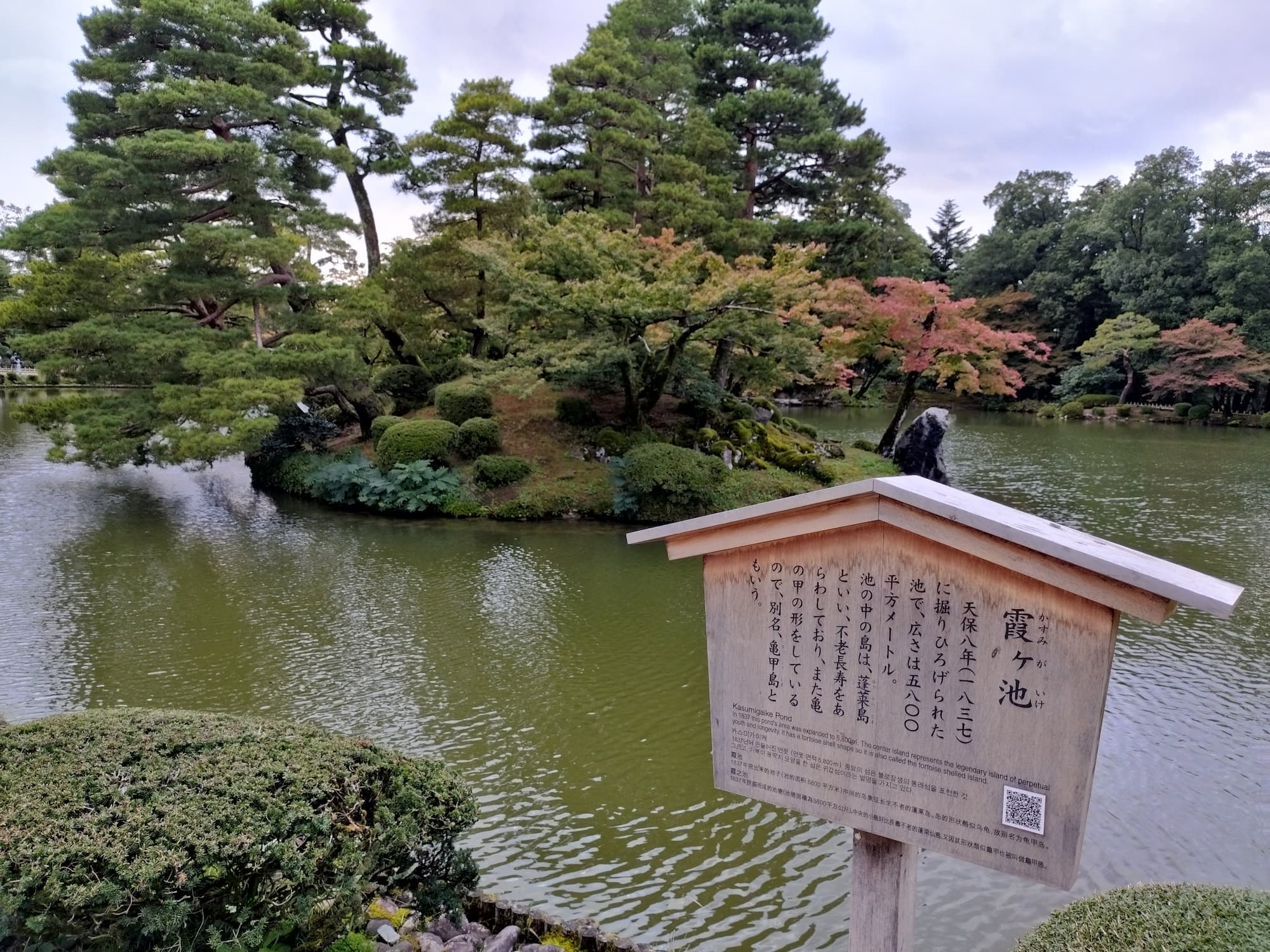
The shape of the islet resembles a turtle shell—an auspicious symbol of longevity—with a stone placed at the edge suggesting the turtle’s head.
JP: 小島の形は亀の甲羅を思わせ、縁起の良い長寿の象徴とされ、端には亀の頭を思わせる石が置かれています。
8. EN: Meaning of the Name
The name Kasumigaike, literally meaning “Hazy Pond,” expresses the idea of vastness, evoking an image of a distant shore softened by haze and disappearing from sight.
JP: 「霞ヶ池」という名は広がりのある景観を表し、霞によって対岸がぼんやりと見えなくなる情景を想起させます。
9. EN: Emergency Water System
It is said that the pond was designed not only for its scenic beauty but also with an emergency mechanism that allowed water to drain from the bottom and raise the water level of the castle moat.
JP: 見た目の美しさだけでなく、非常時に備えて池の底から水が抜けて城の堀の水位を上げる仕掛けがあったと言われています。
10. EN: Water Source and Circulation
Kasumigaike, which is supplied by water drawn from the Tatsumi Waterway constructed about four centuries ago, feeds other ponds and waterfalls throughout the garden, forming the central hub of Kenroku-en’s water circulation system.
JP: 約四百年前に造られた用水から水を引いて、この水は庭園内の他の池や滝にも流れ込んでいます。霞ヶ池は、庭園全体の水循環の中心的な役割を担っています。
👤連続音声:1-5
👥連続音声:6-10
5.2 口頭説明
基本情報をベースにゲストと歩きながら使える口頭説明例です。
- EN: Central Pond
Kasumigaike sits near the center of Kenroku-en and works like the heart of the entire garden.
JP: 霞ヶ池は兼六園のほぼ中央にあり、庭全体の「心臓」のような役割を果たしています。 - EN: Strolling Features
As you walk around the pond, you’ll see many distinctive garden features that create different views from every angle.
JP: 池の周囲には特徴的な庭園の要素があり、歩くたびに景色が変わして見えます。 - EN: Reduced Landscape
This pond also shows a classic technique called “reduced landscape,” where famous places are recreated in miniature.
JP: この池には、有名な景勝地を小さく再現する「縮景」という伝統的な技法が使われています。 - EN: Model of Lake Biwa
Kasumigaike is said to be modeled after Lake Biwa, the largest lake in Japan.
JP: 霞ヶ池は、日本最大の湖である琵琶湖を模したものと言われています。 - EN: Cultural Center
Lake Biwa and nearby Kyoto have long been cultural centers admired since ancient times.
JP: 琵琶湖と京都は、古くから文化の中心地として人々に敬われてきました。 - EN: Island of Immortality
The small island in the pond represents an island in Lake Biwa known for a legend of immortality.
JP: 池の小島は、不老長寿の伝説で知られる琵琶湖の島を表しています。 - EN: Turtle Symbolism
Its shape resembles a turtle shell, and the stone at the edge suggests the turtle’s head—a symbol of long life.
JP: 島の形は亀の甲羅に似ており、端の石は亀の頭を表す長寿の象徴です。 - EN: Meaning of the Name
The name Kasumigaike, or “Hazy Pond,” comes from the idea of a distant shore fading softly into the haze.
JP: 「霞ヶ池」という名は、霞で対岸がぼんやりと見えなくなる情景に由来しています。 - EN: Emergency Water System
It’s said that the pond once had a system that could release water from the bottom to raise the castle moat in an emergency.
JP: 非常時には池の底から水を抜き、城の堀の水位を上げる仕掛けがあったと言われています。 - EN: Water Source and Circulation
The Tatsumi Waterway, with centuries of history, supplies this pond and then feeds other ponds and waterfalls throughout the garden.
JP: 数世紀の歴史を持つ辰巳用水がこの池の源となり、池は庭園内の他の池や滝へ水を供給しています。
5.3 笑いが取れるかも?
このパートでは、霞が池を前にして、よく聞かれる質問に対する説明例をご紹介しています。前半部は説明にも使える真面目パート、後半部は雑談力UPの為のおふざけパートの2部構成になっています。以下のボタンから各ストーリーへ直接飛べます。
Q1: この池はどれくらい広いのですか?
”How big is the pond in Kenroku-en?”
ここでは池の広さが話題になった際のネタでまとめてみました。
前半(1-6)が真面目パート、後半(7-10)がおふざけパートです。
- Although you can’t see its full shape from here, the pond stretches all the way to the tea house in the distance.
ここからは全体の形がつかめませんが、向こうに見える茶室のあたりまで広がっています。 - Its actual size is only slightly smaller than a soccer field, so it’s not extraordinarily large.
実際の大きさはサッカーコートより一回り小さいくらいで、そこまで極端に広いわけではありません。 - Even so, a pond of this scale is quite rare in Japanese gardens.
それでも、日本庭園でこれほどの規模の池はなかなかありません。 - Many traditional gardens feature a central pond, and this is likely one of the largest examples of that style.
多くの庭園では中央に大きな池を配置しますが、その中でも最大級のスケールです。 - The pond is named Kasumiga-ike, which literally translates to “Hazy Pond.”
この池の名は「霞ヶ池(Kasumiga-ike)」といい、直訳すると “Hazy Pond” になります。 - The idea is to evoke a serene scene where the opposite shore fades softly into the haze.
霞によって対岸がぼんやりと霞んで見えなくなるような、風情ある情景を想起させる意図が込められています。 - But personally, I suspect the real intention was to make the pond feel so vast that the far shore seems to disappear.
でも私個人としては、「対岸が見えないほどの圧倒的な広さ」を演出したかったのではないかと踏んでいます。 - After all, it was modeled after Japan’s largest lake, Lake Biwa.
何と言っても、日本最大の湖である「琵琶湖」をイメージして造られたわけですからね。 - If so, calling it “slightly smaller than a soccer field” sounds a bit less grand, doesn’t it?
だったら、「サッカーコートより小さめ」なんて説明したら、ちょっとスケールが小さく聞こえてダメじゃないかと思われますよね? - But if a guest comes from a country whose national team struggles in the World Cup, they might just nod and say, “Oh yeah, the opponent’s goal always feels miles away—this place is massive!” (laughs)
でもワールドカップでなかなか勝てない国のゲストなら、「そうなんだよ、相手のゴールがあまりにも遠くて見えない…ここ、めちゃくちゃ広いじゃん!」って共感してくれるかもしれません。(笑)
Q2: この池の見どころって何ですか?
”What are the main must-see features around the pond?”
ここでは池の中の蓬莱島(亀島)や縮景の背景について触れる際のネタでまとめてみました。
前半(1-8)が真面目パート、後半(9-10)がおふざけパートです。
- There are many highlights, but first and foremost, this pond is a prime example of shukkei, or a “reduced landscape.”
見どころはたくさんありますが、まずはこの池が「縮景(しゅっけい)」という技法で作られていることですね。 - Shukkei is a traditional Japanese gardening technique that recreates famous scenic places on a smaller scale.
「縮景」とは、有名な景勝地をコンパクトに縮小して再現する日本の伝統的な庭園技法です。 - Without an explanation, it might look like just an ordinary pond, but it actually depicts Lake Biwa—Japan’s largest lake.
説明がないとただの大きな池に見えますが、実は日本最大の湖である「琵琶湖」を再現しています。 - Lake Biwa lies right next to Kyoto, the ancient capital, and has long symbolized history, culture, and prosperity for the Japanese people.
琵琶湖は千年の都・京都のすぐそばにあり、歴史と文化、知識と繁栄の象徴として日本人にとって特別な存在でした。 - It might be similar to what the Mediterranean Sea meant to the people of ancient Europe.
古代ヨーロッパの人々にとっての「地中海」のような存在に近いかもしれません。 - The small island in the center represents an island in Lake Biwa associated with the legendary realm of eternal youth and immortality.
池の中央に浮かぶ小さな島(蓬莱島)は、琵琶湖に実在する不老長寿の伝説を持つ島を表現しています。 - In this way, many features around the pond were designed with wishes for long-lasting prosperity and longevity.
このように、池の周囲のさまざまな趣向には、繁栄と長寿への祈りが込められています。 - Furthermore, the island is shaped to resemble a turtle—a creature believed in Japan to live for ten thousand years.
さらにその島は、日本では「1万年生きる」と信じられてきた長寿の象徴である「カメ」の姿に似せて造られています。 - The island itself represents the turtle’s shell, and the rock at the edge represents its head. Does it look like a turtle to you? Does it look happy, too?
島全体が亀の甲羅で、端にある岩が頭を表していますが…皆さんには亀に見えますか?ついでに、幸せそうに見えますかね? - I couldn’t possibly endure staying still like that for 10,000 years! (laughs)
1万年間もあんな風にじっと動かずにいるなんて、私にはとても耐えられません!(笑)
Q3: この池の何が面白いのですか? / 何が特別な点ですか?
”What makes this pond interesting? / What makes it special?”
ここでは池の水深や金沢城の防衛機構についての話になった際のネタでまとめてみました。
前半(1-8)が真面目パート、後半(9-10)がおふざけパートです。
- People appreciate Japanese gardens in various ways, but here at Kasumiga-ike, the main highlight is its stunning water scenery.
庭園の楽しみ方は人それぞれですが、ここ霞ヶ池の一番の見どころは、その美しい水景です。 - Water is drawn from the upper reaches of the Sai River through the historic Tatsumi Waterway, filling this pond to the brim.
犀川の上流から歴史ある辰巳用水を経由して引き込まれた水が、この池をなみなみと満たしています。 - From here, the water flows to other ponds and waterfalls throughout the garden, making this spot the heart of Kenroku-en’s water circulation system.
ここから園内の他の池や滝へと水が巡っていくため、霞ヶ池は兼六園全体における「水系の中心」といえる場所です。 - However, some guests aren’t quite satisfied with just a standard explanation, so depending on the audience, I sometimes share a few behind-the-scenes stories.
ただ、こうした模範的な説明だけでは物足りないゲストもおられますので、時と場合に応じて「裏話」をお話しすることもあります。 - As I mentioned earlier, this pond—the largest in the garden and holding a massive volume of water—is actually quite deep.
先ほどお話しした通り、豊かな水量を蓄える園内最大のこの池は、実はかなりの深さがあります。 - One reason is that it needed to store a large amount of water for defensive purposes.
その理由の一つは、軍事的な防衛目的で大量の水を蓄えておく必要があったためとされています。 - It is said that there was a secret mechanism to drain water from the bottom during emergencies, quickly raising the water level of the castle moat.
非常時には池の底から一気に水を開放し、外堀の水位を跳ね上げる仕掛けがあったと言われています。 - Kenroku-en was designed not only for scenic beauty but also to bolster the defenses of Kanazawa Castle, so many hidden mechanisms were built throughout the garden.
兼六園は美しさだけでなく金沢城の防衛機能も兼ねて造られており、園内にはそうした隠された仕掛けがいくつも存在します。 - Actually, I do know all the confidential details, but given the current geopolitical climate, I’m refraining from revealing all our defensive strategies.
実は私もすべての詳細を知っているのですが、昨今の国際情勢を鑑みまして、これ以上の防衛上の仕掛けについてお話しすることは控えさせていただいております。 - After all, you never know when a guest’s home country might become an adversary and attack Japan. Your country isn’t planning anything like that, right? (laughs)
なぜなら、いつゲストの母国が敵国となって日本に攻めてくるかわかりませんからね。…皆さんの国は、まさかそんな計画ありませんよね?(笑)
霞ヶ池の解説はお楽しみいただけたでしょうか?
他のスポット(唐崎松、根上松など)の解説へ移動する際は、冒頭の緑色ナビゲーションボタンをご活用くださいませ!