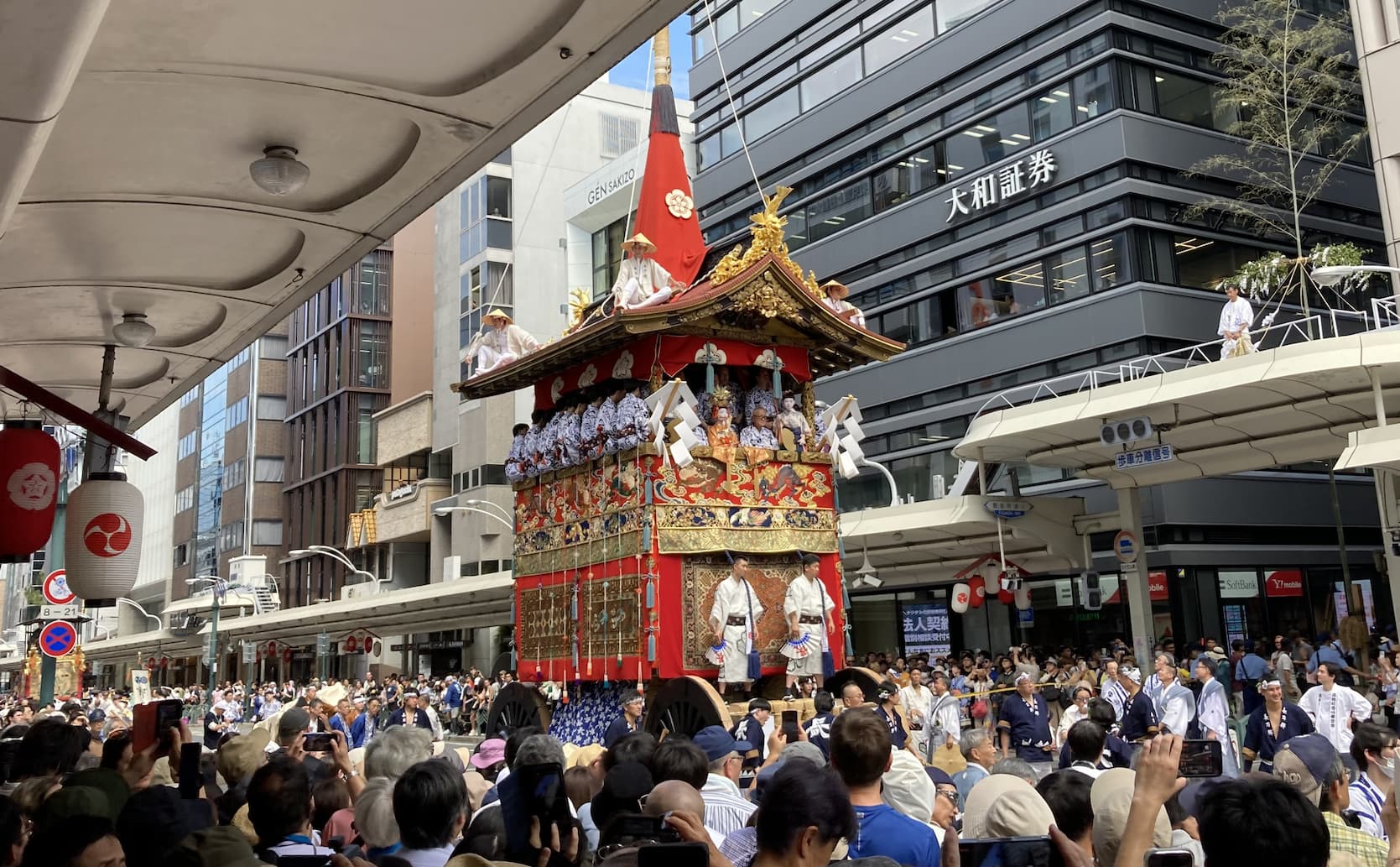
京都で商談相手とハイヤーで移動中… 「祇園祭って何?」と聞かれたら?

Sakura:日本文化コンシェルジュ&ブログガイド
こんにちは!サクラです🌸 今回は、海外ゲストがネットで見かけた「祇園祭(京都)」について、「なぜ特別なお祭りなのか」「なぜあのような山鉾を作って巡行するのか」といった背景のストーリーへ自然につなげ、ゲストを祇園祭の世界へ誘うためのヒントをまとめました。
💡お知らせ:各項目には、洗練されたネイティブレベルの英文と、日本語からそのまま口頭説明に直結できるシンプルな学習者向け口語英訳の2種類を掲載しています。お好みのレベルや接客の場面に合わせてご活用ください!
ゲストの関心に合わせて30秒でネタを仕込む!
【一言で腑に落ちる】王道アプローチ
【インバウンド5大関心別・深掘り】さらに一歩踏み込む
※ハイヤーの窓越しならパート1を、じっくり語るならパート2をチョイス!
1. この一言で腑に落ちる?
このパートのいずれかのワンフレーズでご納得いただけたらラッキーですね。もしだめなようでしたら、次のパートもお試しください。いつも通り、日本語で言えないことは英語でも言えませんので日本語⇒英語の順でご紹介します。移動中の短い時間でもパッと情景が浮かぶフレーズです。
1.1 祭りの中の祭り・ザ・ベストオブフェス?
祇園祭は、数千ある日本の祭りの中でも頂点に位置する、まさに “ザ・ベストオブフェス” と呼べる存在です。千年以上続く歴史、1ヶ月にわたって繰り広げられる華やかな行事、そして起源となった「疫病退散」への人々の真摯な祈り。これを体験すると、「日本の祭りを本当に見た」と胸を張って言えるほどの感動を持ち帰れるかもしれません。
“The Gion Festival is arguably the pinnacle of Japan’s countless festivals—the very best of the best. With over a thousand years of history, a full month of continuous, elaborately crafted events, and the profound sincerity of prayers to ward off epidemics—the very origin of the festival—it offers an experience so moving that you may feel you haven’t truly witnessed a Japanese festival until you’ve seen this one.”
✅ 口頭説明文(日本語ベース)
“The Gion Festival is truly the top of all Japanese festivals — the very best of the best. It has over a thousand years of history, a whole month of colorful events, and it began from people’s sincere prayers to drive away epidemics. If you experience it, you may feel you can proudly say you’ve really seen what a Japanese festival is.”
1.2 『日本三大祭』と『日本三大美祭』のお祭り?
祇園祭は、その壮大な規模から『日本三大祭』に、そして豪華絢爛な山鉾の造りから『日本三大美祭』にも数えられる、他に類を見ない祭りです。古都・京都の街を、悪霊や疫病を追い払う象徴である刀や槍を高く掲げた壮麗な山鉾が次々と巡行する光景は、まさに必見です。国の平和と疫病退散を願う祈りから始まった千年以上前の世界へ、見る人を自然といざなってくれます。
“The Gion Festival is a top-tier celebration that uniquely ranks among both the “Three Great Festivals of Japan” for its grand scale, and the “Three Most Beautiful Festivals” for its opulent craftsmanship. The sight of magnificent floats parading one after another through Kyoto, the ancient capital, with swords and spears—symbols of driving away evil spirits and epidemics—reaching high into the sky, is an absolute must-see. It invites you to step back over a millennium to when the festival first began as a heart-felt prayer for the peace of the nation and protection against disease.”
✅ 口頭説明文(日本語ベース)
“The Gion Festival is one of Japan’s Three Great Festivals because of its huge scale, and also one of the Three Most Beautiful Festivals because of its gorgeous and elaborate floats. You can see magnificent floats moving through Kyoto with swords and spears raised high to symbolize driving away evil and disease — it’s truly a must‑see. The festival naturally invites you into a world from over a thousand years ago, when people prayed for peace and protection from epidemics.”
2. 次のフォローでご納得?
残念ながら前パートで外した場合のフォローセリフ、いつも通りインバウンド視点を踏まえ関心別に置いてみました。様々な英語表現を織り込むため全体的にかなり長くなっていますが、お気に入りのフレーズがあれば現場でも試してみる、そんな軽いノリでご利用ください。
2.1 建築(匠:たくみ)系
伝統的な建築技法も祈りから?
建築に関心のある方は、麻縄だけを使って巨大な山鉾を組み上げる、伝統的な「縄がらみ」という釘を使わない技法に感心することでしょう。この方法によって、荒々しい巡行にも耐えられる、柔軟で衝撃を吸収する構造が生まれます。興味深いことに、山鉾は巡行の直後にすぐ解体されます。これは単なる保管のためではなく、山鉾に閉じ込められた悪霊が再び街へ戻らないようにするための神聖な儀式でもあるのです。
“Architectural enthusiasts will appreciate nawa-garami, a traditional nail-free technique using only hemp rope to assemble these massive floats. This creates a flexible, shock‑absorbing structure suited for the rough procession. Interestingly, you can also see the floats being dismantled immediately afterward—not just for storage, but as a sacred ritual to ensure that any trapped evil spirits do not return to the city.”
✅ 口頭説明文(日本語ベース)
“If you like architecture, you will be impressed by a traditional technique called nawa‑garami, where these huge floats are built only with hemp rope and without any nails. This creates a flexible, shock‑absorbing structure that can handle the rough movement of the parade. Interestingly, you can also see the floats being taken apart right after the procession. This is not only for storage, but also a sacred ritual to make sure that any evil spirits trapped inside do not return to the city.”
2.2 アート系
『動く美術館』とも言える山車を身近で?
芸術を愛する方々は、まさに「動く美術館」とも言える山鉾に魅了されることでしょう。その精巧な装飾には、ベルギーのタペストリー、ペルシャ絨毯、中国の錦など、シルクロードの至宝がふんだんに使われています。これらは、職人技と名声を競い合った裕福な商人たちによって京都にもたらされたものです。夕方の街頭展示では、こうした精緻な細部を間近で楽しむことができ、巡行の際には、動きの中で山鉾の壮麗な全体美を堪能することができます。
“Art enthusiasts will be captivated by the floats, which are often described as literal ‘moving art galleries.’ Their elaborate adornments feature Silk Road treasures—including Belgian tapestries, Persian carpets, and Chinese brocades—brought to Kyoto by wealthy merchants competing in craftsmanship and prestige. You can enjoy these exquisite details up close during the evening street exhibitions, or admire their full splendor in motion during the parade.”
✅ 口頭説明文(日本語ベース)
“If you enjoy art, you will be fascinated by the floats, which are like real ‘moving art museums.’ Their detailed decorations include treasures from the Silk Road, such as Belgian tapestries, Persian carpets, and Chinese brocades. These items were brought to Kyoto by wealthy merchants who competed in skill and prestige. During the evening street displays, you can see these fine details up close, and during the parade, you can enjoy the full beauty of the floats as they move through the streets.”
2.3 ファッション系
お祭り通りは特別なランウェイ?
ファッションが好きな方にとって、祇園祭の通りはまさに特別なランウェイになります。そびえ立つ山鉾、細い路地、そして輝く提灯がつくり出す光景は、歴史の息づかいを感じる没入感のある美しさです。夜には、ライトアップされた祇園祭の象徴・薙刀鉾を背景に写真を撮ると、その鮮やかなコントラストがどんな装いも自然と引き立ててくれます。
“Fashion lovers will find the festival streets an extraordinary runway. The combination of towering floats, narrow alleyways, and glowing paper lanterns creates an immersive, historical aesthetic. Posing at night against the illuminated Naginata-boko, a symbol of the festival, offers a stunning, high‑contrast backdrop that effortlessly elevates any look.”
✅口頭説明文(日本語ベース)
“For people who love fashion, the streets of the Gion Festival feel like a special runway. The tall floats, the narrow lanes, and the glowing lanterns create a beautiful, immersive scene full of history. At night, if you take a photo with the illuminated Naginata‑boko behind you, the bright contrast naturally makes any outfit look great.”
2.4 フード系
祇園祭は高級魚鱧のお祭?
和食が好きな方には、京都の夏を象徴する高級魚「ハモ」をぜひおすすめします。 祇園祭の時期には、昔から家庭やお店でお客さんにハモ料理をふるまう習慣があり、その盛り上がりから「ハモ祭り」と親しみを込めて呼ばれることもあります。 旬の真っ盛りのハモは濃厚で風味豊かです。 「ハモの落とし(さっと湯通ししたハモに梅肉を添えた料理)」を味わうことは、京都ならではの伝統であり、忘れられない食体験になるでしょう。
“For lovers of washoku (traditional Japanese cuisine), we highly recommend hamo (pike conger), a premium fish that epitomizes summer in Kyoto. For centuries, local families and restaurants have treated guests to hamo dishes during the Gion Festival—so much so that it is affectionately known as the “Hamo Festival.” At the peak of its season, hamo is rich and flavorful. Enjoying hamo no otoshi (blanched pike conger served with refreshing plum paste) is a quintessential Kyoto tradition that promises a truly memorable dining experience.”
✅口頭説明文(日本語ベース)
“If you enjoy Japanese food, I really recommend hamo, a premium fish that represents summer in Kyoto. During the Gion Festival, families and restaurants have long served hamo dishes to guests, so people even call it the ‘Hamo Festival.’ When hamo is in peak season, it becomes rich and full of flavor. Trying hamo no otoshi—lightly blanched hamo served with plum paste—is a special Kyoto tradition and a memorable food experience.”
2.5 日本人系
古代からの日本人と神々の関係がわかる?
祇園祭は、現代の私たちが古代から続く日本人と神々の関係を肌で感じられる、非常に珍しい行事です。とくに、その宗教的な意味、伝統の継承、そして祭りの象徴であり神聖な儀式の中心となる「稚児」をめぐる独特のタブーは驚くべきものです。
稚児は単なる先導役ではなく、古代の儀式を通して「生きた神」となります。
その神聖さを守るため、稚児の足は地面に触れてはならず、「ゴウリキ」と呼ばれる男性たちに肩車されて運ばれます。1000年以上続くこの神聖な行列を、活気ある人々の中で追体験することは、まさに一生の思い出になるでしょう。
“The Gion Festival is a rare event that allows today’s visitors to witness firsthand the relationship between the Japanese people and the gods that dates back to ancient times. In particular, the religious significance, the preservation of tradition, and the unique taboos surrounding the “Chigo”—the symbol of this festival and the core of its sacred rituals—are truly remarkable. Rather than just a young parade leader, the Chigo becomes a living deity through ancient rites. To maintain his sacred purity, his feet must not touch the ground, requiring him to be carried on the shoulders of men known as “Gōriki.” Mingling with the vibrant crowds to follow this sacred procession—a tradition unbroken for over a millennium—might just become the memory of a lifetime.”
✅口頭説明文(日本語ベース)
“The Gion Festival is a rare event where modern visitors can really feel the ancient relationship between the Japanese people and the gods. The religious meaning, the way traditions are preserved, and the special taboos around the Chigo—the symbol of the festival—are truly remarkable. The Chigo is not just a young leader of the parade; through ancient rituals, he becomes a living deity. To keep his sacred purity, his feet must not touch the ground, so he is carried on the shoulders of men called Gōriki. Following this sacred procession, which has continued for over a thousand years, can become a once‑in‑a‑lifetime memory.”
御礼🔶あとがき
👆 今回も最後までお読みいただき、ありがとうございます。 本ブログに関するご意見やご要望がございましたら、下記より、お気軽にお声がけくださいね。