Welcome! I’m Sakura, your local traditional culture insider in Kanazawa. Are you planning a trip to Japan or curious about what real samurai-era teahouses are actually like?

Forget dry history lessons and official guidebooks! Here, I’m sharing essential facts, common traveler Q&As, and hilarious backstories about Kanazawa’s historic teahouses (Ochaya) that you won’t find on standard travel sites or AI tours.
✨ Jump Straight to Teahouse Facts, Q&A & Secret Stories!
If these stories make you smile or spark your curiosity, be sure to step inside a historic teahouse during your Kanazawa journey. We’re excited to welcome you—see you in Kanazawa!
📍 Table of Contents (Click to Jump)
2. Teahouse Architecture & Secrets

Cross-section view revealing the private second-floor tatami parlors and hidden architectural details of a Kanazawa teahouse
2.1a Essential History & Key Facts
- Fewer Operating Teahouses Today
There used to be many teahouses, but only a few are still in business today. - Strict Traditional Rules Persist
Even today, the basic rules of ‘no first-time visitors’ and ‘no-wallet visit and pay later’ still apply. - A Trust-Based Credit Business
If the customer does not pay, the introducer must pay, making it a typical credit business. - Public Museums and Special Performances
While some teahouses are open to the public and offer performances for foreign visitors, others have been converted into museums. - Rare Access Compared to Kyoto
There are also many teahouses in Kyoto, but most of them are closed to the public, so it is a rare experience to be able to see the inside of a teahouse here. - Preserved 200-Year-Old Atmosphere
The building is as it was when it was built about two centuries ago, allowing visitors to enjoy the authentic atmosphere of the teahouse and the geisha who entertained guests in those days. - Strict Separation of Floors
The second floor was used for entertaining customers, while the first floor was used for the proprietress and geisha staff. - Dual Staircase Layout for Privacy
The staircase was also divided into two sections—one for customers and one for staff—to ensure that guests did not witness the daily routines of employees. - Acoustic Design and High Ceilings
Therefore, the second floor is luxurious, with a high ceiling for acoustics, and part of the staircase opens into a open-well stairwell. - Seating Arrangement for Guests and Musicians
Guests sit in the tatami room with their backs to the alcove, while a Geiko, a traditional Japanese entertainer, performs in a small room next door, visible through the sliding doors. - Dramatic Entrance of Performers
When the time is right, the sliding door is opened like a stage curtain, and the Geiko, who has been waiting, begins to play. - A Salon for Interactive Cultural Exchange
In those days, in addition to geiko performances, the guests themselves performed tricks and were sometimes playfully punished by drinking sake, making it a place for cultural exchange. - Kanazawa’s Signature Drum Performances
In particular, Kanazawa geiko performed the art of taiko drumming in the tatami room, and sometimes invited guests to join in and beat the drums with them. - Building Anticipation with Incense and Flutes
Teahouses employ various methods to enhance the ambiance before a geiko performance begins, such as burning incense or playing a Japanese flute in the adjoining antechamber. - Catered Cuisine and Sake Warming
Since the teahouse was a social gathering place, the kitchen did not prepare meals but instead sourced food from a caterer, focusing solely on warming drinks like sake. - Small Inner Courtyards for Light and Air
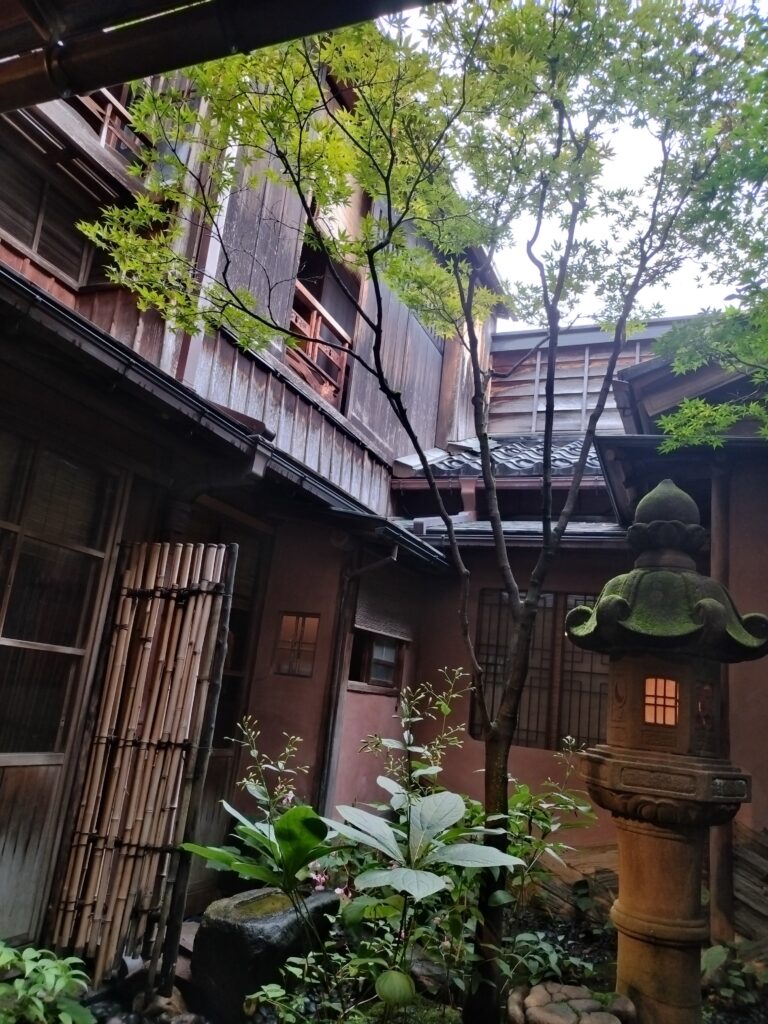
A typical teahouse includes a small courtyard designed primarily for lighting and ventilation, while also being aesthetically pleasing by making the most of the limited space. - Creating Depth with Stones and Moss
By skillfully arranging natural stones and moss within a confined area, the courtyard creates a sense of depth, offering viewers a feeling of tranquility. - Privacy Lattice Windows (Kagami-goshi)
The outer walls on the front street side of the teahouse are covered with special lattice windows that prevent people on the outside from looking inside. - Lacquered Wooden Pillars for Durability
Most of the pillars in the teahouse are coated with lacquer to prevent corrosion and add luster. - Red Bengara Pigment for Ambiance
To create a more relaxed atmosphere, the inside and outside of the building are coated with a unique reddish bengara (red iron oxide pigment).
2.1b Top 10 Traveler Q&As About Teahouses
- Q: What were people doing here?
A: Here, the rich and cultured people were entertained by geisha during nightly Japanese-style parties, known as o-cha-ya play. - Q: Was a tea ceremony held here?
A: While a tea ceremony could be arranged upon request, teahouses were not originally designed for this purpose. - Q: Did guests stay here?
A: Teahouses served as social settings for entertaining customers, so guests typically did not stay overnight. - Q: Did geishas live here?
A: Kanazawa’s geishas, or geikos, were sent to various teahouses to entertain guests but did not reside in specific teahouses. - Q: Until what time did the ochaya stay open?
A: There was typically no specific closing time, as some customers stayed until morning. - Q: Why was the teahouse no longer used?
A: Originally a pastime of the upper classes, teahouses became increasingly exclusive to a select few with the rise of democratization and the spread of popular games. - Q: What makes it different from a typical townhouse, or machiya?
A: Generally, the machiya served as a space for daily life, whereas the teahouse was exclusively designed for socializing, without practical structures like closets. - Q: How did teahouses manage summer and winter temperatures?
A: In summer, they improved ventilation with courtyards and front lattice windows, and kept food cool in a stone box in the basement. In winter, they used braziers to provide warmth. - Q: How did teahouses manage water?
A: Water was drawn from a well within the building and drained through a stone-lined channel. - Q: Why does each room have a different structure and design?
A: The colors and designs of each room were varied to enhance the beauty of both the interiors and the geishas, especially under the lighting.
2.2 Fun Backstories & Mysteries
Q1: What Were People Doing Here in the First Place?
- This is called a teahouse, but it’s not a place where tea parties are held.
- This is a kind of secret salon where only customers introduced by patrons are allowed.
- This spacious tatami room, complete with a gold folding screen and alcove, is exclusively for guests.
- Here, guests sip sake and enjoy catered dishes, all while marveling at geisha performances in the adjoining antechamber.
- This isn’t just a one-way show—it’s an intimate gathering where guests join geisha in playing traditional instruments like taiko drums and engaging in games together.
- Once a secret pastime for the wealthy elite, even most Japanese people didn’t really know what went on behind the scenes.
- But thanks to the recent IT (information technology) boom, the secret’s out, and the public now knows what it’s all about.
- While the traditional art of geisha performances is undoubtedly remarkable, many of the games are quite simple, and guests often need to embrace a playful, even foolish, attitude to enjoy them fully.
- Just like IoT (the Internet of Things, where everything is connected through the Net), the geisha game is going viral—capturing the attention of everyone from children to the elderly.
- Perhaps this kind of saying will gain further popularity in the near future… ”I owe tea! Let me treat you at the teahouse!”
Q2: What System Did a Teahouse Operate Under?
- Ochaya, or teahouses, operated by organizing and providing a venue for geisha performances accompanied by banquets, known as ozashiki.
- First, they planned the details of the ozashiki based on the requests and preferences of longtime patrons or customers introduced by these patrons.
- Next, geishas who suited the plan were arranged through a management office called an okiya, and the banquet was ordered from a caterer to prepare for the ozashiki on the event day.
- After the ozashiki ended, the ochaya collected payments from the customers and used the funds to pay the okiya office and caterers, completing the process of managing one event.
- For important customers, it was said that ochaya billed semi-annually or annually, underscoring their central role in the ecosystem of geisha businesses.
- But cases of late or unpaid bills arose, making the role of patrons—responsible for guaranteeing payment—vital.
- In the modern era, easier and more diversified leisure activities like travel and golf have taken over, causing the traditional teahouse business to decline, along with a drastic decrease in geishas and patrons.
- Yet, with the recent surge in demand from foreign visitors, geisha performances have been modernized and revitalized, leading to a revival of the teahouse business.
- Interestingly, the government has now become the new ‘patron,’ establishing national policies to boost tax revenues through increased foreign tourism, much to the locals’ delight.
- I wish they would change their name as well—not the name of the unstable ruling party, but to the Tea Party that everyone loves, and the House of Representatives to the Tea House!
Official Links & Resources
Official Website: Higashi Chaya District (Kanazawa Tourism Association)
Shima Teahouse Museum Official Site (Important Cultural Property)
Thank You & Message from Sakura
👆 Thank you for reading to the end! If you have any questions, customized itinerary inquiries, or travel planning feedback, please feel free to reach out anytime.
🛡️ Travel Safety Notice: Enjoying Historical Paths with Peace of Mind
Higashi Chaya District and other historical Japanese landscapes feature ancient stone cobbles, narrow alleys, and wooden steps. While breathtaking, unexpected trips or stumbles can occur. For international visitors exploring Kanazawa and Japan’s heritage sites, securing real-time travel health insurance is strongly recommended for seamless medical support during your trip.
⚔️ SafetyWing – Real-Time Travel Insurance for Global Travelers (Check Details)