0. Welcome to a virtual (imaginary) tour led by a local!
This tour is a bit long, so feel free to jump into the parts that interest you whenever you need a change of pace. Hopefully, it won’t turn into a “long and wrong” tour! ❤
This blog dives into the fascinating world of Matsumoto Castle—Japan’s oldest surviving castle tower—preserving the spirit of the Warring States period.
Unlike official sites that offer detailed and sophisticated explanations, this blog takes a more casual approach, guiding you through an imaginary tour from a local’s perspective.
We’ll explore common questions that often come up during castle visits, presenting each exhibit in a fun and easy-to-follow way.
👉 Note: If you’re looking for in-depth and detailed explanations, please refer to official websites or travel agency pages.
Whether you’re a foreign visitor, a business guest, or a student exploring Japan, we invite you to experience these stories firsthand.
Come and discover the charm of Matsumoto Castle—we’ll be waiting for you!
1. Quick Overview: Matsumoto Castle
1.1 Basic Information
Let’s begin with a quick overview to give you the full picture of Matsumoto Castle.
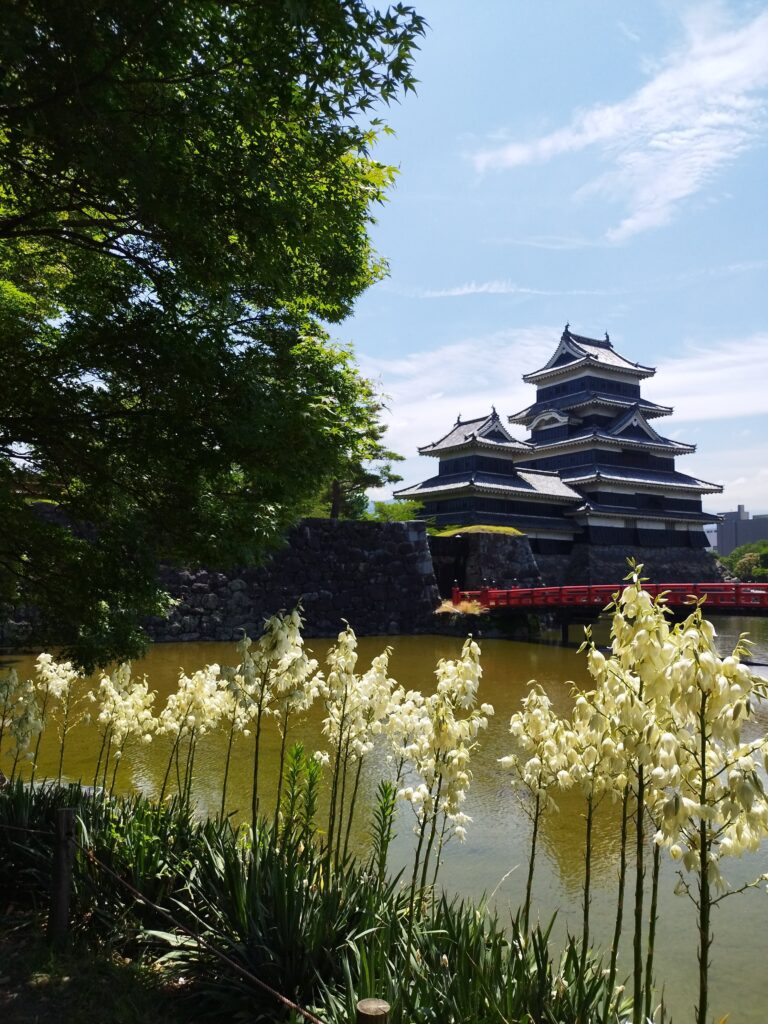
- Japan’s oldest surviving castle tower:Matsumoto Castle boasts Japan’s oldest surviving keep. It is one of only two five-story towers among the twelve that still exist.
- Complex History: Over approximately three centuries since its founding, the castle was ruled by 23 lords representing six different families. Visitors can trace this intricate history by viewing the crests of each ruling family displayed in the castle.
- The Beauty of Black and White: The castle’s exterior features a distinctive black-and-white contrast that makes it an exceptionally beautiful design. While many castles are based primarily on white plaster, Matsumoto Castle’s striking aesthetic immediately sets it apart.
- Defensive Structures Designed for Combat: Fortunately, the castle was never tested in real battles, but its walls still powerfully convey the tense atmosphere of the time. They feature numerous small openings (loopholes) for shooting arrows and firing guns, as well as openings for dropping stones on intruders (stone drop holes).
- The Mystery of Five Stories, Six Floors: From the outside, the keep appears to be a five-story structure, but it actually contains six floors. The difference lies in a ‘hidden floor’, which was strategically designed as a secure refuge during a siege.
- Extremely Steep Stairs: The stairs inside the keep are incredibly steep and narrow. While some believe this was a clever defense mechanism to slow down enemy intruders, it was actually the standard construction practice of the time.
- The unique shape of five connected structures: Centered around the main keep, multiple turrets are linked by connecting turrets, showcasing the evolved, completed form of the castle’s architectural structure.
- The Elegant Moon-Viewing Turret (Tsukimi Yagura): This turret was built solely for enjoying the moon—a purpose entirely unrelated to defense. It is a highly valuable evidence that reveals the castle’s survival through the turbulent Warring States period into the subsequent eras of peace.
- The “Inverted Matsumoto Castle” : The moat surrounding the castle beautifully mirrors the keep, creating the “upside down Matsumoto Castle” reflected on the water’s surface—a prime photo spot.
- The Castle of the People: With the end of the samurai era, many castles were seen as nuisances and ordered to be dismantled. Matsumoto Castle, however, was dramatically saved and preserved through the dedicated efforts of its own citizens.

2. 👀 Perspectives from Foreign Visitors.
This virtual tour blog answers common questions that visitors often ask. Here are some short stories inspired by real questions from foreign guests curious about Japanese culture and local life. I hope you enjoy them!
2.1 The Entire Castle
Q&A from the moment you see the full castle view
Q1.“What are the castle’s white and black outer walls made of?”
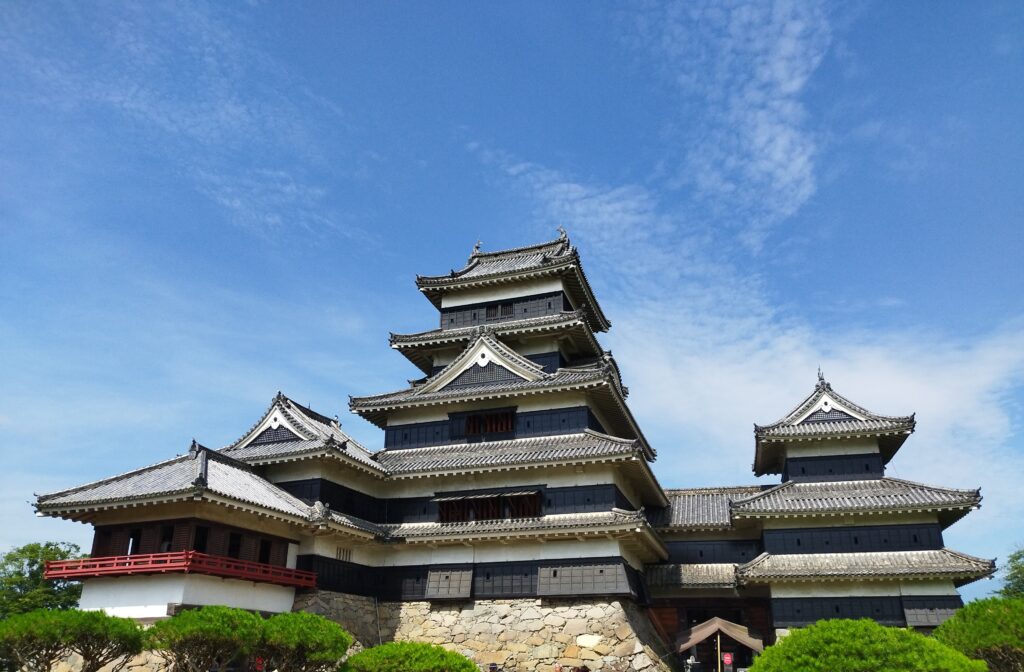
- The upper section is made of white plaster, while the lower half is covered with black lacquered boards.
- This unique design was chosen to suit the local climate—especially the heavy rain and humidity.
- Plaster alone tends to crumble in wet conditions, but these black boards, which get their color from a preservative dye, are said to last up to fifty years.
- Since the castle wasn’t just a military stronghold but also a symbol of authority and wealth, its striking appearance mattered just as much as its defenses.
- This dramatic black-and-white design stands out among castles nationwide, leading many people to call it the “Crow Castle.”
- However, this is not an official name found in historical records.
- In fact, some officials would prefer to prevent the “Crow Castle” name from becoming too established for a National Treasure.
- To truly banish the Crow Castle image, we’d need some kind of scarecrow mechanism to keep the nickname at bay.
- But there’s a problem: public officials, like the city hall employees in charge of the castle, can’t get involved in that.
- Because, in Japan, scarecrows have long symbolized people who are “all show and no substance”—the last thing a responsible public servant wants to be seen as!
Q2.”What’s so great about this castle?”
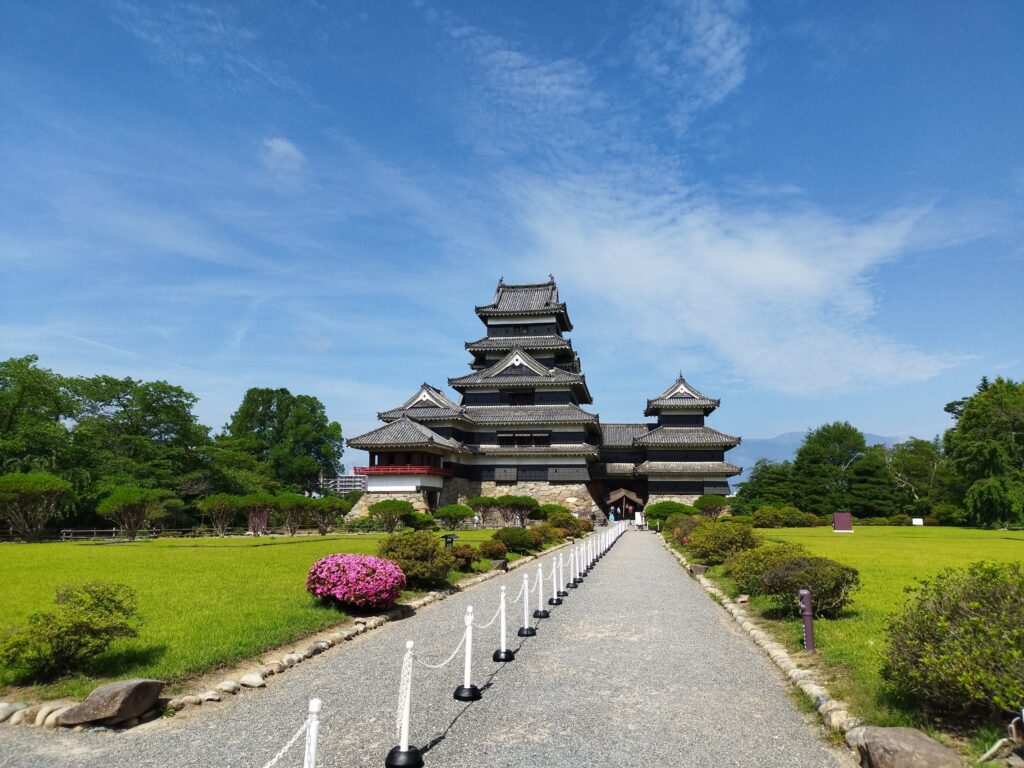
- There are many reasons why Matsumoto Castle is special, but its most distinctive feature is that it is the oldest existing five-tiered castle keep in Japan.
- The World Heritage site, Himeji Castle, shares the unique feature of having a five-tiered exterior yet a six-floor interior, but Matsumoto Castle is said to be the older of the two structures.
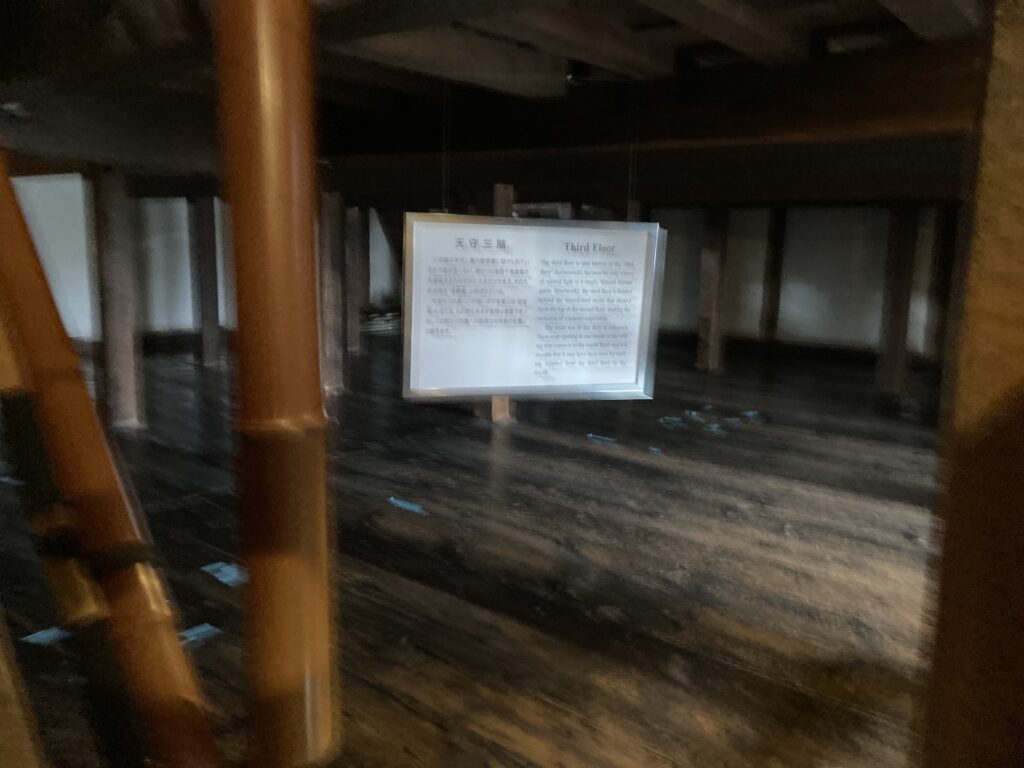
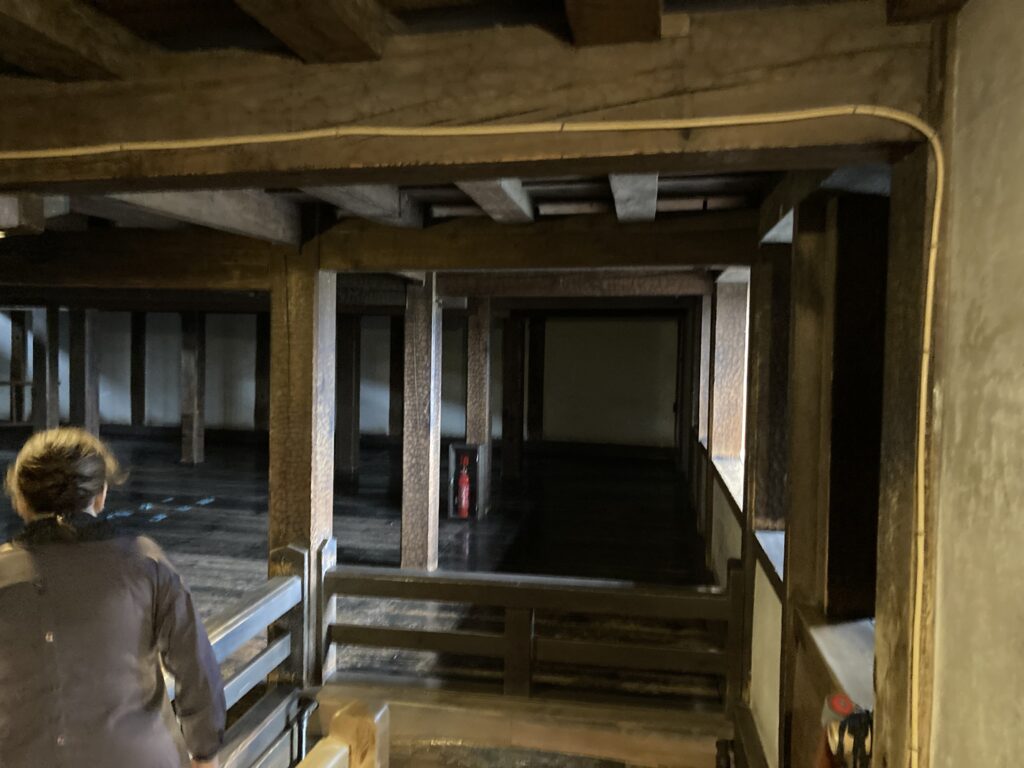
- Structurally, this type of tall castle naturally forms an extra, hidden floor, much like a mezzanine.
- At Matsumoto Castle, this space appeared on the middle third floor, intended for use as a warehouse or emergency shelter.
- Given this unique construction, some might think the guides should promote the room more actively to foreign tourists.
- In reality, everyone passes through that third floor while climbing the stairs, yet hardly anyone notices it exists.
- It’s a windowless, dark room, so it’s understandable that it doesn’t draw attention compared to the bright main keep and massive stone walls.
- Fortunately, this castle has never been involved in actual warfare up to the present day, so I think it’s fine to remain inconspicuous.
- The only time this shelter would be truly needed is if a new war broke out.
- So this dark room should literally remain windowless and dark, a symbol that this place will “never see the light of day.”
2.2 Castle Keep (Interior)
Q1.”Why is there an elevation difference on the floor?”
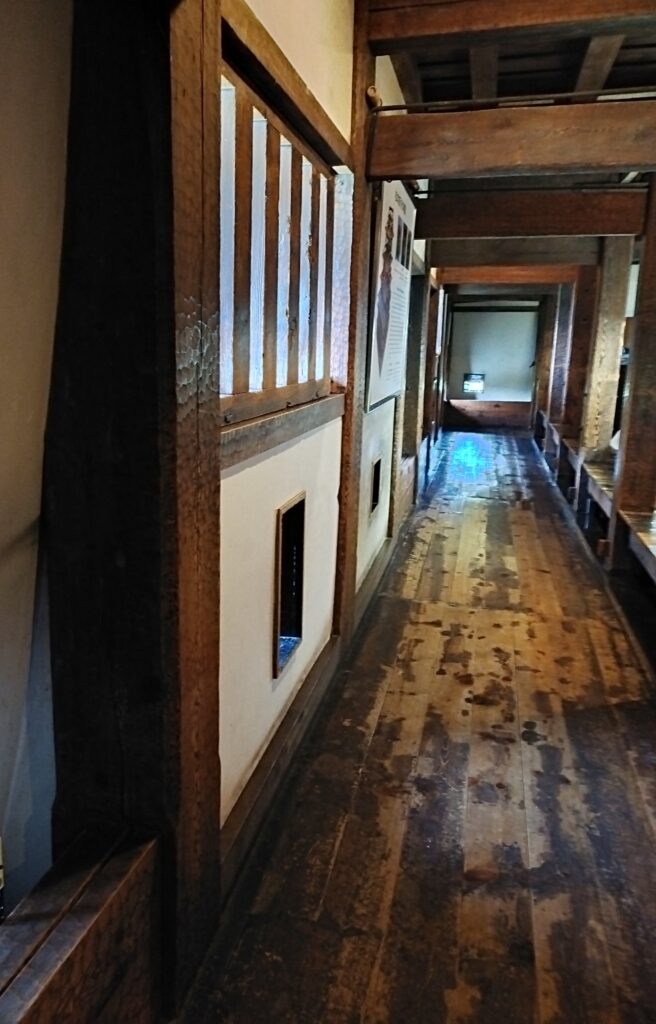
- This low passageway running along the outer wall is called a musha-bashiri, literally meaning a “corridor for soldiers to run.”
- In times of war, it was designed to help the movement of soldiers without obstacles, enabling them to easily defend the outer wall.
- Only the inner area has a double foundation beneath the floor, raising it by about 50 centimeters.
- Generally speaking, these passageways weren’t limited to the castle interior; they were also constructed outside the castle walls, for example, on the ramparts.
- While not unique to Matsumoto Castle, the defensive strength of the first floor was particularly crucial for preventing enemy intrusion.
- And stone drop mechanisms can also be seen along the corridors.
- But actually, not many foreign tourists notice this corridor and ask about it.
- We local guides understand that our guests often have a deep interest in or knowledge of architecture.
- That’s right. This first floor is a crucial defensive line not only for the warriors of the time but also for the guides.
- We guides tremble with tension when we know the guests are particular here and we can’t let our guard down—it’s what we call musha burui, the samurai’s shiver… not musha bashiri, samurai running!
Q2.”Why Are the Stairs in This Castle So Steep?”

- It’s not just Matsumoto Castle; the stairs in most Japanese castles are notoriously steep, making climbing up and down quite a challenge. Matsumoto Castle is especially famous for this, featuring five tiers and numerous steep staircases.
- The stairs directly beneath the castle keep have an incline of over 60 degrees, giving you the sensation of navigating a ladder on rocky terrain during a mountain hike.
- This extreme steepness even gave rise to a popular theory: that the stairs were built to slow down invaders.
- However, experts dismiss this, pointing out that such an incline hinders the defenders’ movement just as much as the attackers’.
- Castle keep designs were fundamentally built for siege defense, making stairs designed purely for accessibility entirely irrelevant. Simply put, the correct answer seems to be that, by the construction standards of the time, some of the stairs at Matsumoto Castle simply happened to be that steep.
- But the spread of these theories online might be welcome news for tourism professionals!
- Perhaps a few more tourists will choose Matsumoto Castle specifically to experience those exhilarating stairs.
- On the flip side, older individuals or those lacking confidence in their physical strength might avoid it entirely, leading to a flat growth in visitor numbers, quite unlike the steep climb of the stairs themselves.
- But perhaps that’s all right. Stairs are a means, not an end.
- So, as guides, we mustn’t let this minor challenge cause us to lose our focus—or, quite literally, lose our footing! We must, quite simply, take the stairs steadily.
Q3. “Why is there a reed screen in this room?”@4F
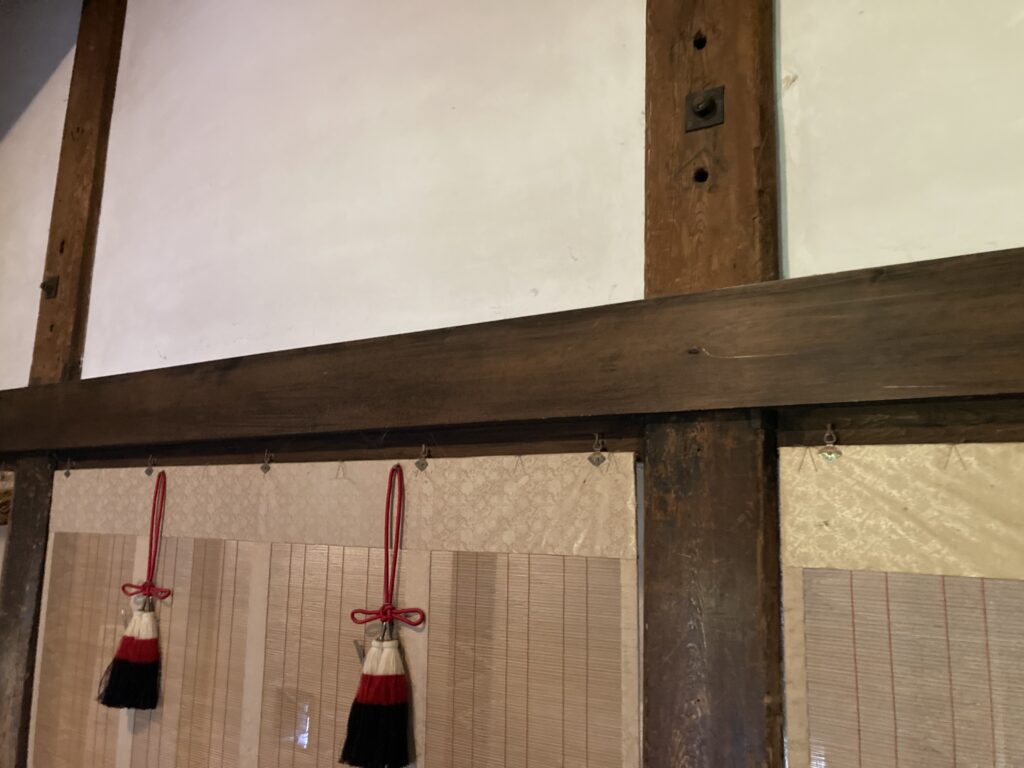
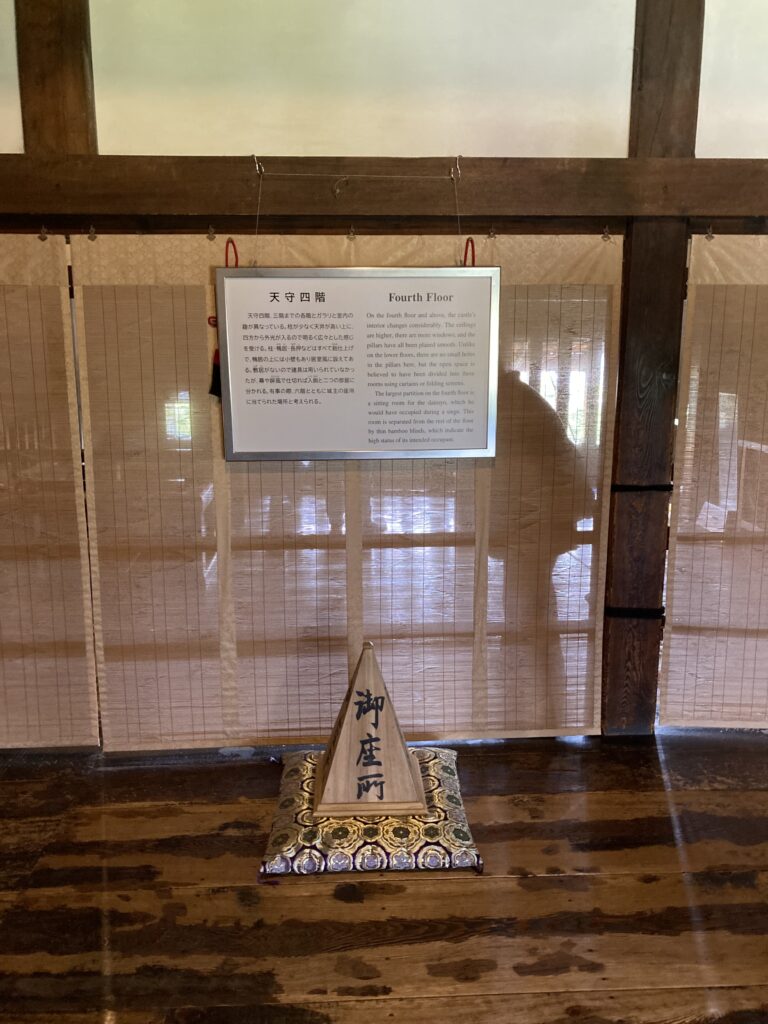
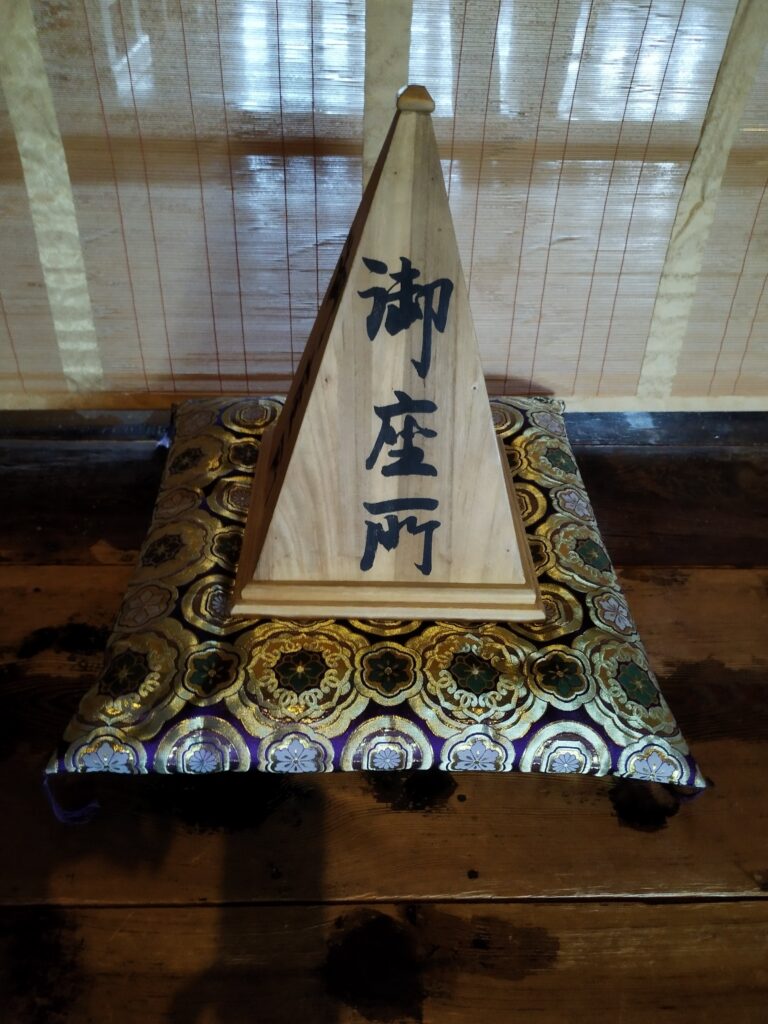
- This room was built not for soldiers, but for the lord of the castle.
- It was designed primarily with dignity and comfort in mind, rather than defense.
- Many assume the lord would reside on the top floor of the keep, but he actually used this fourth floor as his quarters.
- During battle, this room would serve as the command center where orders are issued, functioning as the operation’s brain.
- Consequently, it possesses an entirely different atmosphere from the lower floors below the third level, which are solely dedicated to defensive functions.
- It also incorporates the refined architectural style known as shoin-zukuri—a feature commonly found in the residences of high-ranking samurai.
- But when defeat seems inevitable, the lord must prepare for the castle’s fall and execute his final decision.
- That is, he commits seppuku inside these curtains, hidden from view.
- This thin reed screen, easily torn by hand, is in a sense more resilient than the thick, sturdy castle walls that can stop a gun bullet.
- It ensures the samurai’s supreme ritual of seppuku is performed successfully, and serves as a spiritual defensive wall, protecting the castle lord’s honor.“
Q4. ”What is that rope-like thing on the ceiling?”@6F
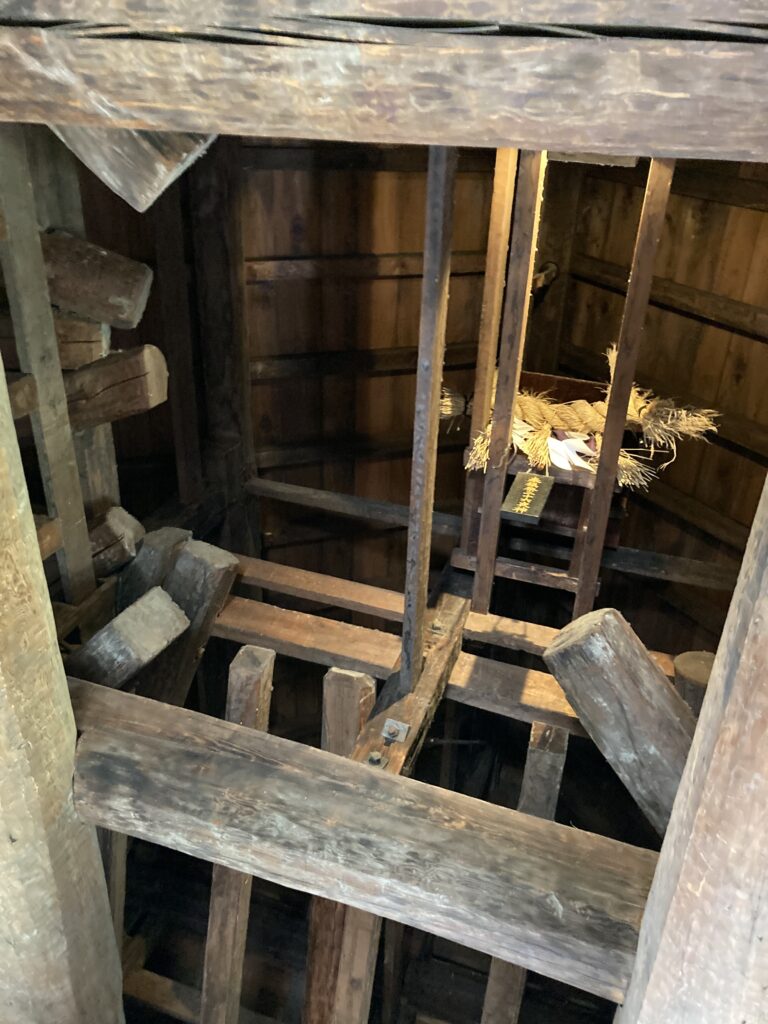
- That is the sacred rope and principal image installed shortly after the castle’s construction to serve as Matsumoto Castle’s guardian deity.
- As you can see, it is a small shrine originally dedicated to the female deity “Jurokuya-gami” (十六夜神), who was worshipped in certain areas.
- According to legend, the goddess gave an oracle that thousands of portions of rice cakes be offered on the twenty-sixth day of each month, after which they were to be distributed among the people.
- The feudal lord continued this practice for centuries throughout the samurai era, and it is believed that this is how Matsumoto Castle survived numerous fire disasters.
- One theory suggests the origin of the 26th stems from twice-yearly rituals held before dawn on the 26th day of the first and seventh months of the lunar calendar, where a slender, crescent-shaped moon (the waxing crescent moon) was worshipped.
- The Japanese have long cherished the moon’s changing phases, and even today, full moon festivals on the fifteenth night are celebrated nationwide.
- Still, I usually don’t explain this little shrine unless guests ask.
- Because, aside from haiku poets and stargazers, most people—including myself—aren’t familiar with the Twenty-Sixth Night, and the number 26 itself doesn’t hold much cultural weight in Japan.
- On the contrary, most guests know that number inside out, so we can’t compete with them.
- In English, which uses a 26-letter alphabet, that number is a basic truth—they know it completely from A to Z!
Q5. ”Why is this window the only one shaped like this?”

- This feature is called a Katomado, or flower-shaped window, and you can spot it in various cultural properties across Japan.
- Originally a style of Chinese Zen architecture, its sophisticated design led to its adoption not only in castles but also in renowned temples and modern buildings.
- The window’s original name and shape represent fire—literally meaning a window of firelight.
- Yet, because fire was the most dreaded thing in a castle, samurai cleverly adopted a different kanji with the same pronunciation to express a window shaped like a flower’s head (花頭窓).
- When I explain this, guests sometimes react negatively. I used to think it was because the image of a fading flower evokes death, making it inauspicious, much like the fire itself.
- I often explained the samurai aesthetic—their desire to die beautifully, like scattered petals, which is certainly preferable to perishing in flames.
- But I see the problem now. The shape simply doesn’t look much like firelight or a flower head! The reaction was slow because the visual connection just wasn’t there.
- Then, I once remarked to a group that the window strongly resembles a bell tower. Their response was immediately positive!
- The resemblance was so striking, it instantly “rang their bell.”
- And just like that, I was “saved by the bell,” like a boxer on the verge of being knocked out!
2.3 Main Keep (Exhibition)
Q1. ”What is this fish-like thing?”
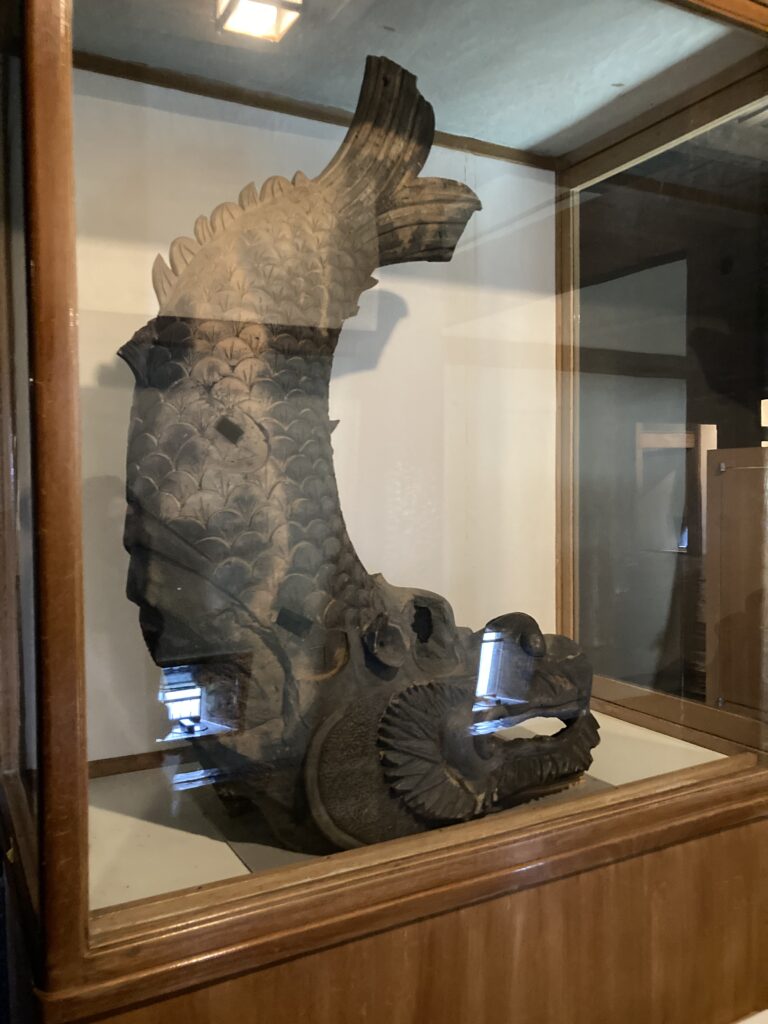
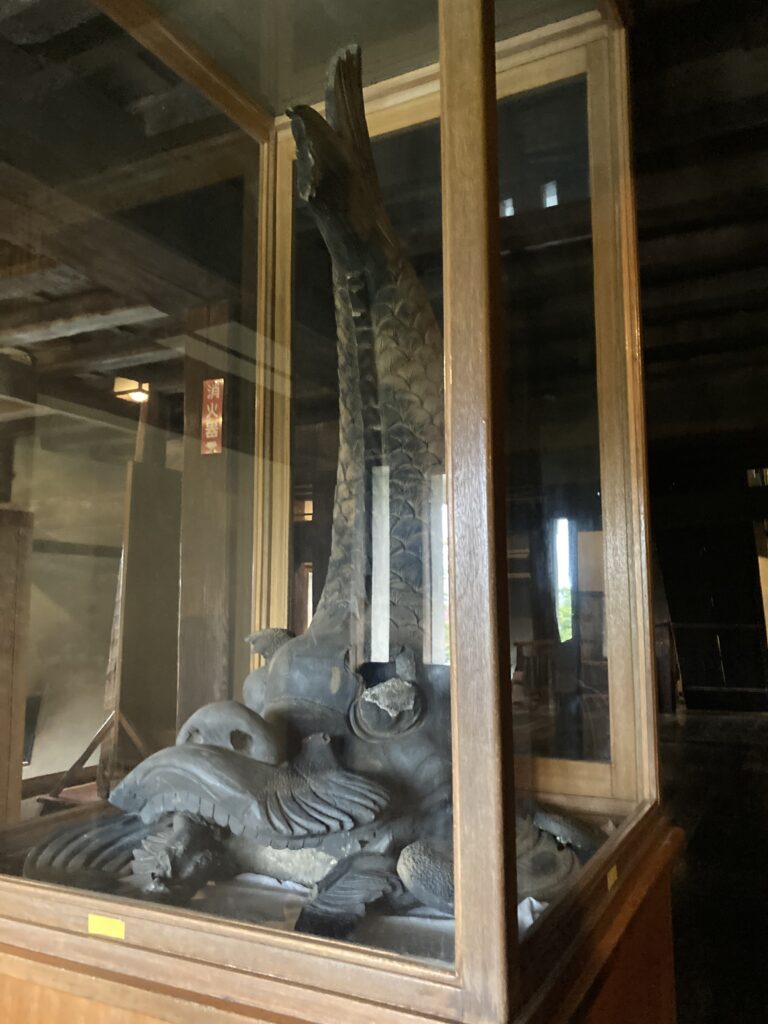
- This is a Shachihoko (or just shachi), the striking ornament placed at both ends of the main ridge on the castle tower’s roof.
- A mythical creature with the body of a fish and the head of a dragon, it served as a guardian deity against fire.
- While you’ll find shachi on virtually every castle, the roofing material is typically baked clay—though some famous examples feature dazzling gold leaf.
- Did you know they come in pairs? The male has its mouth open, while the female keeps its mouth closed and is often slightly smaller.
- This particular shachi was removed during the most recent repairs, offering a rare opportunity to see it up close. Most of Japan’s historic castle towers were lost to fires caused by samurai wars, lightning strikes, or modern air raids.
- However, since its construction, the shachi of Matsumoto Castle have stood guard and kept the structure safe from fire to this day—a track record truly worthy of gold medalists
- I feel terribly sorry that so many people walk right by this magnificent shachi without a second glance.
- It’s almost as if it’s saying that, in this modern age of advanced fire protection systems, there’s no need to rely on such things anymore.
- Looking at it this way, this shachihoko seems like the sad fate of a human left behind in the internet’s heyday.
- It’s like, “Old soldiers never die, they just fade away” from the online age!
Q2. “Why are there so many guns on display?”
- This extensive collection was a donation to Matsumoto City decades ago by a private collector. There is no direct connection between Matsumoto Castle and these firearms.
- Matsumoto Castle was built approximately fifty years after firearms were introduced to Japan from Europe, and the castle was designed under this consideration.
- The placement of the gun-shooting holes and the thickness of the keep walls particularly reflect this.
- Unlike many reconstructed castles, Matsumoto Castle remains in its original state, making it extremely valuable and historically significant.
- The collector who donated the collection felt that Matsumoto Castle was the most fitting destination for the collection he had spent many years gathering.
- Generally, most guides don’t offer individual explanations for the vast number of exhibits. For non-enthusiasts, the details are too technical, and listening without asking questions can be quite tiring.
- Therefore, I only provide explanations when questions arise.
- When I explain this in advance, most guests understand, but occasionally there are enthusiasts who just won’t accept this.
- He’s literally sticking to his guns, refusing to leave the gun display.
- For us guides planning the day’s schedule, this is the one scenario we want to avoid most—it leaves us under the gun… right in front of the gun display!”
Thank you & Afterwards
🔶Thank you very much for reading to the end of this issue. If you have any comments or requests, please feel free to contact us at the Help Desk.🔶GOLD💎251007.v4a.v4a.v2